 |
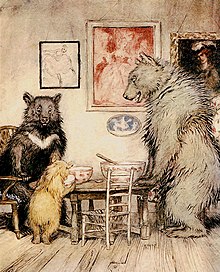
What was originally a fearsome oral tale became a cosy family story with only a hint of menace. The story has elicited various interpretations and has been adapted to film, opera, and other media.
"The Story of the Three Bears" is one of the most popular fairy tales in the English language.
 |
The story makes extensive use of the literary rule of three, featuring three chairs, three bowls of porridge, three beds, and the three title characters who live in the house. There are also three sequences of the bears discovering in turn that someone has been eating from their porridge, sitting in their chairs, and finally, lying in their beds, at which point is the climax of Goldilocks being discovered. This follows three earlier sequences of Goldilocks trying the bowls of porridge, chairs, and beds successively, each time finding the third "just right". Author Christopher Booker characterizes this as the "dialectical three", where "the first is wrong in one way, the second in another or opposite way, and only the third, in the middle, is just right." Booker continues "This idea that the way forward lies in finding an exact middle path between opposites is of extraordinary importance in storytelling".This concept has spread across many other disciplines, particularly developmental psychology, biology, economics and engineering where it is called the "Goldilocks Principle".
The Goldilocks principle
The Goldilocks principle states that in a given sample, there may be entities belonging to extremes, but there will always be an entity belonging to the average. Or in other words, in a sample, there will always be a U-shaped distribution. When the effects of the principle are observed, it is known as the Goldilocks effect.
The Goldilocks principle is derived from a children's story "The Three Bears" in which a little girl named Goldilocks finds a house owned by three bears. Each bear has its own preference of food and beds. After testing all three examples of both items, Goldilocks determines that one of them is always too much in one extreme (too hot or too large), one is too much in the opposite extreme (too cold or too small), and one is "just right".
The Goldilocks principle is applied across many disciplines, particularly developmental psychology, biology,economics and engineering.
Origins
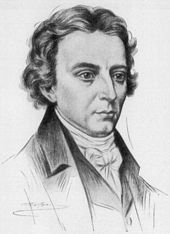 |
| Robert Southey |
The story was first recorded in narrative form by British writer and poet Robert Southey, and first published anonymously as "The Story of the Three Bears" in 1837 in a volume of his writings called The Doctor. The same year Southey's tale was published, the story was versified by George Nicol who acknowledged the anonymous author of The Doctor as "the great, original concocter" of the tale. Southey was delighted with Nicol's effort to bring more exposure to the tale, concerned children might overlook it in The Doctor. Nicol's version was illustrated with engravings by B. Hart (after "C.J."), and was reissued in 1848 with Southey identified as the story's author.
The story of the three bears was in circulation before the publication of Southey's tale.In 1813, for example, Southey was telling the story to friends, and in 1831 Eleanor Mure fashioned a handmade booklet about the three bears and the old woman for her nephew Horace Broke's birthday.Southey and Mure differ in details. Southey's bears have porridge, but Mure's have milk;Southey's old woman has no motive for entering the house, but Mure's old woman is piqued when her courtesy visit is rebuffed;[8] Southey's old woman runs away when discovered, but Mure's old woman is impaled on the steeple of St Paul's Cathedral.
Folklorists Iona and Peter Opie point out in The Classic Fairy Tales (1999) that the tale has a "partial analogue" in "Snow White": the lost princess enters the dwarfs' house, tastes their food, and falls asleep in one of their beds. In a manner similar to the three bears, the dwarfs cry, "Someone's been sitting in my chair!", "Someone's been eating off my plate!", and "Someone's been sleeping in my bed!" The Opies also point to similarities in a Norwegian tale about a princess who takes refuge in a cave inhabited by three Russian princes dressed in bearskins. She eats their food and hides under a bed.
In 1865, Charles Dickens referenced a similar tale in Our Mutual Friend, but in Our Mutual Friend, the house belongs to hobgoblins rather than bears. Dickens' reference however suggests a yet to be discovered analogue or source.Hunting rituals and ceremonies have been suggested and dismissed as possible origins.
In 1894, "Scrapefoot", a tale with a fox as antagonist that bears striking similarities to Southey's story, was uncovered by the folklorist Joseph Jacobs and may predate Southey's version in the oral tradition. Some sources state that it was illustrator John D. Batten whom in 1894 reported a variant of the tale at least 40 years old. In this version, the three bears live in a castle in the woods and are visited by a fox called Scrapefoot who drinks their milk, sits in their chairs, and rests in their beds.This version belongs to the early Fox and Bear tale-cycle.Southey possibly heard "Scrapefoot", and confused its "vixen" with a synonym for an unpleasant malicious old woman. Some maintain however that the story as well as the old woman originated with Southey.
Southey most likely learned the tale as a child from his uncle William Tyler. Tyler may have told a version with a vixen (she-fox) as intruder, and Southey later confused vixen with a common appellation for a crafty old woman.P.M. Zall writes in "The Gothic Voice of Father Bear" that "It was no trick for Southey, a consummate technician, to recreate the improvisational tone of an Uncle William through rhythmical reiteration, artful alliteration, even bardic interpolation ('She could not have been a good, honest Old Woman')". Ultimately, it is uncertain where Southey or his uncle learned the tale.
※analogue: That which is analogous to, or corresponds with, some other thing.
※vixen: A cross, ill-tempered person; -- formerly used of either sex, now only of a woman.
----------------------------------------------------------------------------------------------------------------------
Protestant
 |
 |
| Martin Luther |
Luther's ideas struck a fundamental blow to the primacy of the Catholic Church. He was excommunicated by the pope and rejected by the Holy Roman emperor Charles V, but he had captured the imagination of many in Catholic Europe.
By the mid-16th century, two competing ideologies -- one Catholic, the other a burgeoning Protestantism -- warred for supremacy. The ideological battle raged with particular ferocity in England, where King Henry VIII wished to divorce his wife, Catherine of Aragon, the daughter of Spain's Ferdinand and Isabella, in order to marry his mistress, Anne Boleyn. When the Vatican refused to grant a divorce, Henry separated himself from the Catholic Church and established the Church of England. He then became head of both the church and the state in England. Catholics who refused to swear oaths of allegiance or recognize Henry's new marriage were persecuted.
When she became the queen of England six years after her father's death, Mary Tudor, King Henry's daughter by Catherine of Aragon and an ardent Catholic, attempted to restore Catholicism to England and launched a systematic persecution of Protestants. At her death in 1558, her half-sister, Elizabeth I, was crowned queen of England.
 |
| Martin Luther |
 |
Prodigal's son

The Parable of the Prodigal Son (also known as the Lost Son, Running Son, Loving Father, or Lovesick Father)is one of the parables of Jesus which appears in Luke 15:11-32. Jesus Christ shares it with his disciples, the Pharisees and others.
In the story, a father has two sons. The younger son asks for his inheritance and after wasting his fortune (the word "prodigal" means "wastefully extravagant"), becomes destitute. He returns home with the intention of begging his father to be made one of his hired servants, expecting his relationship with his father is likely severed. The father welcomes him back and celebrates his return. The older son refuses to participate. The father reminds the older son that one day he will inherit everything. But, they should still celebrate the return of the younger son because he was lost and is now found.
It is the third and final part of a cycle on redemption, following the Parable of the Lost Sheep and the Parable of the Lost Coin. In Revised Common Lectionary and Latin Rite Catholic Lectionary, this parable is read on the fourth Sunday of Lent ; in the latter it is also included in the long form of the Gospel on the 24th Sunday of Ordinary Time in Year C, along with the preceding two parables of the cycle. In the Eastern Orthodox Church it is read on the Sunday of the Prodigal Son.

The parable begins with a young man, the younger of two sons, who asks his father to give him his share of the estate. The implication is the son could not wait for his father's death for his inheritance, he wanted it immediately. The father agrees and divides his estate between both sons.
Upon receiving his portion of the inheritance, the younger son travels to a distant country and wastes all his money in extravagant living. Immediately thereafter, a famine strikes the land; he becomes desperately poor and is forced to take work as a swineherd. (This, too, would have been abhorrent to Jesus' Jewish audience, who considered swine unclean animals.) When he reaches the point of envying the food of the pigs he is watching, he finally comes to his senses:
But when he came to himself he said, "How many hired servants of my father's have bread enough to spare, and I'm dying with hunger! I will get up and go to my father, and will tell him, 'Father, I have sinned against heaven, and in your sight. I am no more worthy to be called your son. Make me as one of your hired servants.'" He arose, and came to his father. But while he was still far off, his father saw him, and was moved with compassion, and ran towards him, and fell on his neck, and kissed him.
— Luke 15:17–20, World English Bible
This implies the father was hopefully watching for the son's return.
The son does not even have time to finish his rehearsed speech, since the father calls for his servants to dress him in a fine robe, a ring, and sandals, and slaughter the "fattened calf" for a celebratory meal.
The older son, who was at work in the fields, hears the sound of celebration, and is told about the return of his younger brother. He is not impressed, and becomes angry. He also has a speech for his father:
But he answered his father, "Behold, these many years I have served you, and I never disobeyed a commandment of yours, but you never gave me a goat, that I might celebrate with my friends. But when this, your son, came, who has devoured your living with prostitutes, you killed the fattened calf for him."
— Luke 15:29-30, World English Bible
The parable concludes with the father explaining that because the younger son had returned, in a sense, from the dead, celebration was necessary:
"But it was appropriate to celebrate and be glad, for this, your brother, was dead, and is alive again. He was lost, and is found."
— Luke 15:32, World English Bible
Context and interpretation
Engraving of the Prodigal Son as a swineherd by Hans Sebald Beham.
This is the last of three parables about loss and redemption, following the parable of the Lost Sheep and the parable of the Lost Coin, that Jesus tells after the Pharisees and religious leaders accuse him of welcoming and eating with "sinners." The father's joy described in the parable reflects divine love, the "boundless mercy of God," and "God's refusal to limit the measure of his grace."
The request of the younger son for his share of the inheritance is "brash, even insolent" and "tantamount to wishing that the father was dead."His actions do not lead to success, and he eventually becomes an indentured servant, with the degrading job of looking after pigs, and even envying them for the carob pods they eat.
The mention of the son's longing to eat with the swine in Luke 15:16 could refer to how the Pharisees viewed the sinners (and Christ, for eating with them) in Luke 15:2. The Pharisees, caught up in their ideas of ritual cleanliness, might have thought of these people as filthy pigs.
On the son's return, the father treats him with a generosity far more than he has a right to expect.Some have suggested that this mirrors what Christians should do after sinning: feel contrition and return to their Heavenly Father, who will graciously welcome them back.
The older son, in contrast, seems to think in terms of "law, merit, and reward," rather than "love and graciousness."He may represent the Pharisees who were criticizing Jesus.
The father, who represents our Heavenly Father, implies to the older son that his love for both sons is not dependent upon their perfection, but their willingness to return to Him with a broken heart and a contrite spirit.
--------------------------------------------------------------------------------------------------------------
12 things you need to know about the Prodigal Son
Jimmy Akin
It is a moving story that teaches us about God's love for us and his willingness to forgive us no matter what we have done.
But there is more to the story than meets the eye . . . much more.
Here are 12 things you need to know.
1. What does "prodigal" mean?
The word "prodigal" is mysterious to us. Almost the only time we ever hear it is in the title of this parable.
It's basic meaning is "wasteful"--particularly with regard to money.
It comes from Latin roots that mean "forth" (pro-) and "to drive" (agere). It indicates the quality of a person who drives forth his money--who wastes it by spending with reckless abandon
That's what the prodigal son does in this story.
2. Why does Jesus tell this parable?
This question is answered at the beginning of Luke 15, where we read:
[1] Now the tax collectors and sinners were all drawing near to hear him [Jesus].
[2] And the Pharisees and the scribes murmured, saying, "This man receives sinners and eats with them."
[3] So he told them this parable . . .
Actually, Jesus tells three parables:
The parable of the lost sheep
The parable of the lost coin
The parable of the lost son (or, as we know it, the parable of the prodigal son)
All three parables are on the subject of recovering the lost, which is the implicit explanation of why Jesus receives sinners and eats with them: They are lost, and he wants to recover them.
Interestingly, the parable of the prodigal son (and the parable of the lost coin) occur only in Luke.
3. What's happening in the parable?
Jesus' parables are based on real-life situations, though they often veer off from the expected course of events in surprising ways. Those surprises teach us lessons.
Here, Jesus relates the situation of a father who has two sons, one of whom can't wait for his inheritance.
In Jewish society, there were laws regarding how inheritances were typically divided. The oldest brother got a double share (cf. Deut. 21:17), while the other brothers got a single share.
When there were two brothers (as here), the older brother would get 2/3rds of the estate, and the younger brother would get 1/3rd.
4. What is the prodigal son asking for?
In this parable, the younger son demands "the share of property that falls to me" (v. 12).
That means he is asking for the 1/3rd of the father's possessions that he would ordinarily get when the father dies.
Think about that.
He's asking his father to give him 1/3rd of everything that he owns right now, before the father is dead, when his father would still have use for these possessions.
How many fathers would receive that suggestion well today? How many would comply with it if one of their children asked it?
Not many!
This is a truly astonishing request, and it would have been even more astonishing in the ancient world.
In a society that highly reverenced parents, it would have been equivalent to saying: "Father, I can't even wait for you to die. Give me 1/3rd of everything you have right now."
5. What does the father's reaction teach us?
Despite the breathtaking--and insulting--audacity of the younger son's request, the father grants it!
Amazing!
This reflects the amazing indulgence that God shows toward us. Even when we are acting as selfishly as the prodigal son, God indulges us.
He yields what is his and allows us to misuse it out of respect for the freedom that he has given us.
But he knows that the misuse of our freedom will have no better results than it did with the prodigal son's misuse of his freedom, and God trusts that we will learn our lesson and come back to him.
6. What does the prodigal son do next?
After he gets 1/3rd of his father's estate, he takes everything he has and goes "into a far country, and there he squandered his property in loose living" (v. 13).
In context, this means that he abandoned the Holy Land to go, voluntarily, into exile into a gentile, pagan country where he could live loosely without being censured by fellow Jews living all around him.
He wanted to get out of God's land so that he could live in sin and fund his sinful lifestyle by what he took from his father.
But eventually the resources he had were exhausted and a hard time came.
If he had not spent what he had on loose living (as we will later learn, on prostitutes), he would have had the money he needed to weather the hard time, but he didn't.
Thus he was reduced to a state of hunger and had to subject himself to a pagan (humiliation #1) and to feed the pagan's pigs (humiliation #2).
 |
| Prodigal's younger son and humiliation |
Having been brought to such a low state, he recalled how his righteous father treated even his hired servants better: "How many of my father's hired servants have bread enough and to spare, but I perish here with hunger!" (v. 17).
He thus plans to return to his father and say three things:
(a) "Father, I have sinned against heaven and before you" (v. 18),
(b) "I am no longer worthy to be called your son" (v. 19a),
(c) "treat me as one of your hired servants" (v. 19b).
Even being treated as one of his father's hired servants would be better than the treatment he is receiving in the gentile world.
7. What do the actions of the prodigal son teach us?
They teaches us the depths to which our own misuse of freedom will bring us.
If we are bent on leaving God, things will go badly for us. We will be humiliated in the uncaring world.
The farther we get from the Father's loving care, the worse off we will be, and our best course is to return to God and his forgiveness.
8. What does the father do next?
When the prodigal son returns to his father, something significant happens.
While he is still at a distance, the father sees him, has compassion upon him, runs to him, hugs him, and kisses him.
This is far from the humiliating reunion that the son might expect based on his previous audacious and insulting treatment of his father!
The returning son must have been astonished!
But he continues by beginning to recite his pre-scripted speech to his father, and he manages to get the first two parts of it out. He says:
(a) "Father, I have sinned against heaven and before you" (v. 21a),
(b) "I am no longer worthy to be called your son" (v. 21b).
But before he can say the third part--before he can ask to be treated merely as a servant--the father interrupts things and takes them in a very different direction.
Rather than treating his younger son as a mere servant, he turns to the actual servants and orders a celebration.
 |
The first lesson is that the father will not treat a son as a hired servant. The younger son is still a son!
As a result, his return is something to be celebrated!
He is to wear a fancy robe! A fancy ring! Shoes! There is to be a fancy feast for everyone! There is to be music and dancing!
Why?
Because "This my son was dead, and is alive again" and "He was lost, and is found."
This shows us God's reaction when we return from being lost in sin.
He doesn't begrudge us what we have done. He doesn't take us back reluctantly.
Like the father in the parable, he takes us back joyously! Eagerly!
10. What does the older brother do next?
There is usually at least one major lesson per parable for each major figure in it, and now we come to the lesson that the older brother can teach us.
He didn't demand his inheritance. He stayed faithful to his father. And now he is angry.
Why should his younger, wasteful, sinful brother receive such a reception by their father?
The older brother is so angry that he refuses to go inside and join the party.
Naturally, his father hears about it and comes to talk to him.
When that happens, we discover that he's not just angry with his brother, he's angry with his father, too.
He points out that he has never disobeyed his father's commands but that his father has never given him a kid (a young goat) so that he could slaughter it and have a party with his friends.
In contrast, the younger brother has "devoured your living with harlots" (wasting a third of the father's estate!), but when he comes back "the fatted calf" (that is, the best, most tender and delicious animal, specially raised to be so) is killed!
The older brother sees this difference in treatment as a manifest injustice toward him and is angry with his father because of it.
As we will see, he even seems to be worrying about his own security in the family since the father is showing such seeming favoritism to the younger son.
11. What does the father do?
The father tells the son three things.
First, he tells him: "Son, you are always with me." This seems to be a reassurance to the elder son that he has not lost his place in the family. His place is secure.
Second, he tells him: "and all that is mine is yours." This is because the division of property has already taken place. The younger soon took his third, so the two-thirds that remain will go entirely to the older son.
This means that the current celebration does not represent a threat to the older brother or his inheritance. Instead, it is a celebration of joy occasioned by the return of the son.
Thus the father thirdly tells him: "It was fitting to make merry and be glad, for this your brother was dead, and is alive; he was lost, and is found.'"
 |
From this parable we can draw a number of spiritual lessons:
We can be a genuine son of the Father--who is spiritually "alive"--and be "lost" through sin. We can turn our backs on our heavenly Father and leave him of our own free will. Mortal sin is a real possibility.
Mortal sin inevitably lands us in a far worse state than we were in originally.
We can, however, return to the Father and be accepted by him with great joy. In fact, he is ready and eager to accept us back and forgive us, no matter what we've done.
Christians who have never fallen should not resent those who come back. They should share in their Father's joy.
Their own place is secure and their heavenly reward is not threatened. God loves them just as much as he loves those who come back through a dramatic conversion.
※implicit :capable of being understood from something else though unexpressed : implied
※veer off: To direct to a different course; to turn; to wear;
※gentile: a person of a non-Jewish nation or of non-Jewish faith; especially : a Christian as distinguished from a Jew
※pagan: Neither having the accent of Christians, nor the gait of Christian, pagan, nor man.
※censure: The act of blaming or finding fault with and condemning as wrong; reprehension; blame.
※misuse: to use (something) incorrectly
※harlot: prostitute

沒有留言:
張貼留言