2016年12月29日 星期四

Raven by Allen Poe
「raven」的圖片搜尋結果

Once upon a midnight dreary, while I pondered, weak and weary,
Over many a quaint and curious volume of forgotten lore—
    While I nodded, nearly napping, suddenly there came a tapping,
As of some one gently rapping, rapping at my chamber door.
“’Tis some visitor,” I muttered, “tapping at my chamber door—
            Only this and nothing more.”

    Ah, distinctly I remember it was in the bleak December;
And each separate dying ember wrought its ghost upon the floor.
    Eagerly I wished the morrow;—vainly I had sought to borrow
    From my books surcease of sorrow—sorrow for the lost Lenore—
For the rare and radiant maiden whom the angels name Lenore—
            Nameless here for evermore.

    And the silken, sad, uncertain rustling of each purple curtain
Thrilled me—filled me with fantastic terrors never felt before;
    So that now, to still the beating of my heart, I stood repeating
    “’Tis some visitor entreating entrance at my chamber door—
Some late visitor entreating entrance at my chamber door;—
            This it is and nothing more.”

    Presently my soul grew stronger; hesitating then no longer,
“Sir,” said I, “or Madam, truly your forgiveness I implore;
    But the fact is I was napping, and so gently you came rapping,
    And so faintly you came tapping, tapping at my chamber door,
That I scarce was sure I heard you”—here I opened wide the door;—
            Darkness there and nothing more.

    Deep into that darkness peering, long I stood there wondering, fearing,
Doubting, dreaming dreams no mortal ever dared to dream before;
    But the silence was unbroken, and the stillness gave no token,
    And the only word there spoken was the whispered word, “Lenore?”
This I whispered, and an echo murmured back the word, “Lenore!”—
            Merely this and nothing more.

    Back into the chamber turning, all my soul within me burning,
Soon again I heard a tapping somewhat louder than before.
    “Surely,” said I, “surely that is something at my window lattice;
      Let me see, then, what thereat is, and this mystery explore—
Let my heart be still a moment and this mystery explore;—
            ’Tis the wind and nothing more!”

    Open here I flung the shutter, when, with many a flirt and flutter,
In there stepped a stately Raven of the saintly days of yore;
    Not the least obeisance made he; not a minute stopped or stayed he;
    But, with mien of lord or lady, perched above my chamber door—
Perched upon a bust of Pallas just above my chamber door—
            Perched, and sat, and nothing more.

Then this ebony bird beguiling my sad fancy into smiling,
By the grave and stern decorum of the countenance it wore,
“Though thy crest be shorn and shaven, thou,” I said, “art sure no craven,
Ghastly grim and ancient Raven wandering from the Nightly shore—
Tell me what thy lordly name is on the Night’s Plutonian shore!”
            Quoth the Raven “Nevermore.”

    Much I marvelled this ungainly fowl to hear discourse so plainly,
Though its answer little meaning—little relevancy bore;
    For we cannot help agreeing that no living human being
    Ever yet was blessed with seeing bird above his chamber door—
Bird or beast upon the sculptured bust above his chamber door,
            With such name as “Nevermore.”

    But the Raven, sitting lonely on the placid bust, spoke only
That one word, as if his soul in that one word he did outpour.
    Nothing farther then he uttered—not a feather then he fluttered—
    Till I scarcely more than muttered “Other friends have flown before—
On the morrow he will leave me, as my Hopes have flown before.”
            Then the bird said “Nevermore.”

    Startled at the stillness broken by reply so aptly spoken,
“Doubtless,” said I, “what it utters is its only stock and store
    Caught from some unhappy master whom unmerciful Disaster
    Followed fast and followed faster till his songs one burden bore—
Till the dirges of his Hope that melancholy burden bore
            Of ‘Never—nevermore’.”

    But the Raven still beguiling all my fancy into smiling,
Straight I wheeled a cushioned seat in front of bird, and bust and door;
    Then, upon the velvet sinking, I betook myself to linking
    Fancy unto fancy, thinking what this ominous bird of yore—
What this grim, ungainly, ghastly, gaunt, and ominous bird of yore
            Meant in croaking “Nevermore.”

    This I sat engaged in guessing, but no syllable expressing
To the fowl whose fiery eyes now burned into my bosom’s core;
    This and more I sat divining, with my head at ease reclining
    On the cushion’s velvet lining that the lamp-light gloated o’er,
But whose velvet-violet lining with the lamp-light gloating o’er,
            She shall press, ah, nevermore!

    Then, methought, the air grew denser, perfumed from an unseen censer
Swung by Seraphim whose foot-falls tinkled on the tufted floor.
    “Wretch,” I cried, “thy God hath lent thee—by these angels he hath sent thee
    Respite—respite and nepenthe from thy memories of Lenore;
Quaff, oh quaff this kind nepenthe and forget this lost Lenore!”
            Quoth the Raven “Nevermore.”

    “Prophet!” said I, “thing of evil!—prophet still, if bird or devil!—
Whether Tempter sent, or whether tempest tossed thee here ashore,
    Desolate yet all undaunted, on this desert land enchanted—
    On this home by Horror haunted—tell me truly, I implore—
Is there—is there balm in Gilead?—tell me—tell me, I implore!”
            Quoth the Raven “Nevermore.”

    “Prophet!” said I, “thing of evil!—prophet still, if bird or devil!
By that Heaven that bends above us—by that God we both adore—
    Tell this soul with sorrow laden if, within the distant Aidenn,
    It shall clasp a sainted maiden whom the angels name Lenore—
Clasp a rare and radiant maiden whom the angels name Lenore.”
            Quoth the Raven “Nevermore.”

    “Be that word our sign of parting, bird or fiend!” I shrieked, upstarting—
“Get thee back into the tempest and the Night’s Plutonian shore!
    Leave no black plume as a token of that lie thy soul hath spoken!
    Leave my loneliness unbroken!—quit the bust above my door!
Take thy beak from out my heart, and take thy form from off my door!”
            Quoth the Raven “Nevermore.”

    And the Raven, never flitting, still is sitting, still is sitting
On the pallid bust of Pallas just above my chamber door;
    And his eyes have all the seeming of a demon’s that is dreaming,
    And the lamp-light o’er him streaming throws his shadow on the floor;
And my soul from out that shadow that lies floating on the floor
            Shall be lifted—nevermore!
「raven allen poe」的圖片搜尋結果

※dreary:  feeling, displaying, or reflecting listlessness or discouragement
saintly :relating to, resembling, or befitting a saint( holy)
yore: time past and especially long past 
obeisance :obedience and respect ,or something you do which express this
beguile: to persuade ,attract or interest ,sometimes in oreder to deceive
decorum: behaviour that is controlled ,calm and polite
relevancy: It's  a noun-->something relevant
ghastly:(informal)1.unpleasant and shocking 2.extremely bad 3.(literally)describes someone who looks very ill or very shocked ,especially with a very pale face.
gaunt(I've learn this word from lately class): very thin,especially because of illness or hunger
quaff: to drink something quickly or in large amounts
nepenthe:  (1)a potion used by the ancients to induce forgetfulness of pain or sorrow
(2) something capable of causing oblivion of grief or suffering
※come down: to feel less exited after a very enjoyable experience
=decline
=decrease
About the author Edgar Allan Poe 
「allen poe」的圖片搜尋結果
Edgar Allan Poe was an American writer, editor, and literary critic. Poe is best known for his poetry and short stories, particularly his tales of mystery and the macabre. He is widely regarded as a central figure of Romanticism in the United States and American literature as a whole, and he was one of the country's earliest practitioners of the short story. Poe is generally considered the inventor of the detective fiction genre and is further credited with contributing to the emerging genre of science fiction. He was the first well-known American writer to try to earn a living through writing alone, resulting in a financially difficult life and career.

Poe was born in Boston, the second child of two actors. His father abandoned the family in 1810, and his mother died the following year. Thus orphaned, the child was taken in by John and Frances Allan of Richmond, Virginia. They never formally adopted him, but Poe was with them well into young adulthood. Tension developed later as John Allan and Edgar repeatedly clashed over debts, including those incurred by gambling, and the cost of secondary education for the young man. Poe attended the University of Virginia for one semester but left due to lack of money. Poe quarreled with Allan over the funds for his education and enlisted in the Army in 1827 under an assumed name. It was at this time that his publishing career began, albeit humbly, with the anonymous collection of poems Tamerlane and Other Poems (1827), credited only to "a Bostonian". With the death of Frances Allan in 1829, Poe and Allan reached a temporary rapprochement. However, Poe later failed as an officer cadet at West Point, declaring a firm wish to be a poet and writer, and he ultimately parted ways with John Allan.

Poe switched his focus to prose and spent the next several years working for literary journals and periodicals, becoming known for his own style of literary criticism. His work forced him to move among several cities, including Baltimore, Philadelphia, and New York City. In Richmond in 1836, he married Virginia Clemm, his 13-year-old cousin. In January 1845, Poe published his poem "The Raven" to instant success. His wife died of tuberculosis two years after its publication. For years, he had been planning to produce his own journal The Penn (later renamed The Stylus), though he died before it could be produced. Poe died in Baltimore on October 7, 1849, at age 40; the cause of his death is unknown and has been variously attributed to alcohol, brain congestion, cholera, drugs, heart disease, rabies, suicide, tuberculosis, and other agents.

Poe and his works influenced literature in the United States and around the world, as well as in specialized fields such as cosmology and cryptography. Poe and his work appear throughout popular culture in literature, music, films, and television. A number of his homes are dedicated museums today. The Mystery Writers of America present an annual award known as the Edgar Award for distinguished work in the mystery genre.
※macabre: describes something that is very strange and unpleasant because it is connected with death or violence
=spooky
=ghastly
=grim
=frightening
=gruesome(extremely unpleasant and shocking ,and usually dealing with death or injury )
*gruesome murder
※Romanticism: a style of art , music and literature that was common un Europe in the late 18th and earky 19th centuries , which describes the beauty of nature and emphsizes the importance of human emotions
※practitioner: someone involved in a skilled job or activity
※prose: written language in its ordinary from rather than poetry
=composition
=essay
=text
=writing
※agent: (cause) a person or thing produces a paricular effect or change
※【brain】congestion: describes lungs or other body parts that have become too full of blood or other liquid.
「cholera」的圖片搜尋結果相關圖片
※cholera: a serious infection  of the bowels  caused by drinking infected water or eating infected food, causing diarrhoea, vomiting and often death
※diarrhoea: an illness in which the body's solid waste is more liquid tha usual and comes out of the body more often.
※cosmology:
※cryptography

How you're reeling me in with the games you play then you hang me out to dry
Summary:

The unnamed narrator is wearily perusing an old book one bleak December night when he hears a tapping at the door to his room. He tells himself that it is merely a visitor, and he awaits tomorrow because he cannot find release in his sorrow over the death of Lenore. The rustling curtains frighten him, but he decides that it must be some late visitor and, going to the door, he asks for forgiveness from the visitor because he had been napping. However, when he opens the door, he sees and hears nothing except the word "Lenore," an echo of his own words.

Returning to his room, he again hears a tapping and reasons that it was probably the wind outside his window. When he opens the window, however, a raven enters and promptly perches "upon a bust of Pallas" above his door. Its grave appearance amuses the narrator, who asks it for its names. The raven responds, "Nevermore." He does not understand the reply, but the raven says nothing else until the narrator predicts aloud that it will leave him tomorrow like the rest of his friends. Then the bird again says, "Nevermore."
「raven allen poe」的圖片搜尋結果


Startled, the narrator says that the raven must have learned this word from some unfortunate owner whose ill luck caused him to repeat the word frequently. Smiling, the narrator sits in front of the ominous raven to ponder about the meaning of its word. The raven continues to stare at him, as the narrator sits in the chair that Lenore will never again occupy. He then feels that angels have approached, and angrily calls the raven an evil prophet. He asks if there is respite in Gilead and if he will again see Lenore in Heaven, but the raven only responds, "Nevermore." In a fury, the narrator demands that the raven go back into the night and leave him alone again, but the raven says, "Nevermore," and it does not leave the bust of Pallas. The narrator feels that his soul will "nevermore" leave the raven's shadow.
「raven allen poe」的圖片搜尋結果

Analysis:

"The Raven" is the most famous of Poe's poems, notable for its melodic and dramatic qualities. The meter of the poem is mostly trochaic octameter, with eight stressed-unstressed two-syllable feet per lines. Combined with the predominating ABCBBB end rhyme scheme and the frequent use of internal rhyme, the trochaic octameter and the refrain of "nothing more" and "nevermore" give the poem a musical lilt when read aloud. Poe also emphasizes the "O" sound in words such as "Lenore" and "nevermore" in order to underline the melancholy and lonely sound of the poem and to establish the overall atmosphere. Finally, the repetition of "nevermore" gives a circular sense to the poem and contributes to what Poe termed the unity of effect, where each word and line adds to the larger meaning of the poem.

The unnamed narrator appears in a typically Gothic setting with a lonely apartment, a dying fire, and a "bleak December" night while wearily studying his books in an attempt to distract himself from his troubles. He thinks occasionally of Lenore but is generally able to control his emotions, although the effort required to do so tires him and makes his words equally slow and outwardly pacified. However, over the course of the narrative, the protagonist becomes more and more agitated both in mind and in action, a progression that he demonstrates through his rationalizations and eventually through his increasingly exclamation-ridden monologue. In every stanza near the end, however, his exclamations are punctuated by the calm desolation of the sentence "Quoth the Raven, 'Nevermore,'" reflecting the despair of his soul.

Like a number of Poe's poems such as "Ulalume" and "Annabel Lee," "The Raven" refers to an agonized protagonist's memories of a deceased woman. Through poetry, Lenore's premature death is implicitly made aesthetic, and the narrator is unable to free himself of his reliance upon her memory. He asks the raven if there is "balm in Gilead" and therefore spiritual salvation, or if Lenore truly exists in the afterlife, but the raven confirms his worst suspicions by rejecting his supplications. The fear of death or of oblivion informs much of Poe's writing, and "The Raven" is one of his bleakest publications because it provides such a definitively negative answer. By contrast, when Poe uses the name Lenore in a similar situation in the poem "Lenore," the protagonist Guy de Vere concludes that he need not cry in his mourning because he is confident that he will meet Lenore in heaven.

Poe's choice of a raven as the bearer of ill news is appropriate for a number of reasons. Originally, Poe sought only a dumb beast that was capable of producing human-like sounds without understanding the words' meaning, and he claimed that earlier conceptions of "The Raven" included the use of a parrot. In this sense, the raven is important because it allows the narrator to be both the deliverer and interpreter of the sinister message, without the existence of a blatantly supernatural intervention. At the same time, the raven's black feather have traditionally been considered a magical sign of ill omen, and Poe may also be referring to Norse mythology, where the god Odin had two ravens named Hugin and Munin, which respectively meant "thought" and "memory." The narrator is a student and thus follows Hugin, but Munin continually interrupts his thoughts and in this case takes a physical form by landing on the bust of Pallas, which alludes to Athena, the Greek goddess of learning.


Due to the late hour of the poem's setting and to the narrator's mental turmoil, the poem calls the narrator's reliability into question. At first the narrator attempts to give his experiences a rational explanation, but by the end of the poem, he has ceased to give the raven any interpretation beyond that which he invents in his own head. The raven thus serves as a fragment of his soul and as the animal equivalent of Psyche in the poem "Ulalume." Each figure represents its respective character's subconscious that instinctively understands his need to obsess and to mourn. As in "Ulalume," the protagonist is unable to avoid the recollection of his beloved, but whereas Psyche of "Ulalume" sought to prevent the unearthing of painful memories, the raven actively stimulates his thoughts of Lenore, and he effectively causes his own fate through the medium of a non-sentient animal.
------------------------------------------------------------------------------------------------------------
※scarecrow(scare+crow )


「scarecrow」的圖片搜尋結果
Now here is the cutest scarecrow which probably cann't scare the ravens away


「raven represent omen」的圖片搜尋結果
raven represents omen
※raven represents omen
---------------------------------------------------------------------------------------------------------------------
※man-→is the prefix which represents "hand"
manipulate
manual
manufactory
and...
Manicure
「manicure」的圖片搜尋結果
A manicure is a cosmetic beauty treatment for the fingernails and hands, performed at home or in a nail salon. A manicure consists of filing and shaping of the free edge, pushing (with a cuticle pusher) and clipping (with cuticle nippers) any nonliving tissue (limited to cuticle and hangnails), treatments, massage of the hand, and the application of fingernail polish. When applied to the toenails and feet, this treatment is referred to as a pedicure.

Some manicures can include the painting of pictures or designs on the nails, or applying small decals or imitation jewels. Other nail treatments may include the application of artificial nail gel nails, tips, or acrylics, some of which are referred to as French manicures.

「Manicure origin」的圖片搜尋結果
In many areas, manicurists are licensed and follow regulations. Since skin is manipulated and is sometimes trimmed, there is a certain risk of spreading infection when tools are used across many people; therefore, sanitation is a serious issue.
--------------------------------------------------------------------------------------------------------------------

History of manicure


The word manicure comes from a combination of the Latin words “manus” hand and “cura” – care. The art of manicure has an ancient history. Today, manicure means a system for hand care, which includes skin and nail care, medical treatments and procedures, painting techniques and even fake nail application.

In the beginning of the 19th century the fashion in America was for short, almond-shaped nails. Women covered them in aromatic oils and polished them with a soft cloth. Manicure was done using metal instruments, scissors and various acids.

Manicure tools eventually evolved and in 1830 a doctor named Sits was the first to use an orange-tree file on the nails of his patients. His niece took this a step further by inventing a whole nail care system. This system was cheap and spread all around the USA, where every woman, regardless of social status or income could use it to care for her nails.


In the early 20s of the 20th century, the automobile industry develops new paints, which are adapted to cover also nails. Pink nail polish came out on the market in 1925 and obtained instant popularity. The then fashionable “lunar manicure” is done when a stripe of pink nail polish is drawn in the center of the nail, while the rest of it is left free and uncovered.

In the 1930s the lunar manicure now accepted all tones of red. The fashion shifted towards long round nails completely covered in red.

Later with the discovery of nail polish removers the industry grew faster than ever. Brothers Joseph and Charles Revsoni founded the Revlon Company, which produced clear nail polish based on pigments, not paint. This created the possibility of different shades of color. The Max Factor Company offered a smooth nail polish in the color of turquoise pushing the boundaries of the dominating red tones and bringing manicure into a whole new era.

In 1937 in America a patent was given to a product which strengthens the nail.

By 1950 the manicure branch was one of the strongest of the cosmetic industry. Basics of manicure began to be publicly taught by beauticians and hair dressers.

The 70 was the acrylic period of manicure. The profession of a manicure designer was then first defined as a specialist who can paint and pierce nails. These specialists soon became the ones who dictated this field of fashion.

Today, manicure has reached the level of art and is an inseparable part of every successful woman’s life.
---------------------------------------------------------------------------------------------------------------------
Attack on Pearl Harbor
「harbour pearl」的圖片搜尋結果
Pearl Harbor

Pacific War
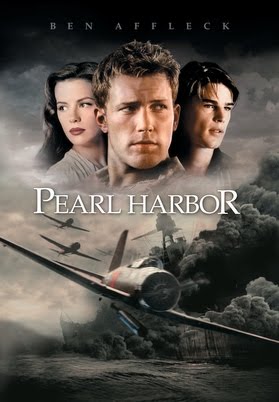
The attack on Pearl Harbor, also known as the Battle of Pearl Harbor, the Hawaii Operation or Operation AI by the Japanese Imperial General Headquarters,and Operation Z during planning, was a surprise military strike by the Imperial Japanese Navy Air Service against the United States naval base at Pearl Harbor, Hawaii Territory, on the morning of December 7, 1941. The attack led to the United States' entry into World War II.

Japan intended the attack as a preventive action to keep the U.S. Pacific Fleet from interfering with military actions they planned in Southeast Asia against overseas territories of the United Kingdom, the Netherlands, and the United States. Over the next seven hours there were coordinated Japanese attacks on the U.S.-held Philippines, Guam and Wake Island and on the British Empire in Malaya, Singapore, and Hong Kong.

「pearl harbour」的圖片搜尋結果

The attack commenced at 7:48 a.m. Hawaiian Time. The base was attacked by 353 Imperial Japanese fighter planes, bombers, and torpedo planes in two waves, launched from six aircraft carriers.All eight U.S. Navy battleships were damaged, with four sunk. All but the USS Arizona were later raised, and six were returned to service and went on to fight in the war. The Japanese also sank or damaged three cruisers, three destroyers, an anti-aircraft training ship,and one minelayer. 188 U.S. aircraft were destroyed; 2,403 Americans were killed and 1,178 others were wounded. Important base installations such as the power station, shipyard, maintenance, and fuel and torpedo storage facilities, as well as the submarine piers and headquarters building (also home of the intelligence section) were not attacked. Japanese losses were light: 29 aircraft and five midget submarines lost, and 64 servicemen killed. One Japanese sailor, Kazuo Sakamaki, was captured.

The undeclared assault came as a profound shock to the American people and led directly to the American entry into World War II in both the Pacific and European theaters. The following day, December 8, the United States declared war on Japan.Domestic support for non-interventionism, which had been fading since the Fall of France in 1940,disappeared. Clandestine support of the United Kingdom (e.g., the Neutrality Patrol) was replaced by active alliance. Subsequent operations by the U.S. prompted Germany and Italy to declare war on the U.S. on December 11, which was reciprocated by the U.S. the same day.
「pearl harbour movie」的圖片搜尋結果

There were numerous historical precedents for unannounced military action by Japan. However, the lack of any formal warning, particularly while negotiations were still apparently ongoing, led President Franklin D. Roosevelt to proclaim December 7, 1941, "a date which will live in infamy". Because the attack happened without a declaration of war and without explicit warning, the attack on Pearl Harbor was judged by the Tokyo Trials to be a war crime.
--------------------------------------------------------------------------------------------------------------
Walt Whitman ----Children of Adam

「walt whitman children of adam」的圖片搜尋結果

TO THE GARDEN THE WORLD

To the garden the world anew ascending,
Potent mates, daughters, sons, preluding,
The love, the life of their bodies, meaning and being,
Curious here behold my resurrection after slumber,
The revolving cycles in their wide sweep having brought me again,
Amorous, mature, all beautiful to me, all wondrous,
My limbs and the quivering fire that ever plays through them, for 
reasons, most wondrous,
Existing I peer and penetrate still,
Content with the present, content with the past,
By my side or back of me Eve following,
Or in front, and I following her just the same.


FROM PENT-UP ACHING RIVERS.

FROM pent-up aching rivers,
From that of myself without which I were nothing,
From what I am determined to make illustrious, even if I stand 
sole among men,
From my own voice resonant, singing the phallus,
Singing the song of procreation,
Singing the need of superb children and therein superb grown 
people,
Singing the muscular urge and the blending,
Singing the bedfellow's song, (O resistless yearning!
O for any and each the body correlative attracting!


Summary &Analysis
A group of fifteen poems in the 1860 version of Leaves of Grass was entitled Enfans d'Adam. In 1867, these poems, after a few changes, were retitled Children of Adam. In the 1892 edition, the group consists of sixteen poems.

The major themes of Children of Adam are procreation and physical love between man and woman. The themes are dealt with through imagery rich in Christian tradition. Whitman uses many Christian concepts in his own unique way to express his individual precepts for mankind.

Fundamental to Christian belief is the story of the Fall of Man, interpreted either literally or symbolically. Adam and Eve, falling prey to Satan's temptation, disobeyed the divine command and ate the forbidden fruit of knowledge. This act of disobedience resulted in Original Sin, the inheritance of humanity. Man is therefore a born sinner, and his only hope of salvation lies in the grace of God, attained through Jesus Christ.

Whitman reverses this traditional Christian tenet. He asserts that it is not Adam but Adam's children who have really lost the Garden of Eden. Adam's children can regain this lost paradise not by denying the flesh, which had been a Puritan belief, but by accepting it. Man will then be reborn through this glorification of his body, for the human body is as sacred as the spirit. Thus, man is not born debased as a result of Original Sin. He should be proud of his heritage and of the "Adamic" in him.

The theme of procreation in these poems was revolutionary at the time of their first publication. Whitman thinks that procreation is a creative act, an act of spiritual regeneration. Man finds fulfillment in sex and should thus rejoice in it, for it is only through physical love that man can take his place in the cycle of life. And it is only through spiritual regeneration that man can complete his quest — and the full, uninhibited experience of sex is seen as the first step to spiritual regeneration.
------------------------------------------------------------------------------------------------------------
Situation Comedy
※Definition from Merrian-Webster
a radio or television comedy series that involves a continuing cast of characters in a succession of episodes.
※situation comedy, also called sitcom, radio or television comedy series that involves a continuing cast of characters in a succession of episodes. Often the characters are markedly different types thrown together by circumstance and occupying a shared environment such as an apartment building or workplace. Sitcoms are typically half an hour in length; they are either taped in front of a studio audience or employ canned applause, and they are marked by verbal sparring and rapidly resolved conflicts.
What It Is, How It Works
An Examination of the Situation Comedy
by Richard F. Taflinger, PhD

Disgruntled by Lucy's spendthrift ways, Ricky insists she would feel differently about money if she had to "bring home the bacon". With her neighbor Ethel Mertz' support, Lucy agrees to switch roles for a week--the women will get jobs if the men stay home and do the housework and cooking. The women go to an employment agency, lie about their qualifications, and land jobs at Kramer's Kandy Kitchen. Lucy starts in the candy-dipping section and Ethel in the boxing department, but both fail. They are transferred to "wrapping", where their task is to wrap each piece of candy as it goes by on the conveyer belt. Unfortunately, they find it impossible to keep up with the swift-moving belt and are forced to stuff the excess candies into their mouths, hats, blouses, etc. As "housewives", Ricky and Fred Mertz are doing no better, so the four finally decide to call off the switch.

Anyone familiar with commercial television programming can point to a particular show with a plot like the one above and say, "That is a situation comedy". But what is there about that particular show that makes it fit into that genre, as opposed to a western, or a detective show, or a medical show? There are or have been western comedies , detective comedies , and medical comedies . It is the purpose of this chapter to clarify just what the components of the situation comedy are.

This chapter is about the situation comedy in general, some preliminary statements about the situation comedy that apply to all types. Following this will be chapters giving details about the plots, characters, settings, and thought from my study of the actcom, domcom, and dramedy.

General Comments
---Characters
Main
There are three types of characters in situation comedies: main, supporting, and transient. The main characters are those that carry the bulk of the action. In general, there is only one main character, but there may be as many as three.

The limit on main characters is obvious from merely looking at shows. From Lucy in I LOVE LUCY to Balki and Larry in PERFECT STRANGERS to Leonard and Sheldon in THE BIG BANG THEORY, the main characters are the ones that the audience is supposed to watch; what happens to them is important. It is extremely difficult in a half hour to give everyone enough spotlight to make them all main characters.
「situation comedy」的圖片搜尋結果

Supporting

Supporting characters are members of the regular cast who do as the name implies: they support the main character and often act as foils. There are few supporting characters, for two main reasons. The first is monetary--the more characters the more actors that must be paid. The second reason is more important: in order to maintain interest and understand the story, the audience must be able to identify each character and remember  personality on sight. When there are too many characters such identification requires a mental effort on the part of the audience, an effort to be avoided as it interferes with aesthetics, involvement, and acceptance of events. WKRP IN CINCINNATI started out slowly because of the number of characters, all of which had to be identified and understood by the audience. Eventually, because of their striking differences and personalities, it was possible to tell them apart without a scorecard, and the show became successful. M*A*S*H also started out with the characters that were in the movie. After the first season several of the characters were dropped: it was possible to develop them all in the movie and give them all something to do. On television this proved impossible.

Transients
There is extensive use of transients. Transient characters come in three varieties: the guest star, the small but necessary role, and the necessary but not constantly needed role. The guest star is a major role in a single episode, providing a plot problem. When I LOVE LUCY was set in Hollywood for several episodes such stars as Richard Widmark, William Holden and John Wayne were brought in. Herve Villechais appeared as a guest on TAXI, Danny Thomas played a dual role as both his own persona and a character on an episode of THE DICK VAN DYKE SHOW, and Robert Alda appeared twice as a doctor on M*A*S*H. The role does not have to be played by an established "star", nor need the guest appear in his or her own persona; it can be any actor playing a major role in a single episode.

Small but necessary roles are usually walk-on characters: delivery people, store clerks and customers, and other supernumeraries. They are necessary for the continuity of the plot by acting as agents for plot problems and complications, but they usually contribute little or nothing of themselves as characters.

The third type of transient, the necessary but not constantly needed role, is a supporting role that does not appear in every episode. Often they will appear only two or three times during the course of a season, although occasionally their function is expanded. Bob's therapy group (THE BOB NEWHART SHOW) began as a single plot variation and was expanded to a regularly appearing part of the show. The psychiatrist, Dr. Freedman (M*A*S*H) was on as a part of a single episode about how the personnel coped with the insanity of their jobs, and soon became a regular poker player and medical consultant, almost a supporting character. The Fonz (HAPPY DAYS) was originally planned to be a supporting transient, but soon became the leading character.

Transient characters provide plot problems and complications, or provide those purely mechanical functions of a story, such as delivering packages or notes, revealing complications, etc.

Audience Perception of the Characters

Most of the characters in a situation comedy are sympathetic. The audience can identify with them and their problems and care whether or not they can solve the problems.

However, to provide necessary conflict there is at least one character, usually a supporting character but occasionally a transient, who is unsympathetic. He is, for want of a better term, the villain. HIs function is to provide obstacles and problems for the main characters. Examples of such characters are Mel Cooley (THE DICK VAN DYKE SHOW), Frank Burns (M*A*S*H), and Dan Fielding, the district attorney on NIGHT COURT.

The villain is not always a villain, though. A sympathetic side of the character is occasionally shown, particularly if the character is a continuing role in the show. Dan Fielding, although a scum of the earth male chauvinist oinker with the morals of a water buffalo in heat, nonetheless does have feelings and will help a friend in trouble or assist a single mother safely deliver her child. However, this character will continue to conflict with the main character. For example, Ida Morganstern, Rhoda's mother on RHODA, will often try to force her own lifestyle on Rhoda, but she eventually gives in and allows Rhoda to live her own life: at least, on that episode. In another episode she will try a different approach or point of view. Dan, of course, ends a show by leaving a trail of slime.

Thought

A factor applicable to all three types of sitcom is that the themes, plots, complications and characterizations are firmly rooted in the idealized American middle-class, either by representing it or departing from it. Because a majority of American television viewers fit into this class, this foundation is of great value: expositions which establish the societal norms against which to measure the incongruity in humor may be greatly condensed, the norms already being known to a majority of the audience. Time, always of great value in so rigidly structured an art form as television, is thus saved, the problem introduced very early in the program and the plot set in motion.

The plots for many episodes will involve a disruption of the status quo by one of the characters attempting to break with the middle-class mores. For example, in an episode of THE ODD COUPLE, Oscar Madison is offered and accepts a job as a writer with a magazine strongly resembling Playboy. His life-style alters drastically toward the sybaritic. However, he is not happy, and only regains his peace of mind and contentment when he returns to his middle-class way of life. As another example, in an episode of EIGHT IS ENOUGH, a friend of David (one of the sons) is killed in an accident. David, taking it very hard and believing that all of his work and clean living is worthless and that one should live for the moment, quits his job and begins to live a hedonistic existence. After a period of dissipation he comes to the realization that his erstwhile middle-class life was not so bad after all, with good food and clean clothes, no hangovers or double-vision, etc., and returns to it.

Not all types of situation comedies extol the virtues of the middle-class. Many of the solutions in a dramedy, for example, will show that middle-class morality and mores are stifling, opinionated, or just wrong. Nonetheless, it is the middle-class that is serving as a foundation and springhead for plot and resolution.

disgruntled: unhappy ,annoyed and disappointed about something
bulk: something  or someone that is very large

2016年12月23日 星期五

Notes from clas

Goldilocks  and three bears
「Goldilocks and the Three Bears」的圖片搜尋結果

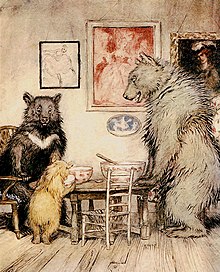
"Goldilocks and the Three Bears" and the older still "The Story of the Three Bears" are two variations of an old fairy tale. The original tale tells of an ugly, old woman who enters the forest home of three bachelor bears whilst they are away. She sits in their chairs, eats some of their porridge, and falls asleep in one of their beds. When the bears return and discover her, she starts up, jumps from the window, and is never seen again. The other major version brings Goldilocks to the tale (replacing the old woman), and an even later version retained Goldilocks, but has the three bachelor bears transformed into Papa, Mama, and Baby Bear.

What was originally a fearsome oral tale became a cosy family story with only a hint of menace. The story has elicited various interpretations and has been adapted to film, opera, and other media.
 "The Story of the Three Bears" is one of the most popular fairy tales in the English language.

「Goldilocks and the Three Bears」的圖片搜尋結果

Literary elements
The story makes extensive use of the literary rule of three, featuring three chairs, three bowls of porridge, three beds, and the three title characters who live in the house. There are also three sequences of the bears discovering in turn that someone has been eating from their porridge, sitting in their chairs, and finally, lying in their beds, at which point is the climax of Goldilocks being discovered. This follows three earlier sequences of Goldilocks trying the bowls of porridge, chairs, and beds successively, each time finding the third "just right". Author Christopher Booker characterizes this as the "dialectical three", where "the first is wrong in one way, the second in another or opposite way, and only the third, in the middle, is just right." Booker continues "This idea that the way forward lies in finding an exact middle path between opposites is of extraordinary importance in storytelling".This concept has spread across many other disciplines, particularly developmental psychology, biology, economics and engineering where it is called the "Goldilocks Principle".
The Goldilocks principle
The Goldilocks principle states that in a given sample, there may be entities belonging to extremes, but there will always be an entity belonging to the average. Or in other words, in a sample, there will always be a U-shaped distribution. When the effects of the principle are observed, it is known as the Goldilocks effect.

The Goldilocks principle is derived from a children's story "The Three Bears" in which a little girl named Goldilocks finds a house owned by three bears. Each bear has its own preference of food and beds. After testing all three examples of both items, Goldilocks determines that one of them is always too much in one extreme (too hot or too large), one is too much in the opposite extreme (too cold or too small), and one is "just right".
The Goldilocks principle is applied across many disciplines, particularly developmental psychology, biology,economics and engineering.


Origins
Robert Southey

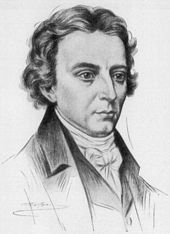
The story was first recorded in narrative form by British writer and poet Robert Southey, and first published anonymously as "The Story of the Three Bears" in 1837 in a volume of his writings called The Doctor. The same year Southey's tale was published, the story was versified by George Nicol who acknowledged the anonymous author of The Doctor as "the great, original concocter" of the tale. Southey was delighted with Nicol's effort to bring more exposure to the tale, concerned children might overlook it in The Doctor. Nicol's version was illustrated with engravings by B. Hart (after "C.J."), and was reissued in 1848 with Southey identified as the story's author.

The story of the three bears was in circulation before the publication of Southey's tale.In 1813, for example, Southey was telling the story to friends, and in 1831 Eleanor Mure fashioned a handmade booklet about the three bears and the old woman for her nephew Horace Broke's birthday.Southey and Mure differ in details. Southey's bears have porridge, but Mure's have milk;Southey's old woman has no motive for entering the house, but Mure's old woman is piqued when her courtesy visit is rebuffed;[8] Southey's old woman runs away when discovered, but Mure's old woman is impaled on the steeple of St Paul's Cathedral.

Folklorists Iona and Peter Opie point out in The Classic Fairy Tales (1999) that the tale has a "partial analogue" in "Snow White": the lost princess enters the dwarfs' house, tastes their food, and falls asleep in one of their beds. In a manner similar to the three bears, the dwarfs cry, "Someone's been sitting in my chair!", "Someone's been eating off my plate!", and "Someone's been sleeping in my bed!" The Opies also point to similarities in a Norwegian tale about a princess who takes refuge in a cave inhabited by three Russian princes dressed in bearskins. She eats their food and hides under a bed.

In 1865, Charles Dickens referenced a similar tale in Our Mutual Friend, but in Our Mutual Friend, the house belongs to hobgoblins rather than bears. Dickens' reference however suggests a yet to be discovered analogue or source.Hunting rituals and ceremonies have been suggested and dismissed as possible origins.

In 1894, "Scrapefoot", a tale with a fox as antagonist that bears striking similarities to Southey's story, was uncovered by the folklorist Joseph Jacobs and may predate Southey's version in the oral tradition. Some sources state that it was illustrator John D. Batten whom in 1894 reported a variant of the tale at least 40 years old. In this version, the three bears live in a castle in the woods and are visited by a fox called Scrapefoot who drinks their milk, sits in their chairs, and rests in their beds.This version belongs to the early Fox and Bear tale-cycle.Southey possibly heard "Scrapefoot", and confused its "vixen" with a synonym for an unpleasant malicious old woman. Some maintain however that the story as well as the old woman originated with Southey.

Southey most likely learned the tale as a child from his uncle William Tyler. Tyler may have told a version with a vixen (she-fox) as intruder, and Southey later confused vixen with a common appellation for a crafty old woman.P.M. Zall writes in "The Gothic Voice of Father Bear"  that "It was no trick for Southey, a consummate technician, to recreate the improvisational tone of an Uncle William through rhythmical reiteration, artful alliteration, even bardic interpolation ('She could not have been a good, honest Old Woman')". Ultimately, it is uncertain where Southey or his uncle learned the tale.
※analogue: That which is analogous to, or corresponds with, some  other thing.
※vixen:  A cross, ill-tempered person; -- formerly used of either sex, now only of a woman.
----------------------------------------------------------------------------------------------------------------------
Protestant
The Protestant Reformation

In 1517, the German monk and theologian Martin Luther challenged Catholicism and its influence on Europe. Luther attacked the sale of indulgences, certificates sold to the faithful and intended to limit the time the dead spent in purgatory. But Luther's real challenge to the church was his new understanding of salvation.
「martin luther」的圖片搜尋結果
Martin Luther
In contrast to Catholicism, which stressed the authority of the church, Luther gave primacy to individual experience, the radical notion that the individual could communicate directly with God and seek his or her own salvation, without the intermediating authority of the church or priests. He was convinced that sins could not be washed away by penance or forgiven by indulgences; salvation came from faith in God and by faith alone -- sola fide. Faith in God came only through contemplating the word of God -- sola scriptura. On spiritual matters, it was the Bible -- not the Vatican -- that possessed ultimate authority.

Luther's ideas struck a fundamental blow to the primacy of the Catholic Church. He was excommunicated by the pope and rejected by the Holy Roman emperor Charles V, but he had captured the imagination of many in Catholic Europe.


By the mid-16th century, two competing ideologies -- one Catholic, the other a burgeoning Protestantism -- warred for supremacy. The ideological battle raged with particular ferocity in England, where King Henry VIII wished to divorce his wife, Catherine of Aragon, the daughter of Spain's Ferdinand and Isabella, in order to marry his mistress, Anne Boleyn. When the Vatican refused to grant a divorce, Henry separated himself from the Catholic Church and established the Church of England. He then became head of both the church and the state in England. Catholics who refused to swear oaths of allegiance or recognize Henry's new marriage were persecuted.

When she became the queen of England six years after her father's death, Mary Tudor, King Henry's daughter by Catherine of Aragon and an ardent Catholic, attempted to restore Catholicism to England and launched a systematic persecution of Protestants. At her death in 1558, her half-sister, Elizabeth I, was crowned queen of England.
「protestant martin luther」的圖片搜尋結果
 Martin Luther
For Protestants, Elizabeth's ascension in 1558 served as a symbol of their hopes. Her triumphal entry into the capital London in 1559 was carefully scripted by her advisers as a display of Protestant pageantry. That same year, Parliament, with a bare Protestant majority, passed the Religious Settlement Act. Thirty-nine articles stated the basic doctrines of the church. The Book of Common Prayer proscribed the prayers and the liturgy to be followed each day. The style of worship was in keeping with the queen's own personal tastes: She liked imagery, in moderation, appreciated choral music and was less enthusiastic about preaching. These reforms passed by Parliament were not radical ones, but steered a careful middle course that was sensitive to Catholic tradition and did not loudly proclaim a robust and assertive Protestantism. But the lingering remnants of Catholicism troubled some Protestant reformers.

-------------------------------------------------------------------------------------------------------------------
Prodigal's son
「Prodigal's son」的圖片搜尋結果
The Parable of the Prodigal Son (also known as the Lost Son, Running Son, Loving Father, or Lovesick Father)is one of the parables of Jesus which appears in Luke 15:11-32. Jesus Christ shares it with his disciples, the Pharisees and others.

In the story, a father has two sons. The younger son asks for his inheritance and after wasting his fortune (the word "prodigal" means "wastefully extravagant"), becomes destitute. He returns home with the intention of begging his father to be made one of his hired servants, expecting his relationship with his father is likely severed. The father welcomes him back and celebrates his return. The older son refuses to participate. The father reminds the older son that one day he will inherit everything. But, they should still celebrate the return of the younger son because he was lost and is now found.

It is the third and final part of a cycle on redemption, following the Parable of the Lost Sheep and the Parable of the Lost Coin. In Revised Common Lectionary and Latin Rite Catholic Lectionary, this parable is read on the fourth Sunday of Lent ; in the latter it is also included in the long form of the Gospel on the 24th Sunday of Ordinary Time in Year C, along with the preceding two parables of the cycle. In the Eastern Orthodox Church it is read on the Sunday of the Prodigal Son.

「Prodigal's son」的圖片搜尋結果

The parable begins with a young man, the younger of two sons, who asks his father to give him his share of the estate. The implication is the son could not wait for his father's death for his inheritance, he wanted it immediately. The father agrees and divides his estate between both sons.

Upon receiving his portion of the inheritance, the younger son travels to a distant country and wastes all his money in extravagant living. Immediately thereafter, a famine strikes the land; he becomes desperately poor and is forced to take work as a swineherd. (This, too, would have been abhorrent to Jesus' Jewish audience, who considered swine unclean animals.) When he reaches the point of envying the food of the pigs he is watching, he finally comes to his senses:

But when he came to himself he said, "How many hired servants of my father's have bread enough to spare, and I'm dying with hunger! I will get up and go to my father, and will tell him, 'Father, I have sinned against heaven, and in your sight. I am no more worthy to be called your son. Make me as one of your hired servants.'" He arose, and came to his father. But while he was still far off, his father saw him, and was moved with compassion, and ran towards him, and fell on his neck, and kissed him.

— Luke 15:17–20, World English Bible
This implies the father was hopefully watching for the son's return.

The son does not even have time to finish his rehearsed speech, since the father calls for his servants to dress him in a fine robe, a ring, and sandals, and slaughter the "fattened calf" for a celebratory meal.

The older son, who was at work in the fields, hears the sound of celebration, and is told about the return of his younger brother. He is not impressed, and becomes angry. He also has a speech for his father:

But he answered his father, "Behold, these many years I have served you, and I never disobeyed a commandment of yours, but you never gave me a goat, that I might celebrate with my friends. But when this, your son, came, who has devoured your living with prostitutes, you killed the fattened calf for him."

— Luke 15:29-30, World English Bible
The parable concludes with the father explaining that because the younger son had returned, in a sense, from the dead, celebration was necessary:

"But it was appropriate to celebrate and be glad, for this, your brother, was dead, and is alive again. He was lost, and is found."

— Luke 15:32, World English Bible

Context and interpretation
Engraving of the Prodigal Son as a swineherd by Hans Sebald Beham.
This is the last of three parables about loss and redemption, following the parable of the Lost Sheep and the parable of the Lost Coin, that Jesus tells after the Pharisees and religious leaders accuse him of welcoming and eating with "sinners." The father's joy described in the parable reflects divine love, the "boundless mercy of God," and "God's refusal to limit the measure of his grace."

The request of the younger son for his share of the inheritance is "brash, even insolent" and "tantamount to wishing that the father was dead."His actions do not lead to success, and he eventually becomes an indentured servant, with the degrading job of looking after pigs, and even envying them for the carob pods they eat.

The mention of the son's longing to eat with the swine in Luke 15:16 could refer to how the Pharisees viewed the sinners (and Christ, for eating with them) in Luke 15:2. The Pharisees, caught up in their ideas of ritual cleanliness, might have thought of these people as filthy pigs.

On the son's return, the father treats him with a generosity far more than he has a right to expect.Some have suggested that this mirrors what Christians should do after sinning: feel contrition and return to their Heavenly Father, who will graciously welcome them back.

The older son, in contrast, seems to think in terms of "law, merit, and reward," rather than "love and graciousness."He may represent the Pharisees who were criticizing Jesus.


The father, who represents our Heavenly Father, implies to the older son that his love for both sons is not dependent upon their perfection, but their willingness to return to Him with a broken heart and a contrite spirit.
--------------------------------------------------------------------------------------------------------------
12 things you need to know about the Prodigal Son
Jimmy Akin

It is a moving story that teaches us about God's love for us and his willingness to forgive us no matter what we have done.

But there is more to the story than meets the eye . . . much more.
Here are 12 things you need to know.
1. What does "prodigal" mean?

The word "prodigal" is mysterious to us. Almost the only time we ever hear it is in the title of this parable.

It's basic meaning is "wasteful"--particularly with regard to money.

It comes from Latin roots that mean "forth" (pro-) and "to drive" (agere). It indicates the quality of a person who drives forth his money--who wastes it by spending with reckless abandon
That's what the prodigal son does in this story.
2. Why does Jesus tell this parable?

This question is answered at the beginning of Luke 15, where we read:

[1] Now the tax collectors and sinners were all drawing near to hear him [Jesus].
 [2] And the Pharisees and the scribes murmured, saying, "This man receives sinners and eats with them."
 [3] So he told them this parable . . .
Actually, Jesus tells three parables:

The parable of the lost sheep
The parable of the lost coin
The parable of the lost son (or, as we know it, the parable of the prodigal son)
All three parables are on the subject of recovering the lost, which is the implicit explanation of why Jesus receives sinners and eats with them: They are lost, and he wants to recover them.

Interestingly, the parable of the prodigal son (and the parable of the lost coin) occur only in Luke.
3. What's happening in the parable?

Jesus' parables are based on real-life situations, though they often veer off from the expected course of events in surprising ways. Those surprises teach us lessons.

Here, Jesus relates the situation of a father who has two sons, one of whom can't wait for his inheritance.

In Jewish society, there were laws regarding how inheritances were typically divided. The oldest brother got a double share (cf. Deut. 21:17), while the other brothers got a single share.

When there were two brothers (as here), the older brother would get 2/3rds of the estate, and the younger brother would get 1/3rd.
4. What is the prodigal son asking for?

In this parable, the younger son demands "the share of property that falls to me" (v. 12).

That means he is asking for the 1/3rd of the father's possessions that he would ordinarily get when the father dies.

Think about that.
He's asking his father to give him 1/3rd of everything that he owns right now, before the father is dead, when his father would still have use for these possessions.
How many fathers would receive that suggestion well today? How many would comply with it if one of their children asked it?
Not many!
This is a truly astonishing request, and it would have been even more astonishing in the ancient world.

In a society that highly reverenced parents, it would have been equivalent to saying: "Father, I can't even wait for you to die. Give me 1/3rd of everything you have right now."
5. What does the father's reaction teach us?

Despite the breathtaking--and insulting--audacity of the younger son's request, the father grants it!
Amazing!
This reflects the amazing indulgence that God shows toward us. Even when we are acting as selfishly as the prodigal son, God indulges us.

He yields what is his and allows us to misuse it out of respect for the freedom that he has given us.

But he knows that the misuse of our freedom will have no better results than it did with the prodigal son's misuse of his freedom, and God trusts that we will learn our lesson and come back to him.

6. What does the prodigal son do next?
After he gets 1/3rd of his father's estate, he takes everything he has and goes "into a far country, and there he squandered his property in loose living" (v. 13).

In context, this means that he abandoned the Holy Land to go, voluntarily, into exile into a gentile, pagan country where he could live loosely without being censured by fellow Jews living all around him.

He wanted to get out of God's land so that he could live in sin and fund his sinful lifestyle by what he took from his father.
But eventually the resources he had were exhausted and a hard time came.
If he had not spent what he had on loose living (as we will later learn, on prostitutes), he would have had the money he needed to weather the hard time, but he didn't.

Thus he was reduced to a state of hunger and had to subject himself to a pagan (humiliation #1) and to feed the pagan's pigs (humiliation #2).
「Prodigal's son」的圖片搜尋結果
Prodigal's younger son and humiliation
He would have been happy just to eat as well as the pigs (humiliation #3), but nobody gave him anything to eat, not even from the pigs' slop (humiliation #4).

Having been brought to such a low state, he recalled how his righteous father treated even his hired servants better: "How many of my father's hired servants have bread enough and to spare, but I perish here with hunger!" (v. 17).

He thus plans to return to his father and say three things:
(a) "Father, I have sinned against heaven and before you" (v. 18),
(b) "I am no longer worthy to be called your son" (v. 19a),
(c) "treat me as one of your hired servants" (v. 19b).

Even being treated as one of his father's hired servants would be better than the treatment he is receiving in the gentile world.
7. What do the actions of the prodigal son teach us?
They teaches us the depths to which our own misuse of freedom will bring us.
If we are bent on leaving God, things will go badly for us. We will be humiliated in the uncaring world.
The farther we get from the Father's loving care, the worse off we will be, and our best course is to return to God and his forgiveness.

8. What does the father do next?
When the prodigal son returns to his father, something significant happens.

While he is still at a distance, the father sees him, has compassion upon him, runs to him, hugs him, and kisses him.

This is far from the humiliating reunion that the son might expect based on his previous audacious and insulting treatment of his father!
The returning son must have been astonished!
But he continues by beginning to recite his pre-scripted speech to his father, and he manages to get the first two parts of it out. He says:
(a) "Father, I have sinned against heaven and before you" (v. 21a),
(b) "I am no longer worthy to be called your son" (v. 21b).
But before he can say the third part--before he can ask to be treated merely as a servant--the father interrupts things and takes them in a very different direction.
Rather than treating his younger son as a mere servant, he turns to the actual servants and orders a celebration.
「Prodigal's son」的圖片搜尋結果

9. What do the actions of the father teach us?
The first lesson is that the father will not treat a son as a hired servant. The younger son is still a son!
As a result, his return is something to be celebrated!
He is to wear a fancy robe! A fancy ring! Shoes! There is to be a fancy feast for everyone! There is to be music and dancing!
Why?
Because "This my son was dead, and is alive again" and "He was lost, and is found."
This shows us God's reaction when we return from being lost in sin.
He doesn't begrudge us what we have done. He doesn't take us back reluctantly.
Like the father in the parable, he takes us back joyously! Eagerly!
10. What does the older brother do next?

There is usually at least one major lesson per parable for each major figure in it, and now we come to the lesson that the older brother can teach us.

He didn't demand his inheritance. He stayed faithful to his father. And now he is angry.
Why should his younger, wasteful, sinful brother receive such a reception by their father?
The older brother is so angry that he refuses to go inside and join the party.
Naturally, his father hears about it and comes to talk to him.
When that happens, we discover that he's not just angry with his brother, he's angry with his father, too.
He points out that he has never disobeyed his father's commands but that his father has never given him a kid (a young goat) so that he could slaughter it and have a party with his friends.
In contrast, the younger brother has "devoured your living with harlots" (wasting a third of the father's estate!), but when he comes back "the fatted calf" (that is, the best, most tender and delicious animal, specially raised to be so) is killed!
The older brother sees this difference in treatment as a manifest injustice toward him and is angry with his father because of it.
As we will see, he even seems to be worrying about his own security in the family since the father is showing such seeming favoritism to the younger son.

11. What does the father do?
The father tells the son three things.
First, he tells him: "Son, you are always with me." This seems to be a reassurance to the elder son that he has not lost his place in the family. His place is secure.
Second, he tells him: "and all that is mine is yours." This is because the division of property has already taken place. The younger soon took his third, so the two-thirds that remain will go entirely to the older son.
This means that the current celebration does not represent a threat to the older brother or his inheritance. Instead, it is a celebration of joy occasioned by the return of the son.

Thus the father thirdly tells him: "It was fitting to make merry and be glad, for this your brother was dead, and is alive; he was lost, and is found.'"
There is more to the story of the prodigal son than meets the eye. Here are 12 things you should know about it.

12. What are the spiritual lessons for us? 
From this parable we can draw a number of spiritual lessons:
We can be a genuine son of the Father--who is spiritually "alive"--and be "lost" through sin. We can turn our backs on our heavenly Father and leave him of our own free will. Mortal sin is a real possibility.
Mortal sin inevitably lands us in a far worse state than we were in originally.
We can, however, return to the Father and be accepted by him with great joy. In fact, he is ready and eager to accept us back and forgive us, no matter what we've done.
Christians who have never fallen should not resent those who come back. They should share in their Father's joy.
Their own place is secure and their heavenly reward is not threatened. God loves them just as much as he loves those who come back through a dramatic conversion.
※implicit :capable of being understood from something else though unexpressed :  implied
※veer off:  To direct to a different course; to turn; to wear;
※gentile:  a person of a non-Jewish nation or of non-Jewish faith; especially :  a Christian as distinguished from a Jew
※pagan:    Neither having the accent of Christians, nor the gait of Christian, pagan, nor man.
※censure:  The act of blaming or finding fault with and condemning as wrong; reprehension; blame.
※misuse:  to use (something) incorrectly
※harlot: prostitute


2016年12月18日 星期日

Notes from class

Hello~Every body.Christmas is around the corner,it's the first Christmas,i use this blog and it's such an amazing experience.
Now ,I want to introduce U... Mistletoe by Justin Bieber
「under the mistletoe」的圖片搜尋結果

It's the most beautiful time of the year
Lights fill the streets spreading so much cheer
I should be playing in the winter snow
But I'mma be under the mistletoe

I don't wanna miss out on the holiday
But I can't stop staring at your face
I should be playing in the winter snow
But I'mma be under the mistletoe

With you, shawty with you
With you under the mistletoe

Everyone's gathering around the fire
Chestnuts roasting like a hot July
I should be chillin' with my folks, I know
But I'mma be under the mistletoe

Word on the street Santa's coming at night,
Reindeer's flying into the sky so high
I should be making a list I know
But I'mma be under the mistletoe

With you, shawty with you
With you under the mistletoe

With you, shawty with you
With you under the mistletoe

Eh, love, the wise men followed the star
The way I follow my heart
And it led me to a miracle

Eh love, don't you buy me nothing
I am feeling one thing, your lips on my lips
That's a merry merry Christmas

It's the most beautiful time of the year
Lights fill the streets spreading so much cheer
I should be playing in the winter snow
But I'mma be under the mistletoe

I don't wanna miss out on the holiday
But I can't stop staring at your face
I should be playing in the winter snow
But I'mma be under the mistletoe

With you, shawty with you
With you under the mistletoe

With you, shawty with you
Shawty with you, under the mistletoe

Kiss me underneath the mistletoe
Show me baby that you love me so-oh-oh
Oh, oh ,ohhh
Kiss me underneath the mistletoe,
Show me baby that you love me so-oh-oh
Oh, oh ,ohhh
----------------------------------------------------------------------------------------------------
相關圖片
Mistletoe is especially interesting botanically because it is a partial parasite (a "hemiparasite"). As a parasitic plant, it grows on the branches or trunk of a tree and actually sends out roots that penetrate into the tree and take up nutrients. But mistletoe is also capable for growing on its own; like other plants it can produce its own food by photosynthesis. Mistletoe, however, is more commonly found growing as a parasitic plant. There are two types of mistletoe. The mistletoe that is commonly used as a Christmas decoration (Phoradendron flavescens) is native to North America and grows as a parasite on trees in the west as also in those growing in a line down the east from New Jersey to Florida. The other type of mistletoe, Viscum album, is of European origin. The European mistletoe is a green shrub with small, yellow flowers and white, sticky berries which are considered poisonous. It commonly seen on apple but only rarely on oak trees. The rarer oak mistletoe was greatly venerated by the ancient Celts and Germans and used as a ceremonial plant by early Europeans. The Greeks and earlier peoples thought that it had mystical powers and down through the centuries it became associated with many folklore customs.

The Plant :
Mistletoe is especially interesting botanically because it is a partial parasite (a "hemiparasite"). As a parasitic plant, it grows on the branches or trunk of a tree and actually sends out roots that penetrate into the tree and take up nutrients. But mistletoe is also capable for growing on its own; like other plants it can produce its own food by photosynthesis. Mistletoe, however, is more commonly found growing as a parasitic plant. There are two types of mistletoe. The mistletoe that is commonly used as a Christmas decoration (Phoradendron flavescens) is native to North America and grows as a parasite on trees from New Jersey to Florida. The other type of mistletoe, Viscum album, is of European origin. The European mistletoe is a green shrub with small, yellow flowers and white, sticky berries which are considered poisonous. It commonly seen on apple but only rarely on oak trees. The rarer oak mistletoe was greatly venerated by the ancient Celts and Germans and used as a ceremonial plant by early Europeans. The Greeks and earlier peoples thought that it had mystical powers and down through the centuries it became associated with many folklore customs.

The Mistletoe Magic :
From the earliest times mistletoe has been one of the most magical, mysterious, and sacred plants of European folklore. It was considered to bestow life and fertility; a protection against poison; and an aphrodisiac. The mistletoe of the sacred oak was especially sacred to the ancient Celtic Druids. On the sixth night of the moon white-robed Druid priests would cut the oak mistletoe with a golden sickle. Two white bulls would be sacrificed amid prayers that the recipients of the mistletoe would prosper. Later, the ritual of cutting the mistletoe from the oak came to symbolize the emasculation of the old King by his successor. Mistletoe was long regarded as both a sexual symbol and the "soul" of the oak. It was gathered at both mid-summer and winter solstices, and the custom of using mistletoe to decorate houses at Christmas is a survival of the Druid and other pre-Christian traditions. The Greeks also thought that it had mystical powers and down through the centuries it became associated with many folklore customs. In the Middle Ages and later, branches of mistletoe were hung from ceilings to ward off evil spirits. In Europe they were placed over house and stable doors to prevent the entrance of witches. It was also believed that the oak mistletoe could extinguish fire. This was associated with an earlier belief that the mistletoe itself could come to the tree during a flash of lightning. The traditions which began with the European mistletoe were transferred to the similar American plant with the process of immigration and settlement.

「kissing under the mistletoe」的圖片搜尋結果


Kissing under the mistletoe :
Kissing under the mistletoe is first found associated with the Greek festival of Saturnalia and later with primitive marriage rites. They probably originated from two beliefs. One belief was that it has power to bestow fertility. It was also believed that the dung from which the mistletoe would also possess "life-giving" power. In Scandinavia, mistletoe was considered a plant of peace, under which enemies could declare a truce or warring spouses kiss and make-up. Later, the eighteenth-century English credited with a certain magical appeal called a kissing ball.

Kissing under Mistletoe
At Christmas time a young lady standing under a ball of mistletoe, brightly trimmed with evergreens, ribbons, and ornaments, cannot refuse to be kissed. Such a kiss could mean deep romance or lasting friendship and goodwill. If the girl remained unkissed, she cannot expect not to marry the following year. In some parts of England the Christmas mistletoe is burned on the twelfth night lest all the boys and girls who have kissed under it never marry. Whether we believe it or not, it always makes for fun and frolic at Christmas celebrations. Even if the pagan significance has been long forgotten, the custom of exchanging a kiss under the mistletoe can still be found in many European countries as well as in Canada. Thus if a couple in love exchanges a kiss under the mistletoe, it is interpreted as a promise to marry, as well as a prediction of happiness and long life. In France, the custom linked to mistletoe was reserved for New Year's Day: "Au gui l'An neuf" (Mistletoe for the New Year). Today, kisses can be exchanged under the mistletoe any time during the holiday season.

The Legend :
For its supposedly mystical power mistletoe has long been at the center of many folklore. One is associated with the Goddess Frigga. The story goes that Mistletoe was the sacred plant of Frigga, goddess of love and the mother of Balder, the god of the summer sun. Balder had a dream of death which greatly alarmed his mother, for should he die, all life on earth would end. In an attempt to keep this from happening, Frigga went at once to air, fire, water, earth, and every animal and plant seeking a promise that no harm would come to her son. Balder now could not be hurt by anything on earth or under the earth. But Balder had one enemy, Loki, god of evil and he knew of one plant that Frigga had overlooked in her quest to keep her son safe. It grew neither on the earth nor under the earth, but on apple and oak trees. It was lowly mistletoe. So Loki made an arrow tip of the mistletoe, gave to the blind god of winter, Hoder, who shot it , striking Balder dead. The sky paled and all things in earth and heaven wept for the sun god. For three days each element tried to bring Balder back to life. He was finally restored by Frigga, the goddess and his mother. It is said the tears she shed for her son turned into the pearly white berries on the mistletoe plant and in her joy Frigga kissed everyone who passed beneath the tree on which it grew. The story ends with a decree that who should ever stand under the humble mistletoe, no harm should befall them, only a kiss, a token of love.

What could be more natural than to translate the spirit of this old myth into a Christian way of thinking and accept the mistletoe as the emblem of that Love which conquers Death? Its medicinal properties, whether real or imaginary, make it a just emblematic of that Tree of Life, the leaves of which are for the healing of the nations thus paralleling it to the Virgin Birth of Christ.
----------------------------------------------------------------------------------------------------------------
The most romantic movie---while you are sleeping
「the movie poster--While you are sleeping」的圖片搜尋結果

Synopsis
'While You Were Sleeping' is the story of Lucy Moderatz, a lonely young woman who lives alone in a Chicago apartment with her cat, and spends her days (including holidays) working the token booth at a subway station. Her little world is turned upside down when she saves the life of one of her regular customers, Peter, (whom she has been admiring from afar) after he has been mugged and pushed onto the train tracks. The hospital staff and his eccentric family mistake her for his fiancee, which begins a humorous chain of events, during which Lucy finds unconditional friendship and a sense of belonging to a family--something she has been aching for, and which causes her to hesitate from telling them the truth of her identity. She also forges a friendship with Peter's brother, Jack. Jack and Lucy open each other's eyes to their need to let go of their fears and pursue their dreams...and, they fall in love, which really adds a twist to the situation. Finally Lucy is able to overcome her fear, speak the truth, and pursue her dreams.
-----------------------------------------------------------------------------------------------------------------
Dramatic irony
→A theatrical effect in which the true meaning of a situation, or some incongruity in the plot, is understood by the audience, but not by the characters in the play.
→ is a type of irony often used in literature. The author purposefully allows his characters to make a mistake, because they do not have information that the reader has. One such example of Dramatic Irony is in Romeo and Juliet, where Shakespeare stages the two lovers to meet at a masked ball. They do not know that they are from warring families, but the audience does, creating a sense of tension/suspense.
「Romeo and Juliet」的圖片搜尋結果
Aristotle's Poetics 
Aristotle's Poetics  is the earliest surviving work of dramatic theory and the first extant philosophical treatise to focus on literary theory.This has been the traditional view for centuries. However, recent work is now challenging whether Aristotle focuses on literary theory per se (given that not one poem exists in the treatise) or whether he focuses instead on dramatic musical theory that only has language as one of the elements.

In it, Aristotle offers an account of what he calls "poetry" (a term which in Greek literally means "making" and in this context includes drama – comedy, tragedy, and the satyr play – as well as lyric poetry and epic poetry). They are similar in the fact that they are all imitations but different in the three ways that Aristotle describes:

Differences in music rhythm, harmony, meter and melody.
Difference of goodness in the characters.
Difference in how the narrative is presented: telling a story or acting it out.


Form and content
Aristotle's work on aesthetics consists of the Poetics, Politics  and Rhetoric. The Poetics is specifically concerned with drama. At some point, Aristotle's original work was divided in two, each "book" written on a separate roll of papyrus. Only the first part – that which focuses on tragedy and epic  – survive. The lost second part addressed comedy. Some scholars speculate that the Tractatus coislinianus summarises the contents of the lost second book.

Form
The table of contents page of the Poetics found in Modern Library's Basic Works of Aristotle (2001) identifies five basic parts within it.

A. Preliminary discourse on tragedy, epic poetry, and comedy, as the chief forms of imitative poetry.
B. Definition of a tragedy, and the rules for its construction. Definition and analysis into qualitative parts.
C. Rules for the construction of a tragedy: Tragic pleasure, or catharsis experienced by fear and pity should be produced in the spectator. The characters must be four things: good, appropriate, realistic, and consistent. Discovery must occur within the plot. It is important for the poet to visualize all of the scenes when creating the plot. The poet should incorporate complication and dénouement within the story, as well as combine all of the elements of tragedy. The poet must express thought through the characters' words and actions, while paying close attention to diction and how a character's spoken words express a specific idea. Aristotle believed that all of these different elements had to be present in order for the poetry to be well-done. However, starting in 1948 with a Macedonian classicist, M.D. Petruševski, some scholars have rejected that Aristotle himself could have written the word katharsis in the definition of tragedy, because unlike all of the other words in the definition, it is not discussed either before or after the definition.
D. Possible criticisms of an epic or tragedy, and the answers to them.
E. Tragedy as artistically superior to epic poetry: Tragedy has everything that the epic has, even the epic meter being admissible. The reality of presentation is felt in the play as read, as well as in the play as acted. The tragic imitation requires less space for the attainment of its end. If it has more concentrated effect, it is more pleasurable than one with a large admixture of time to dilute it. There is less unity in the imitation of the epic poets (plurality of actions) and this is proved by the fact that an epic poem can supply enough material for several tragedies.


Matter
language, rhythm, and melody, for Aristotle, make up the matter of poetic creation. Where the epic poem makes use of language alone, the playing of the lyre involves rhythm and melody. Some poetic forms include a blending of all materials; for example, Greek tragic drama included a singing chorus, and so music and language were all part of the performance. These points also convey the standard view. Recent work, though, argues that translating rhuthmos here as "rhythm" is absurd: melody already has its own inherent musical rhythm, and the Greek can mean what Plato says it means in Laws II, 665a: "(the name of) ordered body movement," or dance. This correctly conveys what dramatic musical creation, the topic of the Poetics, in ancient Greece had: music, dance, and language. Also, the musical instrument cited in Ch 1 is not the lyre but the kithara, which was played in the drama while the kithara-player was dancing (in the chorus), even if that meant just walking in an appropriate way. Moreover, epic might have had only literary exponents, but as Plato's Ion and Aristotle's Ch 26 of the Poetics help prove, for Plato and Aristotle at least some epic rhapsodes used all three means of mimesis: language, dance (as pantomimic gesture), and music (if only by chanting the words).
Subjects
Also "agents" in some translations. Aristotle differentiates between tragedy and comedy throughout the work by distinguishing between the nature of the human characters that populate either form. Aristotle finds that tragedy treats of serious, important, and virtuous people. Comedy, on the other hand, treats of less virtuous people and focuses on human "weaknesses and foibles".Aristotle introduces here the influential tripartite division of characters in superior to the audience, inferior (χείρονας), or at the same level (τοιούτους).
Method
One may imitate the agents through use of a narrator throughout, or only occasionally (using direct speech in parts and a narrator in parts, as Homer does), or only through direct speech (without a narrator), using actors to speak the lines directly. This latter is the method of tragedy (and comedy): without use of any narrator.
Having examined briefly the field of "poetry" in general, Aristotle proceeds to his definition of tragedy:

Tragedy is a representation of a serious, complete action which has magnitude, in embellished speech, with each of its elements separately in the parts of the play and represented by people acting and not by narration, accomplishing by means of pity and terror the catharsis of such emotions.

By "embellished speech", I mean that which has rhythm and melody, i.e. song. By "with its elements separately", I mean that some parts of it are accomplished only by means of spoken verses, and others again by means of song .
He then identifies the "parts" of tragedy:

plot
Refers to the "structure of incidents" (actions). Key elements of the plot are reversals, recognition, and suffering. The best plot should be "complex" (i.e. involve a change of fortune). It should imitate actions arousing fear and pity. Thus it should proceed from good fortune to bad and involve a high degree of suffering for the protagonist, usually involving physical harm or death. However, new work also questions these traditional views: Aristotle says in three different places that tragedy can also go from misfortune to fortune, and the best type of tragedy in Ch 14 (like Cresphontes) ends happily and is explicitly ranked by him over Oedipus, which ends with great suffering.
Actions should be logical and follow naturally from actions that precede them. They will be more satisfying to the audience if they come about by surprise or seeming coincidence and are only afterward seen as plausible, even necessary.
When a character is unfortunate by reversal(s) of fortune (peripeteia known today in pop culture as a plot twist), at first he suffers (pathos) and then he can realize (anagnorisis) the cause of his misery or a way to be released from the misery.
character (ethos)
It is much better if a tragical accident happens to a hero because of a mistake he makes (hamartia) instead of things that might happen anyway. That is because the audience is more likely to be "moved" by it. A hero may have made it knowingly (in Medea) or unknowingly (Oedipus). A hero may leave a deed undone (due to timely discovery, knowledge present at the point of doing deed). Character is the moral or ethical character in tragic play. In a perfect tragedy, the character will support the plot, which means personal motivations will somehow connect parts of the cause-and-effect chain of actions producing pity and fear.

Main character should be:
good—Aristotle explains that audiences do not like, for example, villains "making fortune from misery" in the end. It might happen though, and might make the play interesting. Nevertheless, the moral is at stake here and morals are important to make people happy (people can, for example, see tragedy because they want to release their anger)
appropriate—if a character is supposed to be wise, it is unlikely he is young (supposing wisdom is gained with age)
consistent—if a person is a soldier, he is unlikely to be scared of blood (if this soldier is scared of blood it must be explained and play some role in the story to avoid confusing the audience); it is also "good" if a character doesn't change opinion "that much" if the play is not "driven" by who characters are, but by what they do (audience is confused in case of unexpected shifts in behaviour [and its reasons and morals] of characters)
"consistently inconsistent"—if a character always behaves foolishly it is strange if he suddenly becomes smart. In this case it would be good to explain such change, otherwise the audience may be confused. If character changes opinion a lot it should be clear he is a character who has this trait, not a real life person - this is also to avoid confusion

thought — reasoning of human characters can explain the characters or story background

diction  Lexis is better translated according to some as "speech" or "language." Otherwise, the relevant necessary condition stemming from logos in the definition (language) has no followup: muthos (plot) could be done by dancers or pantomime artists, given Chs 1, 2 and 4, if the actions are structured (on stage, as drama was usually done), just like plot for us can be given in film or in a story-ballet with no words.

Refers to the quality of speech in tragedy. Speeches should reflect character, the moral qualities of those on the stage. The expression of the meaning of the words.
melody . "Melos" can also mean "music-dance" as some musicologists recognize, especially given that its primary meaning in ancient Greek is "limb" (an arm or a leg). This is arguably more sensible because then Aristotle is conveying what the chorus actually did.

The Chorus too should be regarded as one of the actors. It should be an integral part of the whole, and share in the action. Should be contributed to the unity of the plot. It is a very real factor in the pleasure of the drama.

spectacle 

Refers to the visual apparatus of the play, including set, costumes and props (anything you can see). Aristotle calls spectacle the "least artistic" element of tragedy, and the "least connected with the work of the poet (playwright). For example: if the play has "beautiful" costumes and "bad" acting and "bad" story, there is "something wrong" with it. Even though that "beauty" may save the play it is "not a nice thing". Spectacle is like a suspenseful horror film.
----------------------------------------------------------------------------------------------------------------
Love is the Cause of Violence : Romeo and Juliet – Jeetendra Bhudial

          Romeo and Juliet by Williams Shakespeare, depicts the downfall of two lovers whom fell in love at first sight and sacrificed their life to honor their love. Romeo, son of the Montague, and Juliet, daughter of the Capulet fell madly in love with each other, when Romeo attended a party held by Lord Capulet, to see Rosaline. After they had proposed their deep profound love to each other, their relationship escalated very quickly. They secretly got married, against their family rivalry, but soon after Romeo was involved in the murder of Juliet’s cousin Tybalt, he was exiled. The rumor of Juliet’s death caused him to take his life, not being able to bear the loss of his wife. When Juliet awoken from her deep sleep, the sight of Romero’s dead body beside her caused her to commit suicide as well, since she had nothing more to live for than her true love. Love is the main cause of violence in this play.

Love was the cause of violence when Romeo crashed the Capulet’s party. Romeo went to the party because he loves Rosaline. At the party, Romeo and Juliet saw each other and they fall in love at first sight. After Romeo was seen at the party, Tybalt was determined to kill him because of their family feud.
This, by his voice, should be a Montague. Fetch me my rapier boy. What dates the slave? Come hither covered with an antic face. To fleer and scorn at our solemnity? Now, by the stock and honor of my kin, To strike him dead I hold it not a sin.

Tybalt made reference to their family history, the reason for him wanting to kill Romeo to protect the honor of their family. Lord Capulet was fast to diffuse Tybalt’s anger and prevented him from causing any problems at his feast by the excuse that Romeo was a well known as normal, sweet, young man of Verona.

Content thee, gentle coz. Let him alone. He bears him like a portly gentleman, And, to say truth, Verona brags of him, To be a virtuous and well governed youth.

Afterwards, Tybalt seeks out Romeo and kills Mercutio from the desire for revenge over Romeo’s attendance at the party and Romeo kills Tybalt to avenge Mercutio. It can be observed that each of these central fights had only led unto more and more violence. Love is what brought Romeo and Juliet together but it causes violence and reasons for revenge, which compromises their relationship and ultimately pulled the lovers further apart from each other.

 「Romeo and Juliet」的圖片搜尋結果

Love is the cause of violence because both Romeo and Juliet was so deeply in love that they would rather sacrifice their own lives than to be separated from each other. Their minds became plagued with the thoughts of suicide and a willingness to experience it. Romeo brandishes a knife in Friar Lawrence’s cell and threatens to kill himself after he has been banished from Verona, from his love Juliet, for killing Tybalt.

There is no world without Verona’s walls but purgatory;, torture, hell itself. Hence “banished” is banished from the world,” and death mistermed. Calling death “banished,” thou cutt’st my head off with a golden ax and smilest uon the stroke that murders me.

Juliet also pulls out a knife in order to take her own life in Friar Lawrence’s presence after she heard of her father’s plans to get her married to Paris. This act portrayed their dedication towards being loyal and faithful towards each other and shows how much they depended on each other’s companionship and love. After Lord Capulet decided that Juliet would marry Paris, Juliet says, “ If all ever fails, myself have power to die” . This also shows that’s she will take her life, rather than get married to Paris, also because she was already married to Romeo. She isn’t afraid to take her life in honor of up keeping her and her promise of love for Romeo. This continued unto its inevitable, tragic end when Romeo and Juliet chose death, in order to preserve their profound, admirable love. Since love cause violence, it can be seen as an amoral feeling, leading as much to destruction as to happiness.


「Romeo and Juliet」的圖片搜尋結果

In his review on, Paul Jorgensen argues that the demise of Romeo and Juliet was caused by their own, young, childish puppy love: a love which makes a teenager forget all about the world around then and only focuses on their lover. He stated, “Juliet compares their new-found love to lightning” .

 Although I joy in thee, I have no joy of this contract to-night. It is too rash, too unadvised, too sudden; Too like the lightning, which doth cease to be Ere one can say “It lightens.”
(116-20)

He Elaborated on the fact that Juliet was describing the speed at there romance was moving, but also explained that the lightning is a glorious break in the darkness of their lives. When the Nurse does not arrive fast enough with news about Romeo, Juliet laments that love heralds should be thoughts “which ten times faster glides than the sun’s beams” . Here, the heralds of love that will brings comforting news about her darling are compared to light and hope in her life. However, Romeo was the light in her life but they were still forced to part at dawn. Juliet proclaims that the night can
Take Romeo and cut him out into little stars,
And he will make the face of heaven so fine
That all thy world will be thy love with light and pay no attention to the garish sun.
This contrast of the light and speed of their love to darkness of the dawn foreshadowed that their love is going smooth at the moment but it will soon be faced with violence. Paul ended his argument by saying “If we all love at first sight, we only love the outer beauty of the person. We cannot truly love someone unless we understand their personality”. According to Paul, Romeo’s young immature love was only infatuation, which he did not understand and which caused him to make the wrong decisions and led to the downfall of their relationship.

As it can now be proven, love is the cause of violence in Romeo and Juliet. If Romeo’s love for Rosaline hadn’t led him to attend the Capulet’s Party uninvited, he wouldn’t have laid eyes upon Juliet and be involved in the battle of revenge with Tybalt. If Romeo and Juliet didn’t love each other as much as they did, they would’ve seen no reason to sacrifice their life when they saw that each other had died. Lastly, if Romeo and Juliet hadn’t perceived such a young, immature love driven by sexual feelings that escalated so quickly, they wouldn’t have went against their family’s traditions and rivalry in order to satisfy their own selfish desires. Love is the cause of violence.
------------------------------------------------------------------------------------------------------------
THE ENLIGHTENMENT (1650–1800)

「THE ENLIGHTENMENT」的圖片搜尋結果
The Enlightenment
←Overview→
The Enlightenment was a sprawling intellectual, philosophical, cultural, and social movement that spread through England, France, Germany, and other parts of Europe during the 1700s. Enabled by the Scientific Revolution, which had begun as early as 1500, the Enlightenment represented about as big of a departure as possible from the Middle Ages—the period in European history lasting from roughly the fifth century to the fifteenth.


The millennium of the Middle Ages had been marked by unwavering religious devotion and unfathomable cruelty. Rarely before or after did the Church have as much power as it did during those thousand years. With the Holy Roman Empire as a foundation, missions such as the Crusades and Inquisition were conducted in part to find and persecute heretics, often with torture and death. Although standard at the time, such harsh injustices would eventually offend and scare Europeans into change. Science, though encouraged in the late Middle Ages as a form of piety and appreciation of God’s creation, was frequently regarded as heresy, and those who tried to explain miracles and other matters of faith faced harsh punishment. Society was highly hierarchical, with serfdom a widespread practice. There were no mandates regarding personal liberties or rights, and many Europeans feared religion—either at the hands of an unmerciful God or at the hands of the sometimes brutal Church itself.

The Scientific Revolution and the Enlightenment, however, opened a path for independent thought, and the fields of mathematics, astronomy, physics, politics, economics, philosophy, and medicine were drastically updated and expanded. The amount of new knowledge that emerged was staggering. Just as important was the enthusiasm with which people approached the Enlightenment: intellectual salons popped up in France, philosophical discussions were held, and the increasingly literate population read books and passed them around feverishly. The Enlightenment and all of the new knowledge thus permeated nearly every facet of civilized life. Not everyone participated, as many uneducated, rural citizens were unable to share in the Enlightenment during its course. But even their time would come, as the Enlightenment also prompted the beginning of the Industrial Revolution, which provided rural dwellers with jobs and new cities in which to live.

Whether considered from an intellectual, political, or social standpoint, the advancements of the Enlightenment transformed the Western world into an intelligent and self-aware civilization. Moreover, it directly inspired the creation of the world’s first great democracy, the United States of America. The new freedoms and ideas sometimes led to abuses—in particular, the descent of the French Revolution from a positive, productive coup into tyranny and bedlam. In response to the violence of the French Revolution, some Europeans began to blame the Enlightenment’s attacks on tradition and breakdown of norms for inducing the anarchy.

Indeed, it took time for people to overcome this opinion and appreciate the Enlightenment’s beneficial effect on their daily lives. But concrete, productive changes did, in fact, appear, under guises as varied as the ideas that inspired them. The effects of Enlightenment thought soon permeated both European and American life, from improved women’s rights to more efficient steam engines, from fairer judicial systems to increased educational opportunities, from revolutionary economic theories to a rich array of literature and music.

These ideas, works, and principles of the Enlightenment would continue to affect Europe and the rest of the Western world for decades and even centuries to come. Nearly every theory or fact that is held in modern science has a foundation in the Enlightenment; in fact, many remain just as they were established. Yet it is not simply the knowledge attained during the Enlightenment that makes the era so pivotal—it’s also the era’s groundbreaking and tenacious new approaches to investigation, reasoning, and problem solving that make it so important. Never before had people been so vocal about making a difference in the world; although some may have been persecuted for their new ideas, it nevertheless became indisputable that thought had the power to incite real change. Just like calculus or free trade, the very concept of freedom of expression had to come from somewhere, and it too had firm roots in the Enlightenment.