 Paris's sister,Cassandra
In ancient Greek stories, Cassandra was the daughter of Priam, the King of Troy. The god Apollo gave her the power to see what would happen in the future, but he also made sure that no one would believe her, so when she warned her father that the Greeks could use the Trojan Horse to take control of Troy, no one believed her. Struck by her beauty, Apollo had provided her with the gift of prophecy, but when Cassandra refused Apollo's romantic advances, he placed a curse ensuring that nobody would believe her warnings. Cassandra was then left with the knowledge of future events, but could neither alter these events nor convince others of the validity of her predictions.


Mythology is ripe with tragically sad stories. In fact, very few myths actually finish with a happy ending. However, I consider the story of Cassandra to be one of the very saddest tales of all time. Cassandra was princess of the legendary city of Troy. As was very common in Greek mythology, the god Apollo lusted after the beautiful young mortal woman and intended to make her his own. To convince her to give into his advances, he promised to bestow upon her the gift of prophecy.
While Cassandra was obviously flattered that an Olympian god sought her favors, she wasn't at all convinced that she wanted to take him as lover. Still, unable to resist the gift he offered, she eventually relented.
Apollo took Cassandra under his wing and taught her how to use her prophecies. Once her mentorship was finished, however, Cassandra refused to give her body to Apollo as promised.
Furious at being rejected by a mere mortal Apollo decided to punish her. While he couldn't take back the gift he'd already given, he could alter it. After having his way with Cassandra, the god's anger was still not satiated. So he leveled a terrible curse upon her head. While Cassandra would still be able to foresee the future, the curse ensured that no one would believe her. Worse than that, they would believe that she was purposely telling lies.
True to his word, Cassandra was able to foresee the future for herself and those around her. But every attempt she made to warn people in advance of impending doom was ignored or, worse yet, labeled as an out right lie.
Ashamed of his daughter's supposed madness, the king pronounced her insane and jailed her by locking her inside her own chambers. Denying his daughter altogether, he told many people that she had died. Others, who already knew of her predicament simply didn't care since they, too, thought she was either crazy or a pathological liar.
One of Cassandra's most important prophecies involved the fall of Troy at the hands of the Greeks and the infamous Trojan Horse. Escaping from her prison, she begged her people to believe her predictions but, once again, no one would listen.
Cassandra managed to escape from Troy and elude the raping and pillaging of the Greek's as they tore apart her home. She hid within the temple of the goddess Athena, who promised to provide shelter to her former priestess. But Ajax found the girl there, clinging helplessly to the statue of Athena and he could not resist forcing himself upon the young beauty.
The goddess, infuriated that such an act would happen in her sacred temple, involving someone under her protection took revenge upon Ajax. She vowed that he would never again return home. Her wrath was fulfilled when Ajax died after his ship crashed against the rocks of Gyraen.
Twice raped, labeled a liar and insane, Cassandra finally relented and gave in to her fate. She allowed Agamemnon to claim her as his concubine, considering herself a rightful spoil of the Trojan War. Although he didn't marry her, she bore him two children, twin boys named Teledamus and Pelops.
Upon return to his home shores, Agamemnon's wife Clytamnestra greeted the couple with full heroic honors. She even embraced Cassandra, promising the young girl that she would make certain her servitude would not be too difficult. However, Cassandra had foreseen her fate as well as that of Agamemnon and she chose to fight it no longer.
-----------------------------------------------------------------------------------------------------------------
Vocabulary in THIS article:
😉concubine: one having a recognized social status in a household below that of a wife
😉servitude:the condition of being a slave or of having to obey another person
😉pillage:the act of looting or plundering especially in war
------------------------------------------------------------------------------------------------------------------
------------------------------------------------------------------------------------------------------------------
| Greek Name | Roman Name | Description |
|---|---|---|
| Aphrodite | Venus | The famous, beautiful love goddess, the one awarded the apple of Discord that was instrumental in the start of the Trojan War and for the Romans, the mother of the Trojan hero Aeneas |
| Apollo | Brother of Artemis/Diana, shared by Romans and Greeks alike | |
| Ares | Mars | The god of war for both Romans and Greeks, but so destructive he was not much loved by the Greeks, even though Aphrodite loved him. On the other hand, he was admired by the Romans, where he was associated with fertility as well as the military, and a very important deity. |
| Artemis | Diana | The sister of Apollo, she was a hunting goddess. Like her brother, she is often combined with the deity in charge of a celestial body. In her case, the moon; in her brother's, the sun. Although a virgin goddess, she assisted in childbirth. Although she hunted, she could also be the animals' protector. In general, she is full of contradictions |
| Athena | Minerva | She was a virgin goddess of wisdom and crafts, associated with warfare as her wisdom led to strategic planning. Athena was the patron goddess of Athens. She helped many of the great heroes. |
| Demeter | Ceres | A fertility and mother goddess associated with cultivation of grain. Demeter is associated with an important religious cult, the Eleusinian mysteries. She is also the law-bringer |
| Hades | Pluto | While he was the king of the Underworld, he was not the god of death. That was left to Thanatos. He is married to Demeter's daughter, whom he abducted. Pluto is the conventional Roman name and you might use it for a trivia question, but really Pluto, a god of wealth, is the equivalent of a Greek god of wealth called Dis |
| Hephaistos | Vulcan | The Roman version of this god's name was lent to a geological phenomenon and he required frequent pacification. He is a fire and blacksmith god for both. Stories about Hephaestus show him as the lame, cuckolded husband of Aphrodite. |
| Hera | Juno | A marriage goddess and the wife of the king of the gods, Zeus |
| Hermes | Mercury | A many-talented messenger of the gods and sometimes a trickster god and god of commerce. |
| Hestia | Vesta | It was important to keep the hearth fires burning and the hearth was the domain of this stay-at-home goddess. Her Roman virgin priestesses, the Vestals, were vital to the fortunes of Rome. |
| Kronos | Saturn |
A very ancient god, the father of many of the others. Cronus or Kronus is known for having swallowed his children, until his youngest child, Zeus, forced him to regurgitate. The Roman version is far more benign. The Saturnalia festival celebrates his pleasant rule.
|
| Persephone | Proserpina | The daughter of Demeter, the wife of Hades, and another goddess important in religious mystery cults. |
| Poseidon | Neptune | The sea and fresh water springs god, brother of Zeus and Hades. He is also associated with horses. |
| Zeus | Jupiter | Sky and thunder god, the head honcho and one of the most promiscuous of the gods. |

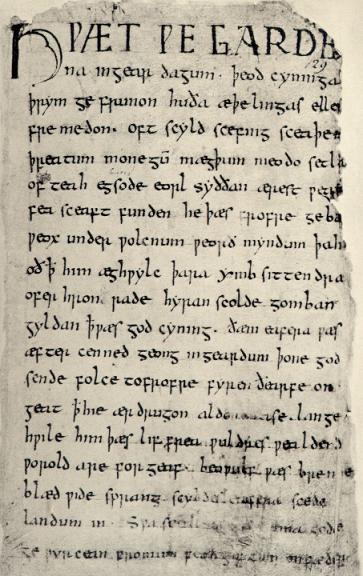 Notable epic poems

