2016年11月24日 星期四

11/24 Note from class

 comedy and tragedy


「drama tragedy comedy mask」的圖片搜尋結果The twin masks of comedy and tragedy are used to represent the creative arts: particularly theater, film, and television. They have their roots in Greek theater, and represented a reflection of ancient Greek mythological tropes. Their endurance across the centuries reflects the power of drama and the twin themes of joy and despair which bracket the human condition. Though they can appear separately and indeed evolved as representations of different dramatic art forms, their appearance together holds far more symbolic importance.


Myths and Duality
Masks were originally thought to be the purveyance of Dionysus, Greek god of wine. His sphere of influence lent him a sense of duality: both the joy of drunken revelry and the darker emotions which wine can evoke. The specific comedy and tragedy masks were also associated with the Muses: nine goddesses who held sway over creative expression. The muse of tragedy, Melpomene, wore the sad mask, and the muse of comedy, Thalia, wore the happy mask.
「Melpomene」的圖片搜尋結果
MelpomeneThis is Muse as Lost Mother, goddess of mourning and melancholy. She’s also got to be the muse of show-biz; big time!

「Thalia muse」的圖片搜尋結果
Thalia 

Greek Theater


It is believed that early Greek theater evolved out of festivals to Dionysus. The masks were frequently used during these festivals and subsequently incorporated into later theater. From a symbolic perspective, the masks freed their wearers from conformity and hidden desires, allowing people to express their true selves without fear. By donning them, the people honored Dionysus and the truths his influence revealed.

Purpose of Masks
From a more practical perspective, the masks helped audience members identify the emotions onstage. The mouths were enlarged in order to
(1)allow the actors to speak more easily, and
(2)the facial expressions were exaggerated so that those in the cheap seats could still understand what was going on.
「spectator in greek theatre」的圖片搜尋結果
Construction
Early comedy and tragedy masks were made from lightweight materials such as wood or pottery. They were intended to cover the entire face, with the help of a wig which would completely hide the actors' head. Women did not appear in Greek theater, so men would portray the women's parts using masks.

Genres
The twin genres represented by the masks are both intended to serve as a form of catharsis.
Comedy acts to deflate our preconceived notions and remind us how foolish we truly are, while tragedy permits us to grapple with dark realities such as death and failure in a safe context.
Though tragedy is today considered the more "artistic" genre, the Greeks actually revered(=respected) comedy more highly. The symbolic linking of the two with the masks emphasizes both their common roots as drama and the complex depth of human experience.

--------------------------------------------------------------------------------------------------------------
※ purveyance: to supply (as provisions) usually as a matter of business
※duality:  the quality or state of having two parts
※revelry :noisy partying or merrymaking(gay or festive activity )
※sway:to move slowly from side to side
※freed : enjoying political independence or freedom from outside domination
※conformity :  enjoying political independence or freedom from outside domination
※don: to put on (an article of clothing)
※lightweight :one of little consequence or ability ;weighing only a little or less than average
※deflate:to reduce in size, importance, or effectiveness
※grapple :a hand-to-hand struggle
----------------------------------------------------------------------------------------------------------
「Mary Had a Little Lamb」的圖片搜尋結果

Mary Had a Little Lamb
Mary had a little lamb, little lamb,
little lamb, Mary had a little lamb
whose fleece was white as snow.
And everywhere that Mary went
Mary went, Mary went, everywhere
that Mary went
The lamb was sure to go.

He followed her to school one day,
school one day, school one day,
He followed her to school one day,
Which was against the rules,
It made the children laugh and play,
laugh and play, laugh and play,
It made the children laugh and play,
To see a lamb at school.

And so the teacher turned it out,
turned it out, turned it out,
And so the teacher turned it out,
But still it lingered near,
He waited patiently about,
ly about, ly about,
He waited patiently about,
Till Mary did appear.

"Why does the lamb love Mary so?"
love Mary so?" love Mary so?"
"Why does the lamb love Mary so?"
The eager children cried.
"Why, Mary loves the lamb, you know,"
lamb, you know," lamb, you know,"
"Why, Mary loves the lamb, you know,"
The teacher did reply.
--------------------------------------------------------------------------------------------------------------
The nursery rhyme was first published by the Boston publishing firm Marsh, Capen & Lyon, as an original poem by Sarah Josepha Hale on May 24, 1830, and was inspired by an actual incident.

As a young girl, Mary Sawyer (later Mary Tyler) kept a pet lamb that she took to school one day at the suggestion of her brother. A commotion naturally ensued. Mary recalled: "Visiting school that morning was a young man by the name of John Roulstone, a nephew of the Reverend Lemuel Capen, who was then settled in Sterling. It was the custom then for students to prepare for college with ministers, and for this purpose Roulstone was studying with his uncle. The young man was very much pleased with the incident of the lamb; and the next day he rode across the fields on horseback to the little old schoolhouse and handed me a slip of paper which had written upon it the three original stanzas of the poem..."

相關圖片

----------------------------------------------------------------------------------------------------------------------
in Just  Related Poem Content Details
by e.e. cummings

spring          when the world is mud- 
luscious the little 
lame balloonman 

whistles          far          and wee 

and eddieandbill come 
running from marbles and 
piracies and it's 
spring 

when the world is puddle-wonderful 

the queer 
old balloonman whistles---->Dionysus
far          and             wee 
and bettyandisbel come dancing 

from hop-scotch andand 

it's 
spring 
and 

         the 

                  goat-footed ---->Dionysus

balloonMan          whistles 
far 
and 
wee

「hop-scotch」的圖片搜尋結果
 hop-scotch
相關圖片
jump-rope
-------------------------------------------------------------------------------------------------------------------
The Thorn Birds
The Thorn Birds (miniseries).jpg

The Thorn Birds is an American television miniseries broadcast on ABC from March 27 to 30, 1983.  It was directed by Daryl Duke and based on a novel by Colleen McCullough. The series was enormously successful and became the United States' second highest-rated miniseries of all time .


「The Thorn Birds」的圖片搜尋結果

*The Thorn Birds Summary

The Thorn Birds is a sweeping love story set on Drogheda, a sheep station in the Australian Outback. At its heart is the ill-fated romance of beautiful Meggie Cleary and the handsome Roman Catholic priest, Father Ralph de Bricassart. Forced to choose between the woman he loves, and the Church he is sworn(swear) to, Father Ralph's ambitions win, and he stays with the Church, eventually becoming a Cardinal in Rome. De Bricassart never realizes that Meggie's bright, compliant young son, Dane, is his child, even when the boy comes to Rome to study for the priesthood. After Dane's tragic death, Meggie must choose between her own comfort, and the independence of her beautiful, willful daughter Justine, a talented actress. McCullough's tome, almost 700 pages in length, details the private lives of three generations of the Cleary clan over 55 years, and paints a convincing portrait of the trials and rewards of life in the Australian desert, and one woman's doomed love for an unavailable man.

Meggie Cleary is a beautiful, but lonely little girl of nine with red-gold hair, when the family moves to Drogheda. Meggie's brothers are all busy with the ranch, and she is soon forced to quit school to care of the younger children. Ralph de Bricassart, a handsome young Roman Catholic priest, befriends the child. As Meggie grows into a beautiful young woman, the two fall in love, culminating in a kiss after a ball, when Meggie is 16 years old. Mary Carson, the clan matriarch, is jealous and ends the romance by bequeathing the enormous sheep ranch to the Roman Catholic Church, ensuring that De Bricassart will be elevated to bishop, far from Drogheda.

Heartbroken, Meggie marries Luke O'Neill, a man who looks like De Bricassart, and moves to Queensland. Meggie's husband has no interest in living with her, and travels around the countryside cutting sugar cane, forcing Meggie to work as a servant for a Queensland couple, Anne and Ludwig Mueller. During one of Luke O'Neill's rare conjugal visits, they conceive their daughter, Justine. Exhausted, and realizing her marriage is not viable, Meggie retreats to the honeymoon resort of Matlock alone, to sort out her future. Anne Mueller sends de Bricassart to join her, and the two conceive a son during a week long idyll. Meggie immediately realizes she is pregnant, and contrives to have sex with her husband, so the child will not be nameless. De Bricassart is transferred to Rome, and does not learn that he has fathered a son, until the boy is grown.

Meggie returns to Drogheda, where Justine grows into a fey, willful young woman, and her brother Dane becomes a sunny child. When Dane decides to become a priest, he travels to Rome to study under De Bricassart's tutelage. Meggie refuses to attend young Dane's ordination in Rome, feeling the Church has taken back the little happiness she stole from it. Just weeks later, Dane dies in Greece, while rescuing a drowning woman. Heartbroken, Justine decides to leave her acting career and lover in London and return to Drogheda. In an act of unselfish love, Meggie insists Justine must continue her own life in Europe, rather than submerging herself in Drogheda, as generations of Cleary women before her have done. The title of the novel is drawn from the legend of a bird that sings just once in its life, more sweetly than any other, but only at the cost of great pain. The title symbolizes the tenderness of the brief, forbidden love affair between Meggie and Father Ralph, resulting in pain and tragedy.

「The Thorn Birds」的圖片搜尋結果
---------------------------------------------------------------------------------------------------------------------
※titian:of a brownish-orange color
※auburn:of a reddish-brown color
※outback : isolated rural country especially of Australia
※deviations : departure from an established ideology or party line
※compliant :readily giving in to the command or authority of another
※sort out: to find an answer or solution for (something) 
※idyll:a very happy,peaceful and simple situation or period of time ,especially in the countryside
※fey:mysterious and strange ,or trying to appear like this
※tutelage: an act or process of serving as guardian or protector 
※ordination:the act or an instance of ordaining :  the state of being ordained
相關圖片
ordination
※bequeathing :to give or leave by will —used especially of personal property
※culminating: to bring to a head or to the highest point(climax)
※clan : a group of people tracing descent from a common ancestor 
※tome: a large or scholarly book
※ Cardinal:
 a high ecclesiastical official of the Roman Catholic Church who ranks next below the pope and is appointed by him to assist him as a member of the college of cardinals
----------------------------------------------------------------------------------------------------------------------


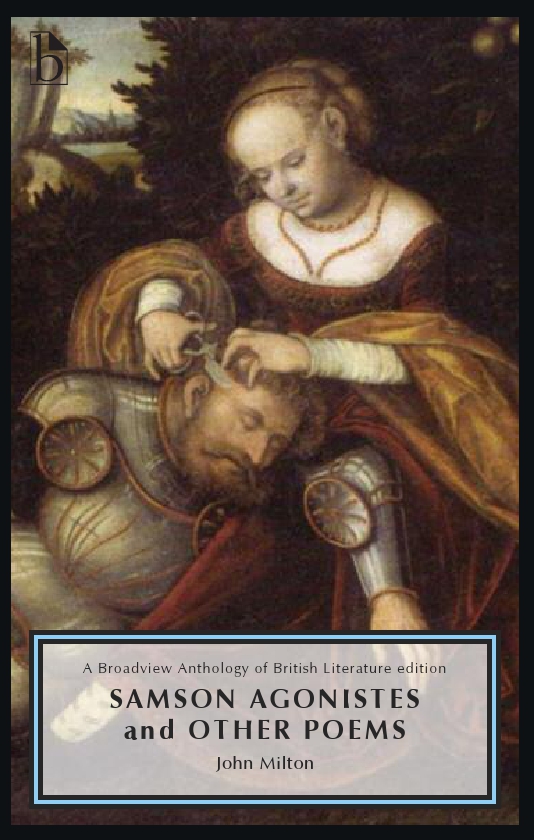
Samson Agonistes---by  John Milton
「samson agonistes」的圖片搜尋結果「samson agonistes」的圖片搜尋結果
Samson Agonistes  is a tragic closet drama by John Milton. It appeared with the publication of Milton's Paradise Regain'd in 1671, as the title page of that volume states: "Paradise Regained / A Poem / In IV Books / To Which Is Added / Samson Agonistes". It is generally thought that Samson Agonistes was begun around the same time as Paradise Regained but was completed after the larger work, possibly very close to the date of publishing, but there is no agreement on this.

SAMSON AGONISTES SUMMARY
「samson agonistes」的圖片搜尋結果


How It All Goes Down
It's a holiday for the Philistines when our poem opens, and this means that their Hebrew prisoner, Samson, gets a day off from the grueling labor he's usually forced to do. But he just can't relax. Instead, he obsesses over the various mistakes he's made in his life that have gotten him to this low point. Also, we learn that he's blind and that he feels he's betrayed his religion and his people.


In comes the Chorus, a group of his Hebrew friends. They try to be helpful, but they don't really have the lingo down and Samson seems to become more and more miserable. Then Manoa, Samson's father, shows up. He wants to negotiate with the Philistine authorities to secure Samson's release, but no dice. Samson feels that he deserves to be in prison. Hey, you can't stop a dad from trying—and off he goes to do just that.

Shortly after his dad departs, Samson's infamous Philistine ex-wife Dalila pays a visit. We learn that she's the reason Samson is in prison: she betrayed the secret that his amazing strength depends on his having a flowing, luscious locks. She told her people, they cut his hair, arrested him, blinded him... and here he is in prison. But she's here to apologize and explain.
「samson and delilah」的圖片搜尋結果
Obviously, Samson is completely uninterested in hearing her excuses and says lots of insulting things to her. She leaves in a fury, with this parting shot: she's now a hero among her people.

Last but definitely not least is the Philistine giant Harapha, who says he's just come by to check out this famous Samson. He also says that he wishes Samson were in better physical condition so they could fight it out and see who's strongest. Samson is totally down, but Harapha won't fight a blind guy. They trash-talk for a while, and then Harapha leaves in a huff. Harumpha!

Just then, a messenger arrives with the order for Samson to come perform in a Philistine festival. Uh, no thanks, Samson says—and then thinks better of it, saying he has had this vague but powerful feeling that he's meant to go and perform some great deed. Off he trots, just missing his father, who's back with good news that he successfully bribed some Philistine leaders and can now take Samson home.

 We're starting to get a bad feeling about this—and we're right. Just as the Chorus is about to celebrate this good news, they hear a horrible shriek. Another messenger runs in and reports that Samson has killed both himself and the entire Philistine elite by toppling the roof of the theater.

The Chorus and Manoa alternate between being super sad over the death of Samson and super happy that their enemy has been defeated. In the end, they go off to look for Samson's body and Manoa promises he's going to build Samson an awesome tomb. And thus ends Samson.
「samson and delilah」的圖片搜尋結果
Equality Still Failing Women in Greece
By Kathy Tzilivakis, Athens News
「hard-working  women」的圖片搜尋結果

THE FACTS of life: Women earn less than men. And more women than men find themselves stuck in low-income dead-end jobs.

Greek women have made impressive progress in academia – the majority of university graduates are females. But there is still a long way to go before they achieve absolute equality with their male counterparts in the work force. Few women hold high-end and decision-making posts in the corporate world, even fewer in political affairs.

Angela Daifa-Frantzeskaki, president of the Panhellenic Women's Organization, is a prominent figure in the local women's movement. She firmly believes the decades-long struggle for equality has not been in vain.

"Greece's legislative framework is one of the best in Europe," Daifa-Frantzeskaki told the Athens News. "We must take advantage of this and promote the right initiatives. We must also raise awareness among women. The Greek movement has made considerable headway, and we are now at the stage of discussing with state agencies about many issues… I believe, as one of the older women in the movement, that we are on the right track."

Work-wise

European Commissioner for Employment and Social Affairs Anna Diamantopoulou has made mainstreaming gender equality in all community policies and activities a top priority. She told a recent Athens conference organized by the interior ministry's General Secretariat for Equality that women have a greater presence in the labour market in recent decades.

 The employment rate of females in the EU has increased from 50 percent in 1997 to 55 percent in 2001. The jobless rate for women, however, is higher than for men in all the 15 member states.

"The gap is smallest in northern Europe," she said. "Larger gaps exist in southern member states like Spain, Greece and Italy. And mothers with young children have the lowest employment rates.

Another problem facing women in all countries is their position in the labour market. Women are concentrated in low-income jobs, service work, the public sector and part-time jobs. Across the Union, the largest occupational group among women is salespersons, followed by domestic and personal care workers. All low-skill jobs."

Diamantopoulou cited statistics depicting a rather disappointing reality: men take up to two-thirds of the high-skilled jobs and the promotion of women in decision-making positions is still poor.

"The so-called glass ceiling is preventing women from accessing jobs with higher levels of responsibilities and high pay," said Diamantopoulou. "The gender pay gap is real."


In Greece, women take home about three-quarters what men earn at the same job. Reports published by the Statistical Office of the EU (Eurostar) show that the greatest pay inequalities are found in the higher income groups, the older age groups and among the highest educated.

In Greece, women take home about three-quarters what men earn at the same job. Reports published by the Statistical Office of the EU (Eurostar) show that the greatest pay inequalities are found in the higher income groups, the older age groups and among the highest educated. More than 50 percent of university graduates in Greece are female, yet women make up only 37 percent of the country's workforce. According to the Centre for Economic Research (KEPE), women's unemployment rate is at 15 percent – twice that of men at 6.7 percent.

"One in four women over the age of 20 is jobless," President of the General Confederation of Workers in Greece (GSEE), Christos Polyzogopoulos, told reporters on March 4. "The percentage of long-term jobless women is three times that of men…More than two-thirds of temporary workers are women, while 28 percent of females work less than 30 hours a week."

On an equal footing with men

Addressing the Commission on the Status of Women (CSW) during the United Nations' 47th session at its New York headquarters on March 3, Interior Minister Costas Skandalidis vowed that Greece and the EU are determined to promote gender equality in the workforce. He said the EU is set to increase female participation in the labour market to 60 percent by 2010. It is currently 53 percent. This policy is based on a decision taken at the March 2000 Lisbon European Council.

"The legislative framework exists, both at the national and the EU level," Skandalidis told an Athens conference on women's rights in January. "Consequently, our efforts must focus on implementing existing legislation…The working women themselves must know about their labour rights and demand them. The state deals with the matter through legislation to protect citizens, but the citizens themselves must demand their rights."

Skandalidis reiterated Prime Minister Costas Simitis' pledge last year to do away with gender inequalities and promote equal opportunities for men and women in society. Ahead of last year's International Women's Day, Simitis said his government was striving to shatter the glass ceiling. He had admitted that women were clustered in lower-status jobs and under-represented in top-end posts in local and central government.

"The EU is on the eve of a historic enlargement…making a Union of some 450 million people. Yet over half of the women are still, to a considerable extent, being excluded from the work of building the future of Europe," said Diamantopoulou at a European Council meeting in Brussels on March 4. "Our goal is clear. Women and men must have equal rights in all fields, irrespective of their race, ethnic or social origin, religion or beliefs."

According to women's rights advocates, gender equality means that females and males are equally represented in committees, government, parliamentary assemblies, managerial posts, unions and public and private bodies as well as in all public institutions. Society, they say, also needs to change attitudes, norms and values that define gender roles.

The way women are portrayed by the media also needs to break away from stereotypes. In a March 3 press release, the Greek Consumers' Institute (INKA) criticized nationwide advertising campaigns targeting women. The consumer watchdog pointed to three areas of concern: women are portrayed as sex objects, the ones in charge of the whole household and all family responsibilities, and intellectually inferior to men. "Advertising today is backwards and does not seem to have been taught very many things from women's new social role," said INKA in the statement.

Affordable child care

Greek women, however, have greater family responsibilities and many shoulder an unequal distribution of work in the home. In fact, studies show most men spend much less time than women on domestic chores. And, women significantly reduce their time spent in paid employment after the birth of a child.

"The role of men and women in marriage remains traditional," Haris Symeonidou, research director at the National Centre of Social Research, told the Athens News, "Few men do housework and care for children. They mostly do outside repairs. Women handle the chores."

Champions of gender equality are calling for more accessible and affordable child care. Last year, Labour Minister Dimitris Reppas unveiled plans to inject billions of euros from the European Union Social Fund into the creation of some 500 child care centers across the country over the next two years. He said this would also create as many as 8,000 jobs to be filled mainly by women. Families in Athens, however, still face long waiting lists at most state-financed child care services. New Athens Mayor Dora Bakoyianni recently promised the municipality would extend the hours of day care centers to meet the needs of working mothers. Still, many resort to private centers, but this is a costly alternative.
-------------------------------------------------------------------------------------------------------------------
※academia  
the life, community, or world of teachers, schools, and education
※high-end
higher in price and of better quality than most others
-------------------------------------------------------------------------------------------------------------------
Dionysus
「dionysus」的圖片搜尋結果
 Dionysus was the god of fertility and wine, later considered a patron of the arts. He created wine and spread the art of viticulture. He had a dual nature; on one hand, he brought joy and divine ecstasy; or he would bring brutal and blinding rage, thus reflecting the dual nature of wine. Dionysus and his followers could not be bound by fetters.


「Semele」的圖片搜尋結果


Seduction by Zeus and birth of Dionysus

In one version of the myth, Semele was a priestess of Zeus, and on one occasion was observed by Zeus as she slaughtered a bull at his altar and afterwards swam in the river Asopus to cleanse herself of the blood. Flying over the scene in the guise of an eagle, Zeus fell in love with Semele and repeatedly visited her secretly.

Zeus' wife, Hera, a goddess jealous of usurpers, discovered his affair with Semele when she later became pregnant. Appearing as an old crone,Hera befriended Semele, who confided in her that her lover was actually Zeus. Hera pretended not to believe her, and planted seeds of doubt in Semele's mind. Curious, Semele asked Zeus to grant her a boon. Zeus, eager to please his beloved, promised on the River Styx to grant her anything she wanted. She then demanded that Zeus reveal himself in all his glory as proof of his divinity. Though Zeus begged her not to ask this, she persisted and he was forced by his oath to comply. Zeus tried to spare her by showing her the smallest of his bolts and the sparsest thunderstorm clouds he could find. Mortals, however, cannot look upon the gods without incinerating, and she perished, consumed in lightning-ignited flame.

Zeus rescued the fetal Dionysus, however, by sewing him into his thigh. A few months later, Dionysus was born. This leads to his being called "the twice-born".

When he grew up, Dionysus rescued his mother from Hades, and she became a goddess on Mount Olympus, with the new name Thyone, presiding over the frenzy inspired by her son Dionysus.
----------------------------------------------------------------------------------------------------------------------
※ usurpers :to seize and hold (as office, place, or powers) in possession by force or without right
※crone  :  a withered old woman
※perished:  to become destroyed or ruined 
※ fetal :of, relating to, or being a fetus(a developing human from usually two months after conception to birth)
※whence :from what place, source, or cause 

「semele and dionysus」的圖片搜尋結果

Dionysus was the son of Zeus and Semele, and he was the only god with a mortal parent.
 Zeus went to Semele in the night, unseen by human eyes, but could be felt as a divine presence. Semele was pleased to be the lover of a god, even though she did not know which one. Word soon got around and Hera quickly assumed who was responsible. She went to Semele in disguise and convinced her she should see her lover as he really was. When Zeus visited her again, she made him promise to grant her one wish. She went so far as to make him swear on the River Styx that he would grant her request. Zeus was madly in love and agreed. She then asked him to show her his true form. Zeus was unhappy knowing what was about to happen, but bound by his oath, he had no choice. He appeared in his true form and Semele was instantly burnt to a crisp by the sight of his glory. Zeus managed to rescue the fetal Dionysus and stitched him into his thigh until he would be ready to be born. His birth from Zeus conferred immortality upon him.
Hera, still jealous of Zeus' infidelity and the fact that Dionysus was alive, arranged for the Titans to kill him. The Titans ripped him to pieces; however, Rhea brought him back to life. After this, Zeus arranged for his protection and gave him to the mountain nymphs to be raised.
相關圖片「Bacchus,」的圖片搜尋結果
Dionysus wandered the world actively spreading his cult. He was accompanied by the Maenads, wild women, flush with wine, shoulders draped with a fawn skin, carrying rods tipped with pine cones. While other gods had temples to be worshipped at, the followers of Dionysus worshipped him in the woods. There, they might go into a state of ecstasy and madness, ripping apart and eating raw any animal they might come upon.
Dionysus was also one of the very few characters able to bring a dead person back from the underworld. Even though he had never seen Semele, he was concerned for her. Eventually, he journeyed into the underworld to find her. He faced down Thanatos and brought her back to Mount Olympus.
Dionysus became one of the most important gods in everyday life and was associated with several key concepts. One was rebirth after death; his dismemberment by the Titans and his return to life was symbolically echoed in viticulture, where the vines must be pruned back sharply, and then become dormant in winter for them to bear fruit. Another concept was that under the influence of wine, one could feel possessed by a greater power. Unlike other gods, Dionysus was not merely a god to be worshipped, but he was also present within his followers; at those times, a man would possess supernatural powers and was able for things he would not be able to do otherwise.
The festival for Dionysus was held in the spring when vines would start bearing leaves. It became one of the most important events of the year and its primary focal point was the theater. Most of the great Greek plays were initially written to be performed at the feast of Dionysus. All participants, writers, actors, spectators, were regarded as sacred servants of Dionysus during the festival.
Dionysus Is also called Bacchus.
-----------------------------------------------------------------------------------------------------------------
cult:a religion regarded as unorthodox or spurious
※draped:to cover or adorn with or as if with folds of cloth
※fawn :  a light grayish brown
※viticulture: the cultivation or culture of grapes especially for wine making
※dormant :  represented on a coat of arms in a lying position with the head on the forepaws

2016年11月17日 星期四

sonnet18

Shall I compare thee to a summer’s day? 
Thou art more lovely and more temperate: 
Rough winds do shake the darling buds of May, 
And summer’s lease hath all too short a date: 
Sometime too hot the eye of heaven shines, 
And often is his gold complexion dimm’d; 
And every fair from fair sometime declines, 
By chance or nature’s changing course untrimm’d; 
But thy eternal summer shall not fade 
Nor lose possession of that fair thou owest; 
Nor shall Death brag thou wander’st in his shade, 
When in eternal lines to time thou growest: 
   So long as men can breathe or eyes can see, 

   So long lives this, and this gives life to thee. 

※commentary
This sonnet is certainly the most famous in the sequence of Shakespeare’s sonnets; it may be the most famous lyric poem in English. Among Shakespeare’s works, only lines such as “To be or not to be” and “Romeo, Romeo, wherefore art thou Romeo?” are better-known. This is not to say that it is at all the best or most interesting or most beautiful of the sonnets; but the simplicity and loveliness of its praise of the beloved has guaranteed its place.

On the surface, the poem is simply a statement of praise about the beauty of the beloved; summer tends to unpleasant extremes of windiness and heat, but the beloved is always mild and temperate. Summer is incidentally personified as the “eye of heaven” with its “gold complexion”; the imagery throughout is simple and unaffected, with the “darling buds of May” giving way to the “eternal summer”, which the speaker promises the beloved. The language, too, is comparatively unadorned for the sonnets; it is not heavy with alliteration or assonance, and nearly every line is its own self-contained clause—almost every line ends with some punctuation, which effects a pause.
「summer days」的圖片搜尋結果

Sonnet 18 is the first poem in the sonnets not to explicitly encourage the young man to have children. The “procreation” sequence of the first 17 sonnets ended with the speaker’s realization that the young man might not need children to preserve his beauty; he could also live, the speaker writes at the end of Sonnet 17, “in my rhyme.” Sonnet 18, then, is the first “rhyme”—the speaker’s first attempt to preserve the young man’s beauty for all time. An important theme of the sonnet (as it is an important theme throughout much of the sequence) is the power of the speaker’s poem to defy time and last forever, carrying the beauty of the beloved down to future generations. The beloved’s “eternal summer” shall not fade precisely because it is embodied in the sonnet: “So long as men can breathe or eyes can see,” the speaker writes in the couplet, “So long lives this, and this gives life to thee.”
---------------------------------------------------------------------------------------------------------------------
※personify:
to think of or represent (a thing or idea) as a person or as having human qualities or powers
※alliteration:
the use of words that begin with the same sound near one another (as in wild and woolly or a babbling brook )
※assonance: the use of words that have the same or very similar vowel sounds near one another (as in “summer fun” and “rise high in the bright sky”)
※unadorned: not adorned :  lacking embellishment or decoration
※explicit:very clear and complete : leaving no doubt about the meaning
※procreation: to produce children or offspring
-----------------------------------------------------------------------------------------------------------------------

List of Homeric characters

Greeks in the Trojan War
Achilles : the leader of the Myrmidons, son of Peleus+ Thetis, and the principal Greek champion whose anger is one of the main elements of the story.
Agamemnon : King of Mycenae, supreme commander of the Achaean armies whose actions provoke the feud with Achilles; elder brother of King Menelaus.
Ajax  : also known as Telamonian Ajax (he was the son of Telamon) and Greater Ajax,
             was the tallest and strongest warrior (after Achilles) to fight for the Achaeans.
Ajax the Lesser: an Achaean commander, son of Oileus often fights alongside Great Ajax; the two together are sometimes called the "Ajaxes" .
Diomedes
the youngest of the Achaean commanders, famous for wounding two gods, Aphrodite and Ares.
Helen
 the wife of Menelaus, the King of Sparta. Paris visits Menelaus in Sparta. With the assistance of Aphrodite, Paris and Helen fall in love and elope back to Troy, but in Sparta her elopement is considered an abduction.
Menelaus
King of Sparta and the abandoned husband of Helen. He is the younger brother of Agamemnon.
Nestor
of Gerênia and the son of Neleus. He was said to be the only one of his brothers to survive an assault from Heracles. Oldest member of the entire Greek army at Troy.
Odysseus 
 another warrior-king, famed for his cunning
Patroclus
 beloved companion to Achilles.
Phoenix
an old Achaean warrior greatly trusted by Achilles, acts as mediator between Achilles and Agamemnon

Aeneas
cousin of Hector, his principal lieutenant, son of Aphrodite, the only major Trojan figure to survive the war. Held by later tradition to be the forefather of the founders of Rome. See the Aeneid.
Antenor
 a Trojan nobleman who argues that Helen should be returned to Menelaus in order to end the war.
Glaucus
co-leader of the Lycian forces allied to the Trojan cause with Sarpedon.
Hector 
 firstborn son of King Priam, husband of Andromache, father of Astyanax, leader of the Trojan and allied armies and heir apparent to the throne of Troy.
Paris
Trojan prince and Hector's brother, also called Alexander; his abduction of Helen is the casus belli. He was supposed to be killed as a baby because his sister Cassandra foresaw that he would cause the destruction of Troy. Raised by a shepherd.
Polydamas
 a young Trojan commander.
Priam
king of the Trojans, son and successor of Laomedon, husband of Queen Hecuba, father of Hector and Paris, too old to take part in the fighting; many of his fifty sons are counted among the Trojan commanders.
Sarpedon
co-leader of the Lycian forces allied to the Trojan cause with Glaucus. Son of Zeus.
Family and Servants of Odysseus
Laertes
father of Odysseus.
Penelope
 wife of Odysseus, mother of Telemachus, she is clever and loyal to Odysseus, she is contrasted with Clytemnestra

Telemachus
 son of Odysseus and Penelope, matures during his travels to Sparta and Pylos, fights Penelope's suitors with Odysseus.

※Suitors of Penelope
Amphinomus
Antinous
Eurymachus

※Mistresses
Briseis, mistress and love interest of Achilles, a woman captured in the sack of Lyrnessos, a small town in the territory of Troy, and awarded to Achilles as a prize; Agamemnon takes her from Achilles in Book 1 and Achilles withdraws from battle as a result.
Helen
 daughter of Zeus, former Queen of Sparta and wife of Menelaus, now espoused to Paris.[1][2]
※Deities
Aphrodite 
goddess of love, beauty, and sexual pleasure. Wife of Hephaestus, and lover of Ares.
Apollo
god of the sun, light, knowledge, healing, plague and darkness, the arts, music, poetry, prophecy, archery. Son of Zeus and Leto, twin of Artemis.
Ares
god of war. Lover of Aphrodite. Driven from the field of battle by Diomedes (aided by Athena).
Athena
goddess of crafts, domestic arts, strategic warfare, and wisdom. Daughter of Zeus.
Hera
goddess of birth, family, marriage, and women. Sister and wife of Zeus, queen of the gods.
Hermes
messenger of the gods, leads Priam into Achilles' camp in book 24.
Iris
messenger of Zeus and Hera.
Poseidon
brother of Zeus, Greek god of the sea and earthquake, curses Odysseus.
Zeus
king of the Gods, brother of Poseidon and Hera and father of Athena, Aphrodite, Ares, and Apollo.
-------------------------------------------------------------------------------------------------------------------
3 ancient Greek tragedians
I.Aeschylus
「Aeschylus」的圖片搜尋結果「aeschylus agamemnon」的圖片搜尋結果
Aeschylus was an ancient Greek tragedian. He is often described as the father of tragedy.
Critic's and scholar's knowledge of the genre begins with his work, and understanding of earlier tragedies is largely based on inferences from his surviving plays. According to Aristotle, he expanded the number of characters in theater allowing conflict among them; characters previously had interacted only with the chorus.


 Fragments of some other plays have survived in quotes and more continue to be discovered on Egyptian papyrus, often giving us surprising insights into his work. He was probably the first dramatist to present plays as a trilogy; his Oresteia is the only ancient example of the form to have survived. At least one of his plays was influenced by the Persians' second invasion of Greece . This work, The Persians, is the only surviving classical Greek tragedy concerned with contemporary events (very few of that kind were ever written), and a useful source of information about its period. The significance of war in Ancient Greek culture was so great that Aeschylus' epitaph commemorates his participation in the Greek victory at Marathon while making no mention of his success as a playwright. Despite this, Aeschylus' work – particularly the Oresteia – is acclaimed by today's literary academics.

Aeschylus family was wealthy and well established; his father was a member of the Eupatridae, the ancient nobility of Attica, though this might be a fiction that the ancients invented to account for the grandeur of his plays.

As a youth, he worked at a vineyard until,
the god Dionysus visited him in his sleep and 
commanded him to turn his attention to the nascent art of tragedy
 As soon as he woke from the dream, the young Aeschylus began to write a tragedy, and his first performance took place in 499 BC, when he was only 26 years old.

In 480, Aeschylus was called into military service again, this time against Xerxes I's invading forces at the Battle of Salamis, and perhaps, too, at the Battle of Plataea in 479. Ion of Chios was a witness for Aeschylus's war record and his contribution in Salamis.Salamis holds a prominent place in The Persians, his oldest surviving play, which was performed in 472 BC and won first prize at the Dionysia.

Aeschylus was one of many Greeks who had been initiated into the Eleusinian Mysteries, a cult to Demeter based in his hometown of Eleusis. As the name usually implies, members of a cult are to gain secret knowledge but this word comes from the Latin word mysterium, and was related to mystai, or initiate, and meant something to be experienced rather than our current view of it as something to solve. Firm details of specific rites are sparse, as members were sworn under the penalty of death not to reveal anything about the Mysteries to non-initiates. Nevertheless, according to Aristotle some thought that Aeschylus had revealed some of the cult's secrets on stage.

Work
The play Agamemnon details the homecoming of Agamemnon, King of Mycene, from the Trojan War. Waiting at home for him is his wife, Clytemnestra, who has been planning his murder, partly as revenge for the sacrifice of their daughter, Iphigenia, and partly because in the ten years of Agamemnon's absence Clytemnestra has entered into an adulterous relationship with Aegisthus, Agamemnon's cousin and the sole survivor of a dispossessed branch of the family (Agamemnon's father, Atreus, killed and fed Aegisthus's brothers to Aegisthus's father, Thyestes, when he took power from him), who is determined to regain the throne he believes should rightfully belong to him. It is in verse 177 of this work that was born the concept of πάθει μάθος (páthei máthos),which means "knowledge/knowing, or wisdom, or learning, through suffering".
--------------------------------------------------------------------------------------------------------------------
Iphigenia
----daughter of Agamemnon
※François Perrier's The Sacrifice of Iphigenia
: depicting Agamemnon's sacrifice of his daughter Iphigenia.
「Iphigenia」的圖片搜尋結果
In Greek mythology, Iphigenia  was a daughter of King Agamemnon and Queen Clytemnestra,.Agamemnon offends the goddess Artemis, who retaliates by commanding him to kill Iphigenia as a sacrifice so his ships can sail to Troy.

Iphigenia as a priestess of Artemis in Tauris sets out to greet prisoners, amongst which are her brother Orestes and his friend Pylades; a Roman fresco from Pompeii, 1st century AD
"Iphigenia" means "strong-born," "born to strength," or "she who causes the birth of strong offspring."

相關圖片

In Euripides’ Iphigenia at Aulis, it is Menelaus who convinces Agamemnon to heed the seer Calchas's advice. After Agamemnon sends a message to Clytemnestra informing her of Iphigenia's supposed marriage, he immediately regrets his decision and tries to send another letter telling them not to come. Menelaus intercepts the letter and he and Agamemnon argue. Menelaus insists that it is Agamemnon's duty to do all he can to aid the Greeks. Clytemnestra arrives at Aulis with Iphigenia and the infant Orestes. Agamemnon tries to convince Clytemnestra to go back to Argos, but Clytemnestra insists on staying for the wedding. When she sees Achilles, Clytemnestra mentions the marriage; Achilles, however, appears to be unaware of it, and she and Iphigenia gradually learn the truth. Achilles, angry that Agamemnon has used him in his plot, vows to help prevent the murder of Iphigenia. Iphigenia and Clytemnestra plead with Agamemnon to spare his daughter's life. Achilles informs them that the Greek army, eager for war, has learned of the seer's advice and now demand that Iphigenia be sacrificed. If Agamemnon refuses, it is likely they will turn on him and kill him and his family. Iphigenia, knowing she is doomed, decides to be sacrificed willingly, reasoning that as a mere mortal, she can't go against the will of a goddess. She also believes that her death will be heroic, as it's for the good of all Greeks. Iphigenia exits, and the sacrifice takes place offstage. Later, Clytemnestra is told of her daughter's  death—and how at the last moment, the gods spared Iphigenia and whisked her away, replacing her with a deer.
「Iphigenia」的圖片搜尋結果
↑In this picture we can see the gods replace Iphigenia  with a deer
----------------------------------------------------------------------------------------------------------------
Aeschylus'  Agamemnon 
Agamemnon is the first play in a trilogy of tragedies by Aeschylus entitled the Oresteia.  When we say it is part of a trilogy, we don't mean like nowadays, when some blockbuster movie makes a ton of money, prompting studio executives to crank out a couple of sequels. In the heyday of Greek tragedy, all three parts of a trilogy were performed back-to-back…to-back, on a single day. Sometimes, these would be followed by a fourth play, called a satyr play, which would provide a goofy contrast. Each series of plays would usually be linked by some overarching story and set of themes; the Oresteia, which talks about a cycle of revenge within three generations of a single family, is no exception.

The Oresteia was first performed in Athens at the Festival of the god Dionysus in 458 B.C. At this festival, tragedies were always performed as part of a contest pitting poet against poet; you'll be pleased to know that, with the Oresteia, Aeschylus took home first-place.
相關圖片
           ※Theater Of Dionysus
The Dionysia, a festival of the Rural Dionysia and the City Dionysia, the central event of which was the performance and judging of tragedies and comedies

So, that trophy must have meant Aeschylus was set for life, right? Well, yes, but Aeschylus was already a very established playwright, and an old man, by the time he won this victory.According to legend, when Aeschylus was a young man, he worked in a vineyard. One day, when he dosed off, the god Dionysus appeared to him in a dream and said, "Hey, Aeschylus! You should become a writer of tragedies." Then Aeschylus supposedly woke up and said, "Word."

.According to Aristotle, before Aeschylus came along, tragedies only featured one actor and a chorus; Aeschylus was the first person to add a second actor. Thus, you could say that Aeschylus invented dramatic dialogue, making him the originator of all subsequent theater, movies, and TV. Not too shabby.

But then, in 468, Aeschylus was given a run for his money by a young upstart named Sophocles, who actually won first prize in his first year competing. Two millennia before the epic battle between the Gillette Mach 3, Schick Quattro, and Gillette Fusion lines of safety razors, Sophocles soon unveiled his new secret weapon: a THIRD ACTOR.  Aeschylus knew a good thing when he saw it, though, and in no time he was working three-actor scenes into his own tragedies, including those of the Oresteia. Aeschylus's trick was that he would keep the third actor silent for long periods of time, making him (all Greek actors were male) speak only at climactic moments. The character of Cassandra in Agamemnon fits this pattern.


Written near the end of his life, and incorporating his own innovations and those of Sophocles, Agamemnon and the rest of the Oresteia make up Aeschylus's greatest achievement. It is no coincidence that these plays were revived and re-performed after Aeschylus's death, a rare honor in ancient Athens. Fortunately for us, they continue to be read and performed today.
------------------------------------------------------------------------------------------------------------------
Clytemnestra
「Clytemnestra」的圖片搜尋結果
Clytemnestra 
In Greek mythology, Clytemnestra was the wife of Agamemnon, king of Mycenae or Argos. She was the daughter of Zeus and Leda(I've mentioned it in ), rulers of Sparta, and sister of Castor, Polydeuces, and Helen.
相關圖片
Helen
When her sister Helen and wife of Agamemnon's brother, Menelaus, was abducted by Paris and was taken to Troy, Agamemnon decided to help his brother and bring his wife back, thus starting the Trojan War. Before the army left for Troy, Agamemnon was forced to sacrifice his daughter Iphigenia, as he had caused the wrath of Artemis. While he was away, Clytemnestra started an affair with Aegisthus, with whom she plotted against her husband. Clytemnestra was angry with her husband, both because of her daughter's sacrifice, as well as because Agamemnon had killed her first husband and taken her by force.
Upon his return from Troy, Agamemnon was welcomed by his wife. When he went to take a bath, Clytemnestra threw a net on him and stabbed him. Agamemnon's concubine, Cassandra, who was outside the palace, had foreseen the plot, but as she was cursed by the god Apollo, no one believed her and she reluctantly accepted her fate and was slain.
Aegisthus and Clytemnestra took the rule of Mycenae for seven years, until Orestes, the son of Clytemnestra and Agamemnon, returned and killed his mother and her lover as revenge for his father's death.
「Clytemnestra」的圖片搜尋結果
Clytemnestra stabbed her husband,Agamemnon
-------------------------------------------------------------------------------------------------------------------------
concubine:
 an unmarried woman who has sex with a man and lives with the man and his wife or wives
※satyr:

 one of the forest gods in Greek mythology who have faces and bodies like men and ears, legs, and tails like goats
※goofy :
crazy or silly
-------------------------------------------------------------------------------------------------------------------------
--------------------------------------------------------------------------------------------------------------------------
II.Sophocles
「Sophocles」的圖片搜尋結果Sophocles is one of three ancient Greek tragedians whose plays have survived. His first plays were written later than those of Aeschylus, and earlier than or contemporary with those of Euripides. Sophocles wrote 120 plays during the course of his life, but only seven have survived in a complete form: Ajax, Antigone, The Women of Trachis, Oedipus the King, Electra, Philoctetes and Oedipus at Colonus. For almost 50 years, Sophocles was the most celebrated playwright in the dramatic competitions of the city-state of Athens that took place during the religious festivals of the Lenaea and the Dionysia. He competed in 30 competitions, won 18, and was never judged lower than second place. Aeschylus won 14 competitions, and was sometimes defeated by Sophocles, while Euripides won 5 competitions.


-----------------------------------------------------------------------------------------------------------------------
Sophocles' OEDIPUS THE KING 
「sophocles oedipus the king」的圖片搜尋結果
blind Oedipus

Oedipus sent his brother-in-law Creon to ask advice of the oracle at Delphi concerning a plague ravaging Thebes. Creon returns to report that the plague is the result of religious pollution, since the murderer of their former King, Laius, had never been caught. Oedipus vows to find the murderer and curses him for causing the plague.
「prophet Tiresias」的圖片搜尋結果
prophet Tiresias
Oedipus summons the blind prophet Tiresias for help. When Tiresias arrives he claims to know the answers to Oedipus's questions, but refuses to speak, instead telling him to abandon his search. Oedipus is enraged by Tiresias' refusal, and verbally accuses him of complicity in Laius' murder. Outraged, Tiresias tells the king that Oedipus himself is the murderer. Oedipus cannot see how this could be, and concludes that the prophet must have been paid off by Creon in an attempt to undermine him. The two argue vehemently, as Oedipus mocks Tiresias' lack of sight, and Tiresias in turn tells Oedipus that he himself is blind. Eventually Tiresias leaves, muttering darkly that when the murderer is discovered he shall be a native citizen of Thebes, brother and father to his own children, and son and husband to his own mother.

Creon arrives to face Oedipus's accusations. The King demands that Creon be executed; however, the chorus persuades him to let Creon live. Jocasta enters and attempts to comfort Oedipus, telling him he should take no notice of prophets. As proof, she recounts (in a flashback) an incident in which she and Laius received an oracle which never came true. The prophecy stated that Laius would be killed by his own son; however, Jocasta reassures Oedipus by her statement that Laius was killed by bandits at a crossroads on the way to Delphi.

The mention of this crossroads causes Oedipus to pause and ask for more details. He asks Jocasta what Laius looked like, and Oedipus suddenly becomes worried that Tiresias's accusations were true. Oedipus then sends for the one surviving witness of the attack to be brought to the palace from the fields where he now works as a shepherd.

Jocasta, confused, asks Oedipus what the matter is, and he tells her. Many years ago, at a banquet in Corinth, a man drunkenly accused Oedipus of not being his father's son. Oedipus went to Delphi and asked the oracle about his parentage. Instead of answers he was given a prophecy that he would one day murder his father and sleep with his mother. Upon hearing this he resolved to leave Corinth and never return. While traveling he came to the very crossroads where Laius was killed, and encountered a carriage which attempted to drive him off the road. An argument ensued and Oedipus killed the travelers, including a man who matches Jocasta's description of Laius. Oedipus has hope, however, because the story is that Laius was murdered by several robbers. If the shepherd confirms that Laius was attacked by many men, then Oedipus is in the clear.

A man arrives from Corinth with the message that Oedipus's father has died. Oedipus, to the surprise of the messenger, is made ecstatic by this news, for it proves one half of the prophecy false, for now he can never kill his father. However, he still fears that he may somehow commit incest with his mother. The messenger, eager to ease Oedipus's mind, tells him not to worry, because Merope was not in fact his real mother.

It emerges that this messenger was formerly a shepherd on Mount Cithaeron, and that he was given a baby, which the childless Polybus then adopted. The baby, he says, was given to him by another shepherd from the Laius household, who had been told to get rid of the child. Oedipus asks the chorus if anyone knows who this man was, or where he might be now. They respond that he is the same shepherd who was witness to the murder of Laius, and whom Oedipus had already sent for. Jocasta, who has by now realized the truth, desperately begs Oedipus to stop asking questions, but he refuses and Jocasta runs into the palace.

When the shepherd arrives Oedipus questions him, but he begs to be allowed to leave without answering further. However, Oedipus presses him, finally threatening him with torture or execution. It emerges that the child he gave away was Laius's own son, and that Jocasta had given the baby to the shepherd to secretly be exposed upon the mountainside. This was done in fear of the prophecy that Jocasta said had never come true: that the child would kill his father.

Everything is at last revealed, and Oedipus curses himself and fate before leaving the stage. The chorus laments how even a great man can be felled by fate, and following this, a servant exits the palace to speak of what has happened inside. When Jocasta enters the house, she runs to the palace bedroom and hangs herself there. Shortly afterward, Oedipus enters in a fury, calling on his servants to bring him a sword so that he might cut out his mother's womb. He then rages through the house, until he comes upon Jocasta's body. Giving a cry, Oedipus takes her down and removes the long gold pins that held her dress together, before plunging them into his own eyes in despair.

-------------------------------------------------------------------------------------------------------------------
III.Euripides
Euripides was the last of the three great tragedians of classical Greece (the other two being Aeschylus and Sophocles). Largely due to an accident of history, eighteen of Euripides' ninety-five plays have survived in a complete form, along with fragments (some substantial) of many of his other plays. He is known primarily for having reshaped the formal structure of traditional Greek tragedy by showing strong female characters and intelligent slaves, and by satirizing many heroes of Greek mythology. He is considered to be the most socially critical of all the ancient Greek tragedians, and his plays seem quite modern in comparison with those of his contemporaries.
「Euripides」的圖片搜尋結果
Euripides
------------------------------------------------------------------------------------------------------------------------
Euripides' Medea
「euripides medea」的圖片搜尋結果
Medea
Euripedes' Medea opens in a state of conflict. Jason has abandoned his wife, Medea, along with their two children. He hopes to advance his station by remarrying with Glauce, the daughter of Creon, king of Corinth, the Greek city where the play is set. All the events of play proceed out of this initial dilemma, and the involved parties become its central characters.


(The first scene)Outside the royal palace, a nurse laments the events that have lead to the present crisis. After a long series of trials and adventures, which ultimately forced Jason and Medea to seek exile in Corinth, the pair had settled down and established their family, achieving a degree of fame and respectability. Jason's recent abandonment of that family has crushed Medea emotionally, to the degree that she curses her own existence, as well as that of her two children.

Fearing a possible plot of revenge, Creon banishes Medea and her children from the city. After pleading for mercy, Medea is granted one day before she must leave, during which she plans to complete her quest for "justice"--at this stage in her thinking, the murder of Creon, Glauce, and Jason. Jason accuses Medea of overreacting. By voicing her grievances so publicly, she has endangered her life and that of their children. He claims that his decision to remarry was in everyone's best interest. Medea finds him spineless, and she refuses to accept his token offers of help.
「medea  Creon」的圖片搜尋結果
Creon
Appearing by chance in Corinth, Aegeus, King of Athens, offers Medea sanctuary in his home city in exchange for her knowledge of certain drugs that can cure his sterility. Now guaranteed an eventual haven in Athens, Medea has cleared all obstacles to completing her revenge, a plan which grows to include the murder of her own children; the pain their loss will cause her does not outweigh the satisfaction she will feel in making Jason suffer.

For the balance of the play, Medea engages in a ruse; she pretends to sympathize with Jason (bringing him into her confidence) and offers his wife "gifts," a coronet and dress. Ostensibly, the gifts are meant to convince Glauce to ask her father to allow the children to stay in Corinth. The coronet and dress are actually poisoned, however, and their delivery causes Glauce's death. Seeing his daughter ravaged by the poison, Creon chooses to die by her side by dramatically embracing her and absorbing the poison himself.
「glauce medea」的圖片搜尋結果
Medea's poison plan
「medea jason」的圖片搜尋結果
A messenger recounts the gruesome details of these deaths, which Medea absorbs with cool attentiveness. Her earlier state of anxiety, which intensified as she struggled with the decision to commit infanticide, has now given way to an assured determination to fulfill her plans. Against the protests of the chorus, Medea murders her children and flees the scene in a dragon-pulled chariot provided by her grandfather, the Sun-God. Jason is left cursing his lot; his hope of advancing his station by abandoning Medea and marrying Glauce, the conflict which opened the play, has been annihilated, and everything he values has been lost through the deaths that conclude the tragedy.
「medea 」的圖片搜尋結果

------------------------------------------------------------------------------------------------------------------------
※attentiveness
: thinking about or watching something carefully : paying careful attention to something
※coronet
: a small crown
※ostensibly(=superficially)
: seeming or said to be true or real but very possibly not true or real
----------------------------------------------------------------------------------------------------------------------