by W. B. Yeats


※Leda and the Swan is a story and subject in art from Greek mythology in which the god Zeus, in the form of a swan, seduces or rapes Leda.
A sudden blow: the great wings beating still
Above the staggering girl, her thighs caressed
By the dark webs, her nape caught in his bill,
He holds her helpless breast upon his breast.
How can those terrified vague fingers push
The feathered glory from her loosening thighs?
And how can body, laid in that white rush,
But feel the strange heart beating where it lies?
A shudder in the loins engenders there
The broken wall, the burning roof and tower
And Agamemnon dead.
Being so caught up,
So mastered by the brute blood of the air,
Did she put on his knowledge with his power
Before the indifferent beak could let her drop?
------------------------------------------------------------------------------------------------------------------------
※Leda and Zeus have four children:
, Leda bore Helen and Polydeuces, children of Zeus, while at the same time bearing Castor and Clytemnestra, children of her husband Tyndareus, the King of Sparta.

--------------------------------------------------------------------------------------------------------------------------
 About the poet----W. B. Yeats
William Butler Yeats, widely considered one of the greatest poets of the English language, received the 1923 Nobel Prize for Literature. His work was greatly influenced by the heritage and politics of Ireland.
-----------------------------------------------------------------------
Types of Poetry
Lyric Poetry

Subcategories of the lyric are, for example
:elegy, ode, sonnet and dramatic monologue and most occasional poetry:
《Elegy》
In modern usage, elegy is a formal lament for the death of a particular person.
More broadly defined, the term elegy is also used for solemn meditations, often on questions of death.
《Ode》
An ode is a long lyric poem with a serious subject written in an elevated style.
《Sonnet》
The sonnet was originally a love poem which dealt with the lover’s sufferings and hopes. It originated in Italy and became popular in England in the Renaissance. From the seventeenth century onwards the sonnet was also used for other topics than love, for instance for religious experience , reflections on art or even the war experience . The sonnet uses a single stanza of fourteen lines and an intricate rhyme pattern (see stanza forms). Many poets wrote a series of sonnets linked by the same theme, so-called sonnet cycles (for instance Petrarch, Spenser, Shakespeare, Drayton, Barret-Browning, Meredith) which depict the various stages of a love relationship.
※stanza:a group of lines in a poem
《Dramatic》
In a dramatic monologue a speaker, who is explicitly someone other than the author, makes a speech to a silent auditor in a specific situation and at a critical moment. Without intending to do so, the speaker reveals aspects of his temperament and character.
In Browning's My Last Duchess for instance, the Duke shows the picture of his last wife to the emissary from his prospective new wife and reveals his excessive pride in his position and his jealous temperament.
《Ocassional》
Occasional poetry is written for a specific occasion: a wedding , the return of a king from exile ,or a death, etc.
------------------------------------------------------------------------------------------------------------------------
Narrative Poetry
Narrative poetry gives a verbal representation, in verse, of a sequence of connected events, it propels characters through a plot. It is always told by a narrator. Narrative poems might tell of a love story , the story of a father and son , or the deeds of a hero or heroine .
Sub-categories of narrative poetry:
《Epic》
Epics usually operate on a large scale, both in length and topic, such as the founding of a nation (Virgil’s Aeneid) or the beginning of world history,they tend to use an elevated style of language and supernatural beings take part in the action.
《 Mock-epic 》
The mock-epic makes use of epic conventions, like the elevated style and the assumption that the topic is of great importance, to deal with completely insignificant occurrences. A famous example is Pope's The Rape of the Lock, which tells the story of a young beauty whose suitor secretly cuts off a lock of her hair.
《Ballad》
A ballad is a song, originally transmitted orally, which tells a story. It is an important form of folk poetry which was adapted for literary uses from the sixteenth century onwards.
------------------------------------------------------------------------------------------------------------------------
Mythology
Ares & Aphrodite- the Forbidden Lovers


Aphrodite,the goddess of love, lust, and mating never had to do a bit of work. Indeed, she had no other responsibility but to make love—and that she did with abandon.
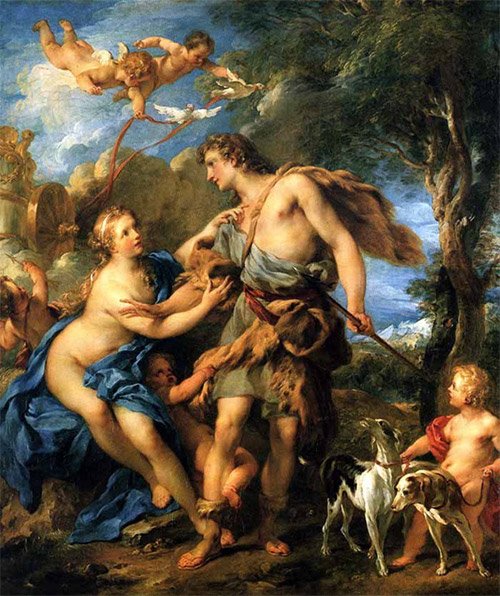 Aphrodite, who possessed a magic girdle that made its wearer an object of desire for everyone who saw her, was always happy to help young lovers. She took particular delight in causing her fellow Olympians to fall in love with mortals. (Zeus paid her back in kind by making her fall in love with the mortal Anchises—and conceive the hero Aeneas.)
※girdle: something (as a belt or sash) that encircles or binds
Like the other gods and goddesses, however, Aphrodite also harshly punished those who refused to honor her properly (in her case, this meant celibates or others who withstood the pleasures of love). Hippolytus was just one of the mortals whom Aphrodite punished for denying himself erotic joys.
Hera, reconciled with her son Hephaestus(god of blacksmiths, sculptors, metallurgy, fire and volcanoes), arranged for him to marry the goddess of love. Zeus, Aphrodite's adoptive father, agreed. Unsurprisingly, the marriage of the enchantingly beautiful, sensual, and insatiable Aphrodite and the powerful, but gruff, ugly, and lame Hephaestus was not a happy one. Aphrodite could not confine her love to just one other. The goddess did not remain faithful to Hephaestus—not by a long shot. She had countless affairs with both gods and mortals.

Hephaestus
The most long-standing and significant of all of Aphrodite's lovers was Ares. But one night, the lovers tarried too long together. As Helius hitched up his golden chariot of the sun, he saw the lovers in Ares' palace in Thrace.
When Helius told Hephaestus what he had seen, the smith god forged an unbreakable bronze net and secretly attached it to the posts and sides of his bed. Then he bid Aphrodite adieu, saying he was going to relax on Lemnos for a while.
As soon as he had gone, Aphrodite sent for Ares. When the morning came, Hephaestus walked in—“Surprise! Hi, honey, I'm home!”—and found the two ensnared in the net. The cuckolded god quickly gathered all the other gods at his bedside to witness the shame of the naked, helpless couple and to heap ridicule upon them.
Hephaestus then demanded the return of the marriage gifts he had given to Zeus. But the ruler of the gods refused, calling the adultery a marital dispute and ridiculing Hephaestus as a fool for making it a public spectacle. (Hermes and Apollo snickered that they would gladly make such a public spectacle if it meant lying with Aphrodite.)
With his first glance at the naked goddess, Poseidon fell in love. So the sea god suggested that Ares should pay for the marriage gifts. Poseidon gladly offered to serve as guarantor: If Ares defaulted on the payment, Poseidon would pay the price and take Aphrodite as his wife. Ares did ultimately default on the debt, but Hephaestus—still smitten with his wife—did not really want a divorce at all, so he never brought it up again.


-------------Poseidon----------------------------------------Hermes-----------------------
Poseidon, however, was not the only god to envy Ares' position. Hermes too fell in love with naked Aphrodite. When Aphrodite spurned his advances, Hermes sought the help of Zeus. The king of gods dispatched an eagle to steal one of Aphrodite's sandals. To retrieve it, the goddess was forced to submit to Hermes. This union produced a double-sexed child: Hermaphroditus.
.jpg/170px-French_School,_Hermaphroditus,_from_a_Herculanese_fresco_(c.1800,_coloured_engraving).jpg)

------Hermaphroditus------------------ Dionysus---------------------------------
Aphrodite also slept with the youngest of gods, Dionysus. But Hera, who disapproved of Aphrodite's free ways, deformed their child Priapus. She made the boy incredibly ugly and endowed him with gargantuan genitals—an ironic comment on his mother's behavior.
---------------- Dionysus----------------------------------------------------------------------------------------------
Dionysus is the god of the grape harvest, winemaking and wine, of ritual madness, fertility, theatre and religious ecstasy in Greek mythology.
--------------------------------------------------------------------------------------------------------------------------
APHRODITE, ARES, AND CUPID

Cupid as son of Aphrodite, the Greek Goddess of Beauty and Ares, the Greek God of War, whose love affair represented an allegory of Love and War.
►Eros, Greek God of Love: Attributes and Themes:
Eros (Or Cupid), The Honey Thief: In “Idylls” of Theocritus (3rd century BC), the poet tells the tale of Cupid the honey thief, the child-god is stung by bees when he steals honey from their hive. He cries and runs to his mother, who laughs, and tells him that he also delivers the sting of love.
Eros and the Dolphin: In later art, Eros is often shown riding a dolphin. This may be a symbol representing how swiftly love moves.
Eros, the Blinfolded Minion: In the later satirical poets, he is represented as a blindfolded child, and this is a symbol of Love being blinkered and arbitrary.
Eros, the winged boy: He is also described a winged boy. This may suggest that lovers are flighty and likely to change their minds. He is just a boy, because love is irrational.
Eros’ symbols: The Arrow and the Torch: His symbols are the arrow and torch, because love is said to wound and inflame the heart”.
According to Ovid, Cupid carries two kinds of arrows, one with a sharp golden point, and the other with a blunt tip of lead.
A person wounded by the golden arrow is filled with uncontrollable desire, but the one struck by the lead feels aversion and desires only to flee.
-------------------------------------------------------------------------------------------------------------------------
arbitrary: not planned or chosen for a particular reason : not based on reason or evidence
blindfold: to cover the eyes of (a person) with a piece of cloth
aversion: a strong feeling of not liking something
gargantuan: very large in size or amount
genital: of or relating to the sexual organs
ensnare: to catch (an animal or person) in a trap or in a place from which there is no escape
spurn: to refuse to accept (someone or something) that you do not think deserves your respect, attention, affection.
adultery: sex between a married person and someone who is not that person's wife or husband
marital: of or relating to marriage
tarry: to be slow in going : to stay somewhere
snicker: to make a short, quiet laugh in a way that shows disrespect
erotic: relating to sex ;causing sexual feelings
celibacy: the state of not being married
metallurgy: a science that deals with the nature and uses of metal
insatiable: always wanting more : not able to be satisfied

沒有留言:
張貼留言