
.jpg/220px-Parco_della_Grotta_di_Posillipo5_(crop).jpg)

When writing the Aeneid,Virgil (or Vergil) drew from his studies on the Homeric epics of the Iliad and the Odyssey to help him create a national epic poem for the Roman people. Virgil used several characteristics associated with epic poetry, more specifically Homer's epics, including the use of hexameter verse, book division, lists of genealogies and underlying themes to draw parallels between the Romans and their cultural predecessors, the Greeks.
Similarities to the Odyssey
The first half of the Aeneid mimics the journey of Odysseus in several ways. Though the Odyssey takes course over the span of 24 books while the Aeneid replicates the happenings in the Odyssey in 6 books, there are several comparisons to make.
The Characters
Odysseus and Aeneas are both royalty, Odysseus being the king of Ithaca and Aeneas a Trojan prince. Without the help of divine intervention though, neither hero would have met his destiny, though there were opposing gods who wanted to delay and provide hardship for the heroes along the journey.Odysseus’ antagonist was Poseidon, the god of the sea, whom he angered by blinding Poseidon's son Polyphemus. In doing this, Poseidon's wrath was given every chance possible, especially with storms blowing the Greek ships off course, even destroying them. Hera was the goddess who used everything in her power to delay Aeneas from ever fulfilling his prophecy since Aeneas was a Trojan, and Hera that she was the most beautiful out of her, Athena and Hera. Storms caused by Hera also blow the Trojan fleet about and off course, which ultimately lands them at Carthage (leading to another reason for Hera to despise Aeneas and the Trojans).
Stories within a Story
The concept of a character narrating a story within the current story, providing subsequent layers, is seen in both the Aeneid and the Odyssey, more specifically the story of the heroes' journey up until that point in time, since both epics start in medias res, in the middle of things. With the story of Odysseus, the Greek washes up on the shores of Scheria, the land of the Phaeacians, whom hospitably take Odysseus in and ask him how he has come to their land. Odysseus spends Books IX through XII recounting his journey from Troy to where he was presently. In Aeneas' case, upon arrival in Carthage, Dido asked Aeneas to share his story, so Books II and III were narrating the fall of Troy and how Aeneas and his people arrived at Carthage.
The Journey
The ultimate purpose of both Aeneas and Odysseus is returning home, or in Aeneas' case, founding a new home.[6] Both heroes sail over the same sea, sometimes visiting the same locations and experiencing the same difficulties. In Book III of the Aeneid, Aeneas and his men come close to Scylla and Charybdis, as Odysseus and his men do in Book XII of the Odyssey, followed by the Trojans landing on the island of the Cyclopes, as Aeneas does in Book IV. Aeneas' crew had the fortune of not having the same fate as some in Odysseus' crew. Virgil also included an emaciated Greek named Achaemenides, who had sailed with Odysseus but had been left behind. The two heroes also make a katabasis into the Underworld to retrieve information from the deceased.
The Homecoming
Upon arrival in Ithaca, Odysseus is met with suitors in his home, destroying it and trying to win his wife, Penelope's hand. Odysseus proceeds to fight off these suitors, killing them so he can have his home back. Similarly, Aeneas is supposed to found his home in Latium and marry the princess Lavinia, where he is met with the army of Turnus, who was the king of Rutuli and Lavinia's leading suitor before Aeneas came along. Aeneas has to engage in a battle before he can finally rest in his newfound home.
Similarities to the Iliad
The second half of the Aeneid, Books VI through XII, follow similarly to what happens throughout the Iliad.
Absences of the Heroes
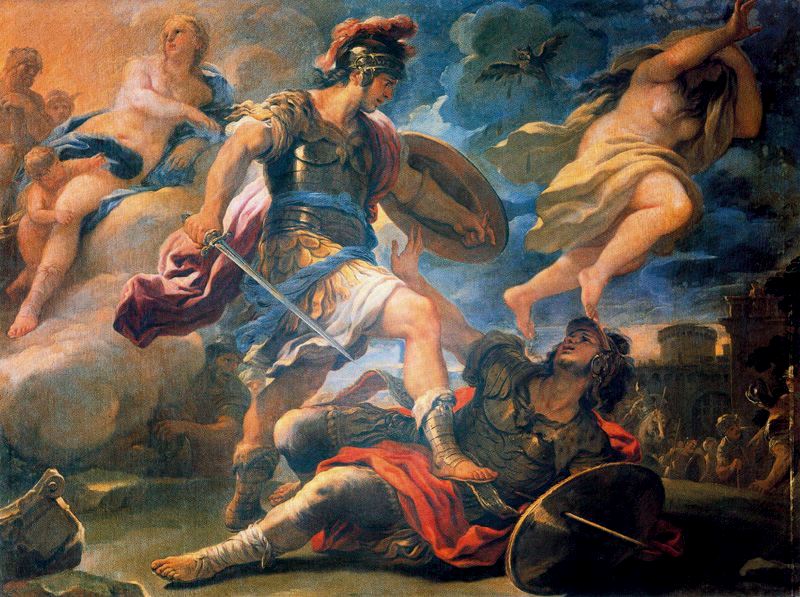
Book VI of the Aeneid reveals a prophecy for Aeneas by the Sibyl of Cumae stating that a Latin-born Achilles exists, who is also the son of a goddess (Aeneid, Book VI, lines 89–90)[1] exists. There are many scholarly debates on who this Latin-born Achilles is, whether he is Aeneas, Turnus, or some other character, and if so, is the opponent symbolic of another character from the Iliad?[citation needed] If comparing Aeneas to Achilles and Turnus to Hector, several parallels can be drawn. One example is when Aeneas is absent from the battlefield, Turnus lays waste to the Trojan army, just as Hector did to the Greek army in the absence of Achilles. Just as Hector kills Patroclus, Turnus slaughters Pallas, and to avenge the deaths of their friends, both Achilles and Aeneas slay their opponents.
Prophecies
Prophecies contribute a large theme among epics, especially that of the Iliad, the Odyssey and the Aeneid. From the beginning of the Iliad, readers knew that the Greeks were fated to triumph over the Trojans, as was declared by the king of the gods, Zeus. Achilles fate was also foretold; if he went to war he would die a hero. Similarly, Aeneas was told by the ghost of Hector in Book II that he was to leave burning Troy to found a new city.Throughout the rest of the epic, the gods include reminders that Aeneas is destined to find Italy and found Rome for future generations.
----------------------------------------------------------------------------------------------------------------------
Did Virgil Copy Homer?
fromPosted on 26/08/2011 by Maddy V-T
The Aeneid
Now, I know this is more of a literary question than a historical one, but why shouldn’t it be included? As everyone else on the blog can tell you, Classical Civilisation is my true passion (History is a very close second), and I thought I’d share some of that with our lovely readers.
When looking at The Aeneid, there is debate as to whether Virgil has simply plagiarised Homer’s works, written centuries before. It is argued that Virgil intended the Aeneid to be a tribute to Homer, while others say he’s manipulated Homer’s works to create his own. In particular, you can see many parallels between the storms in book one of The Aeneid and in books five and twelve of The Odyssey.
One of the most glaring similarities is the parts the gods play in the storms. All are started by a god who has something against the hero. However, there is a notable difference in that whilst Poseidon starts the storm, his Roman counterpart, Neptune, calms it.
----------------------------------------------------------------------------------------------------------------
“With that he marshalled the clouds and, seizing his trident in his hands, stirred up the sea.”
The Odyssey, Book 5
“These were his words and, before he had finished speaking, he was calming the swell…”
The Aeneid, Book 1
----------------------------------------------------------------------------------------------------------------
This is the main difference between the gods’ actions in the storms. Despite this, in both a god who supports the hero calms the storm Neptune in the Aeneid and Athene in the Odyssey.
Also, there is a goddess featured in both although, again, there is a role-reversal- Virgil’s goddess is the villain whilst Homer’s is a heroine.
On the same topic, Virgil’s portrayal of Juno makes her seem less omnipotent that Poseidon in the Odyssey. Whilst he doesn’t say that she can’t raise the storm by herself, she persuades another god to do so for her- Aeolus, King of the Winds. This makes her seems less powerful and more conniving, whereas Poseidon, as seen in the quote above, has no trouble raising a storm by himself.
Another similarity is the way the gods seem to be completely human, only with far more power than any human could ever have. All the gods shown in the storms- Poseidon, Athene, Juno, Aeolus and Neptune- all have their own motives and grudges.
---------------------------------------------------------------------------------------------------------------------
“The sight of Odysseus sailing over the seas enraged him.”
The Odyssey, Book 5
“He recognised the anger and cunning of his sister Juno…”
The Aeneid, Book 1
---------------------------------------------------------------------------------------------------------------------
This is a huge similarity between all Greek and Roman tales- the gods are far more human than we see our modern deities as. They fight with each other as any mortal would, they all have favourites and their family ties are as important as ours are. Since this is a feature of all literature and mythology from that period, it can’t be used to say that Virgil copied Homer.
The way the hero speaks and acts is also quite similar. For example, as the storms gain intensity, they act almost identically- “Odysseus’ knees shook and his spirit failed.” (The Odyssey, Book 5) “A sudden chill went through Aeneas and his legs grew weak.” (The Aeneid, Book 1)
What both heroes also do is make long, heartfelt speeches about their terrible plight and how they wish they’d died heroically at Troy, instead of the ignominious end that would come at sea. They wax lyrical about those who perished at Troy, Achilles mentioned by both. Here is an example of Virgil heavily borrowing from Homer.
Both of the gods who start the storms- Aeolus and Poseidon- use a long weapon to spark it off.
--------------------------------------------------------------------------------------------------------------------
“At these words he struck the side of the hollow mountain with the butt of his spear and the winds seemed to form a column and pour out through the open gate to blow a hurricane over the whole earth.”
The Aeneid, Book 1
“With that he marshalled the clouds and, seizing his trident in his hands, stirred up the sea.”
The Odyssey, Book 5
---------------------------------------------------------------------------------------------------------------------
The difference here is the way they start the storms- Poseidon uses his trident to stir up the sea, whilst Aeolus uses his spear to release the winds who do the stirring for him. However, despite using them in a different fashion, both use weapons to start the storm.
As he describes the winds, seas and skies, many of Virgil’s descriptions bear vast similarity to Homer’s. Amongst these, the most striking similarity is the whirlpool in the Odyssey and the waves in the Aeneid.
------------------------------------------------------------------------------------------------------------------------
“…the waters opened and in the troughs could bee seen the sea-bed and the seething sand.”
The Aeneid, Book 1
“…the awesome Charybdis sucked down the salt water in her dreadful way… and the dark blue sands of the sea-bed were exposed.”
The Odyssey, Book 12
------------------------------------------------------------------------------------------------------------------------
Other examples include the darkening of the sea.
In The Odyssey, Homer tells us ‘the sea was darkened by shadow’ and in The Aeneid, Virgil writes ‘black night brooded over the sea’.
★In my opinion, Virgil was intending for the reader to detect the similarities between his poem and the works of Homer- which all literate Romans would have learnt. He was using intertextuality to increase the reader’s enjoyment of the poem. However, I think that he could have achieved the same effect without taking as much from Homer as he did.
------------------------------------------------------------------------------------------------------------------------
Achilles and Patroclus
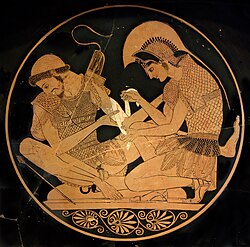
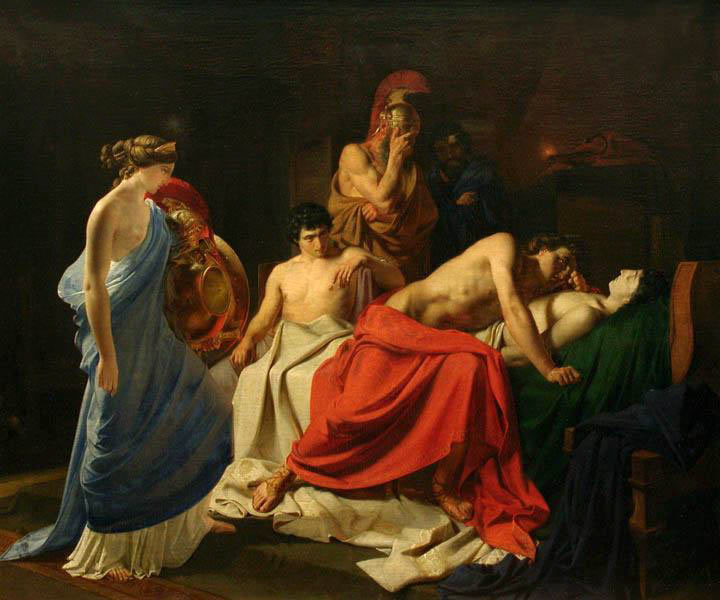
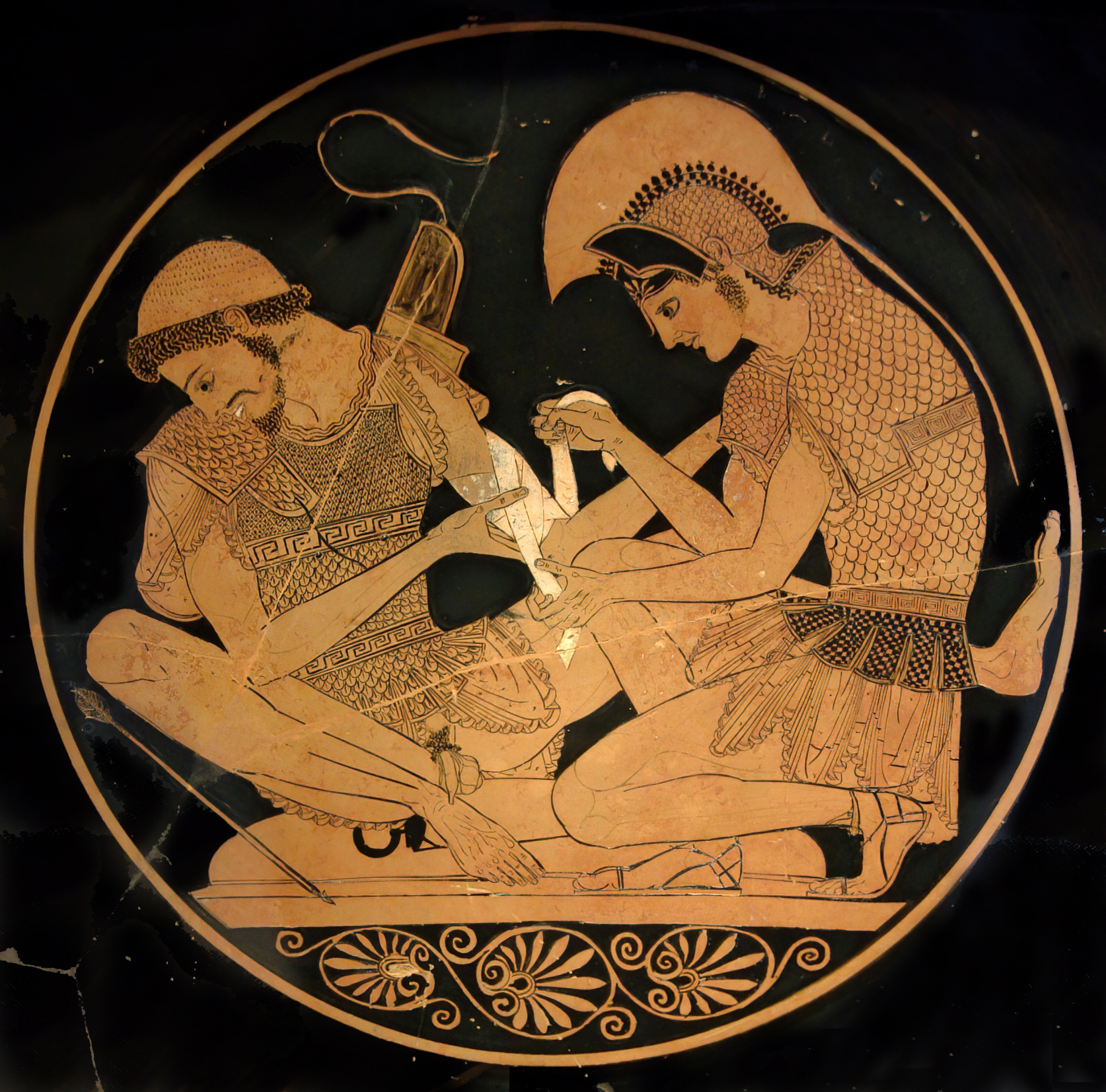
The relationship between Achilles and Patroclus is a key element of the myths associated with the Trojan War. Its exact nature has been a subject of dispute in both the classical period and modern times. In the Iliad, the two heroes have a deep and meaningful relationship. Achilles is tender towards Patroclus, while he is callous and arrogant towards others. In the Iliad Homer describes the friendship of Achilles and Patroclus.
In the Iliad
Due to this strong relationship, the death of Patroclus becomes the prime motivation for Achilles to return to battle. The friendship of Achilles and Patroclus is mentioned explicitly in the Iliad. Whether in the context of a tender friendship or military excellence, Homer makes their strong connection clear.
The death of Patroclus underpins a great deal of Achilles' actions and emotions toward the Trojan war for the rest of the poem. Achilles' strongest interpersonal bond is with Patroclus, whom he loves dearly. As Gregory Nagy points out,
For Achilles ... in his own ascending scale of affection as dramatized by the entire composition of the Iliad, the highest place must belong to Patroklos.... In fact Patroklos is for Achilles the πολὺ φίλτατος ... ἑταῖρος — the ‘hetaîros who is the most phílos by far’ (XVII 411, 655).
Hetaîros meant companion or comrade; in Homer it is usually used of soldiers under the same commander. While its feminine form would be used for courtesans, an hetaîros was still a form of soldier in Hellenistic and Byzantine times. In ancient texts, philos denoted a general type of love, used for love between family, between friends, a desire or enjoyment of an activity, as well as between lovers.
Although most warriors fought for personal fame or their city-state (including, at times, Achilles), at certain junctures in the Iliad, Achilles fights for Patroclus. He dreams that all Greeks would die so that he and Patroclus might gain the fame of conquering Troy alone .After Patroclus dies, Achilles agonizes, touching his dead body, smearing himself with ash, and fasting. He laments Patroclus' death using language very similar to that later used by Andromache of Hector. For a brief moment Achilles' character shifts from a strong and unbreakable warrior to an emotional and vulnerable character. However, Thetis motivates Achilles to return to the battlefield. Achilles returns to the battlefield with the sole aim of avenging Patroclus' death by killing Hector, Patroclus' killer, even though the gods had warned him that it would cost him his life.
Achilles' attachment to Patroclus is an archetypal male bond that occurs elsewhere in Greek culture: Alexander the Great and Hephaestion who made symbolic public references to Achilles and Patroclus, Damon and Pythias, Orestes and Pylades, Harmodius and Aristogeiton are pairs of comrades who gladly face danger and death for and beside each other.

沒有留言:
張貼留言