
Ship of Theseus
The ship wherein Theseus and the youth of Athens returned had thirty oars, and was preserved by the Athenians down even to the time of Demetrius Phalereus,for they took away the old planks as they decayed, putting in new and stronger timber in their place...
The ship had to be maintained in a seaworthy state, for, in return for Theseus's successful mission, the Athenians had pledged to honour Apollo every year henceforth. Thus, the Athenians sent a religious mission to the island of Delos (one of Apollo's most sacred sanctuaries) on the Athenian state galley – the ship itself – to pay their fealty to the god. To preserve the purity of the occasion, no executions were permitted between the time when the religious ceremony began to when the ship returned from Delos, which took several weeks.
To preserve the ship, any wood that wore out or rotted was replaced; it was, thus, unclear to philosophers how much of the original ship actually remained, giving rise to the philosophical question whether it should be considered "the same" ship or not. Such philosophical questions about the nature of identity are sometimes referred to as the Ship of Theseus Paradox.
Regardless of these issues of the originality of the ship's structure, for Athenians the preserved ship kept fresh their understanding that Theseus had been an actual, historic figure – which none then doubted – and gave them a tangible connection to their divine providence.
The myth of Theseus and the Minotaur
The myth of Theseus and the Minotaur is one of the most tragic and fascinating myths of the Greek Mythology.
Theseus, a genuine Greek hero of the Mythology and Minotaur, one of the most devastating and terrifying monsters are the main protagonists of a myth that involves gods and monsters, heroes and kings and two of the main city–states in the Hellenic world: Athens and Crete.
The Minotaur and the Labyrinth of Crete
The Minotaur was the son of Pasiphae, wife of King Minos of Crete.
Queen Pasiphae slept with a bull sent by Zeus, and gave birth to Minotaur, a creature half man – half bull. King Minos was embarrassed, but did not want to kill the Minotaur, so he hid the monster in the Labyrinth constructed by Daedalus at the Minoan Palace of Knossos.
According to the myth, Minos was imprisoning his enemies in the Labyrinth so that the Minotaur could eat them. The labyrinth was such a complicated construction that no one could ever find the way out alive.
Son of Minos, Androgeus, went to Athens to participate to the Panathenaic Games, but he was killed during the Marathon by the bull that impregnated his mother Pasiphae. Minos was infuriated, and demanded Aegeus the king of Athens to send seven men and women every year to the Minotaur to advert the plague caused by the death of Androgeus.
The third year, Theseus, son of Aegeus decided to be one of the seven young men that would go to Crete, in order to kill the Minotaur and end the human sacrifices to the monster. King Aegeus tried to make him change his mind but Theseus was determined to slay the Minotaur.
Theseus promised his father that he would put up white sails coming back from Crete, allowing him to know in advance that he was coming back alive. The boat would return with the black sails if Theseus was killed.
※labyrinth:something that is extremely complicated or difficult to understand
Theseus and the Minotaur
Theseus kills the Minotaur
Theseus announced to King Minos that he was going to kill the Monster, but Minos knew that even if he did manage to kill the Minotaur, Theseus would never be able to exit the Labyrinth.

Ariadne

Ariadne Giving Theseus a Ball of String to Find His Way Out of the Maze
Theseus met Princess Ariadne, daughter of King Minos, who fell madly in love with him and decided to help Theseus. She gave him a thread and told him to unravel it as he would penetrate deeper and deeper into the Labyrinth, so that he knows the way out when he kills the monster.
Theseus followed her suggestion and entered the labyrinth with the thread. Theseus managed to kill the Minotaur and save the Athenians, and with Ariadne’s thread he managed to retrace his way out.
Theseus took Princess Ariadne with him and left Crete sailing happily back to Athens.

Theseus and Ariadne
Aegeus and the Sails
Theseus’ boat stopped at Naxos and the Athenians had a long celebration dedicated to Theseus and Ariadne. After long hours of feasting and drinking, Ariadne fell asleep on the shore and didn’t enter the boat that sailed to Athens. Theseus figured out that Ariadne was not with them when it was too late and he was so upset that he forgot the promise made to his father and did not change the sails.

Ariadne Sleeping on the island of Naxos
King Aegeus was waiting at Cape Sounion to see the sails of the boat. He saw the black sails from afar and presumed his son was dead. He dropped himself to the waters, committing suicide and since then, this sea is called the Aegean Sea.
The myth of Theseus and the Minotaur has inspired numerous artists throughout the centuries, who have created paintings and sculptures dedicated to the myth and the hero of Athens.
-------------------------------------------------------------------------------------------------------------------------
The Apology of Socrates by Plato

Plato's The Apology is an account of the speech Socrates makes at the trial in which he is charged with not recognizing the gods recognized by the state, inventing new deities, and corrupting the youth of Athens. Socrates' speech, however, is by no means an "apology" in our modern understanding of the word. The name of the dialogue derives from the Greek "apologia," which translates as a defense, or a speech made in defense. Thus, in The Apology, Socrates attempts to defend himself and his conduct--certainly not to apologize for it.
For the most part, Socrates speaks in a very plain, conversational manner. He explains that he has no experience with the law courts and that he will instead speak in the manner to which he is accustomed: with honesty and directness. He explains that his behavior stems from a prophecy by the oracle at Delphi which claimed that he was the wisest of all men. Recognizing his ignorance in most worldly affairs, Socrates concluded that he must be wiser than other men only in that he knows that he knows nothing. In order to spread this peculiar wisdom, Socrates explains that he considered it his duty to question supposed "wise" men and to expose their false wisdom as ignorance. These activities earned him much admiration amongst the youth of Athens, but much hatred and anger from the people he embarrassed. He cites their contempt as the reason for his being put on trial.

※ Death of Socrates
Socrates then proceeds to interrogate Meletus, the man primarily responsible for bringing Socrates before the jury. This is the only instance in The Apology of the elenchus, or cross-examination, which is so central to most Platonic dialogues. His conversation with Meletus, however, is a poor example of this method, as it seems more directed toward embarrassing Meletus than toward arriving at the truth.
In a famous passage, Socrates likens himself to a gadfly stinging the lazy horse which is the Athenian state. Without him, Socrates claims, the state is liable to drift into a deep sleep, but through his influence--irritating as it may be to some--it can be wakened into productive and virtuous action.

Socrates is found guilty by a narrow margin and is asked to propose a penalty. Socrates jokingly suggests that if he were to get what he deserves, he should be honored with a great meal for being of such service to the state. On a more serious note, he rejects prison and exile, offering perhaps instead to pay a fine. When the jury rejects his suggestion and sentences him to death, Socrates stoically accepts the verdict with the observation that no one but the gods know what happens after death and so it would be foolish to fear what one does not know. He also warns the jurymen who voted against him that in silencing their critic rather than listening to him, they have harmed themselves much more than they have harmed him.
-------------------------------------------------------------------------------------------------------------------------
Odysseus's women
1.Nausicaa
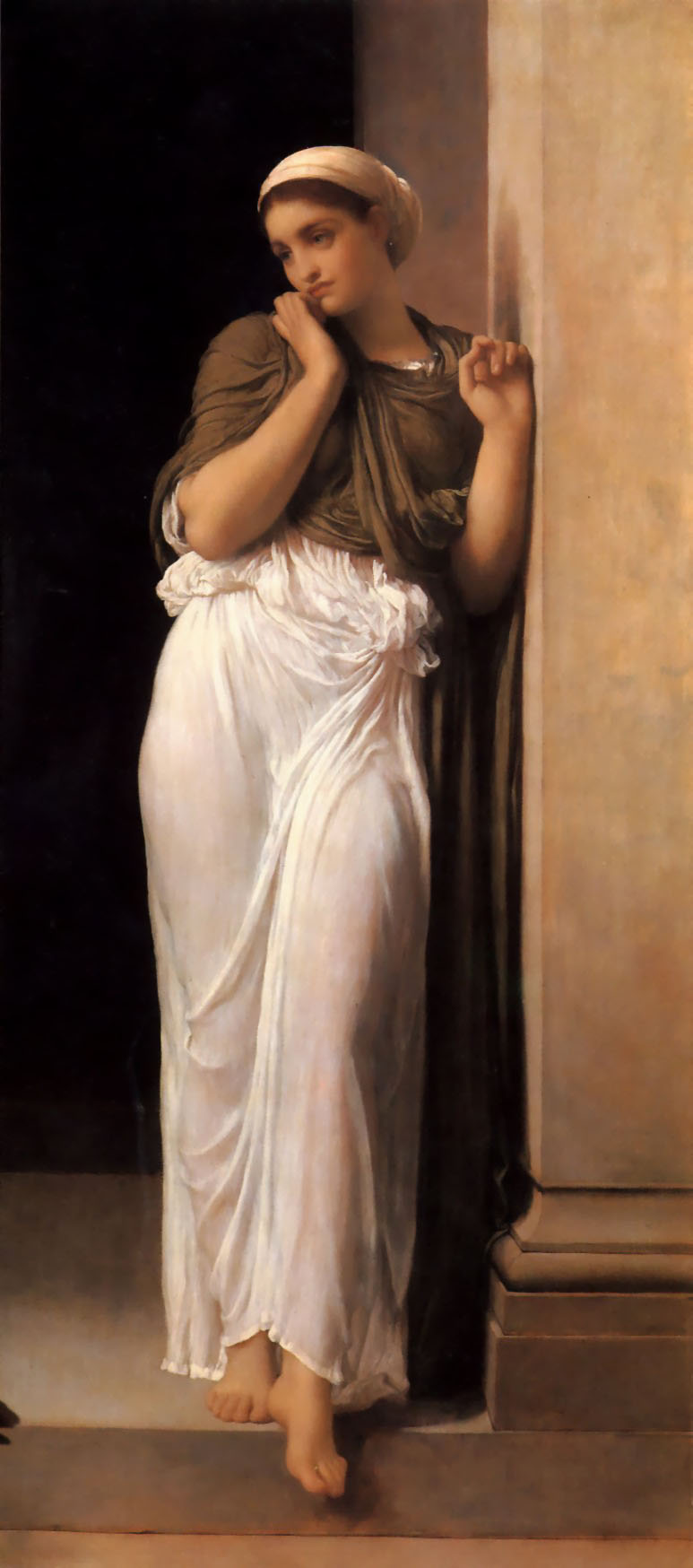
She is the daughter of King Alcinous and Queen Arete of Phaeacia. Her name, in Greek, means "burner of ships" .
In Book Six of the Odyssey, Odysseus is shipwrecked on the coast of the island of Scheria. Nausicaä and her handmaidens go to the sea-shore to wash clothes. Awoken by their games, Odysseus emerges from the forest completely naked, scaring the servants away, and begs Nausicaä for aid.
Nausicaä gives Odysseus some of the laundry to wear, and takes him to the edge of the town. Realizing that rumors might arise if Odysseus is seen with her, she and the servants go ahead into town. But first she advises Odysseus to go directly to Alcinous' house and make his case to Nausicaä's mother, Arete. Arete is known as wiser even than Alcinous, and Alcinous trusts her judgment. Odysseus follows this advice, approaching Arete and winning her approval, and is received as a guest by Alcinous.
During his stay, Odysseus recounts his adventures to Alcinous and his court. This recounting forms a substantial portion of the Odyssey. Alcinous then generously provides Odysseus with the ships that finally bring him home to Ithaca.
Nausicaä is young and very pretty; Odysseus says that she resembles a goddess, particularly Artemis. Nausicaä is known to have several brothers. According to Aristotle and Dictys of Crete, Nausicaä later married Telemachus, the son of Odysseus, and had a son named Ptoliporthus.
Homer gives a literary account of love never expressed. While she is presented as a potential love interest to Odysseus – she says to her friend that she would like her husband to be like him, and her father tells Odysseus he would let him marry her – no romantic relationship takes place between the pair. Nausicaä is also a mother figure for Odysseus; she ensures Odysseus' return home, and thus says "Never forget me, for I gave you life," indicating her status as a "new mother" in Odysseus' rebirth. Odysseus never tells Penelope about his encounter with Nausicaä, out of all the women he met on his long journey home. Some suggest this indicates a deeper level of feeling for the girl.

odysseus and nausicaa
--------------------------------------------------------------------------------------------------------------------
2.Circe

Circe was a powerful sorceress—variously described as a goddess, nymph, or witch—in Greek myth and legend. By most accounts, Circe was the daughter of Helios:[1] Titan of the Sun and Perse[1] the Oceanid. Her brothers were Aeetes, the keeper of the Golden Fleece, and Perses. Her sister was Pasiphaë, the wife of King Minos and mother of the Minotaur.[2] Other accounts make her the daughter of Hecate, the goddess of witchcraft herself.

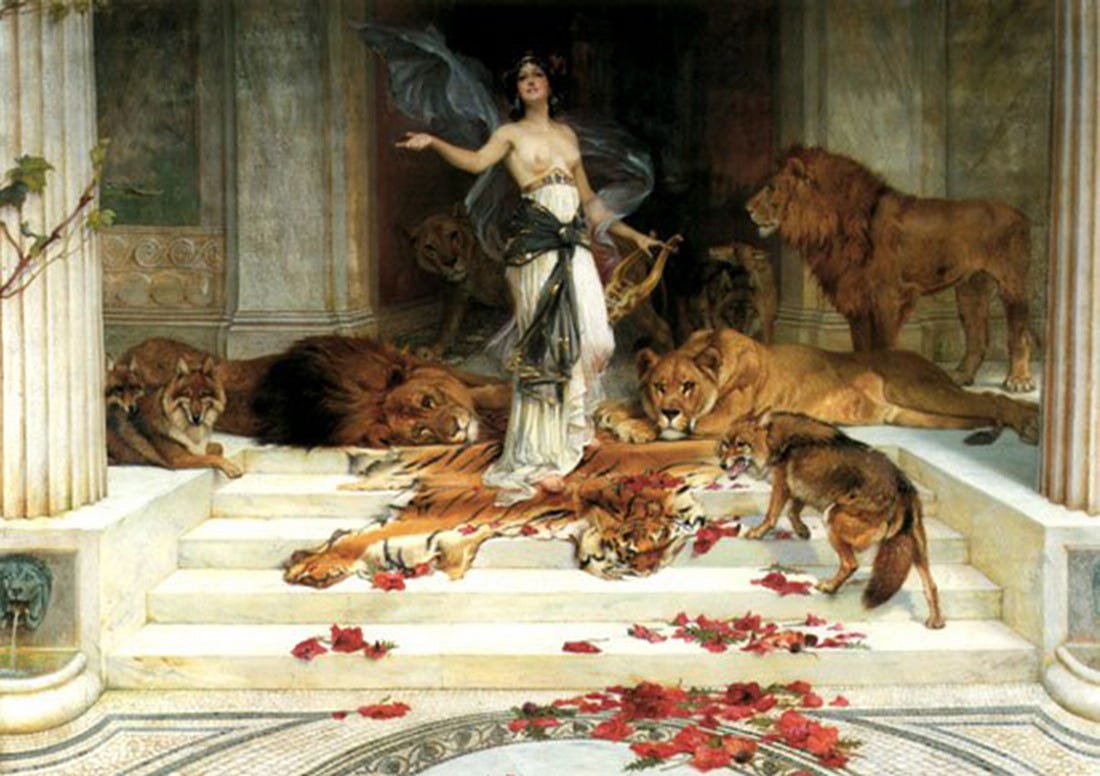
In Homer's Odyssey, Circe is described as living in a mansion that stands in the middle of a clearing in a dense wood. Around the house prowled strangely docile lions and wolves, the drugged victims of her magic;they were not dangerous, and fawned on all newcomers. Circe worked at a huge loom.She invited Odysseus' crew to a feast of familiar food, a pottage of cheese and meal, sweetened with honey and laced with wine, but also laced with one of her magical potions and drunk from an enchanted cup. Thus so she turned them all into swine with her magic wand or staff after they gorged themselves on it. Only drunken Eurylochus, suspecting treachery from the outset, escaped to warn Odysseus and the others who had stayed behind at the ship. Odysseus set out to rescue his men, but was intercepted by the messenger god, Hermes, who had been sent by Athena. Hermes told Odysseus to use the holy herb moly to protect himself from Circe's potion and, having resisted it, to draw his sword and act as if he were to attack Circe. From there, Circe would ask him to bed, but Hermes advised caution, for even there the goddess would be treacherous. She would take his manhood unless he had her swear by the names of the gods that she would not.
Odysseus followed Hermes' advice, freeing his men and then remained on the island for one year, feasting and drinking wine. According to Homer, Circe suggested two alternative routes to Odysseus to return to Ithaca: toward Planctae, the "Wandering Rocks", or
passing between the dangerous Scylla and the whirlpool-like Charybdis,
conventionally identified with the Strait of Messina. She also advised Odysseus to go to the Underworld and gave him directions.
-------------------------------------------------------------------------------------------------------------------------
※nymph: a spirit in the shape of a young woman who lives in mountains, forests, meadows, and water
※docile: easily taught, led, or controlled
※drug: to give a drug to (a person or animal) in order to make that person or animal very sleepy or unconscious
※pottage: a thick soup of vegetables and often meat
※gorge:to eat greedily or to repletion
※moly: a mythical herb with a black root, white blossoms, and magical powers
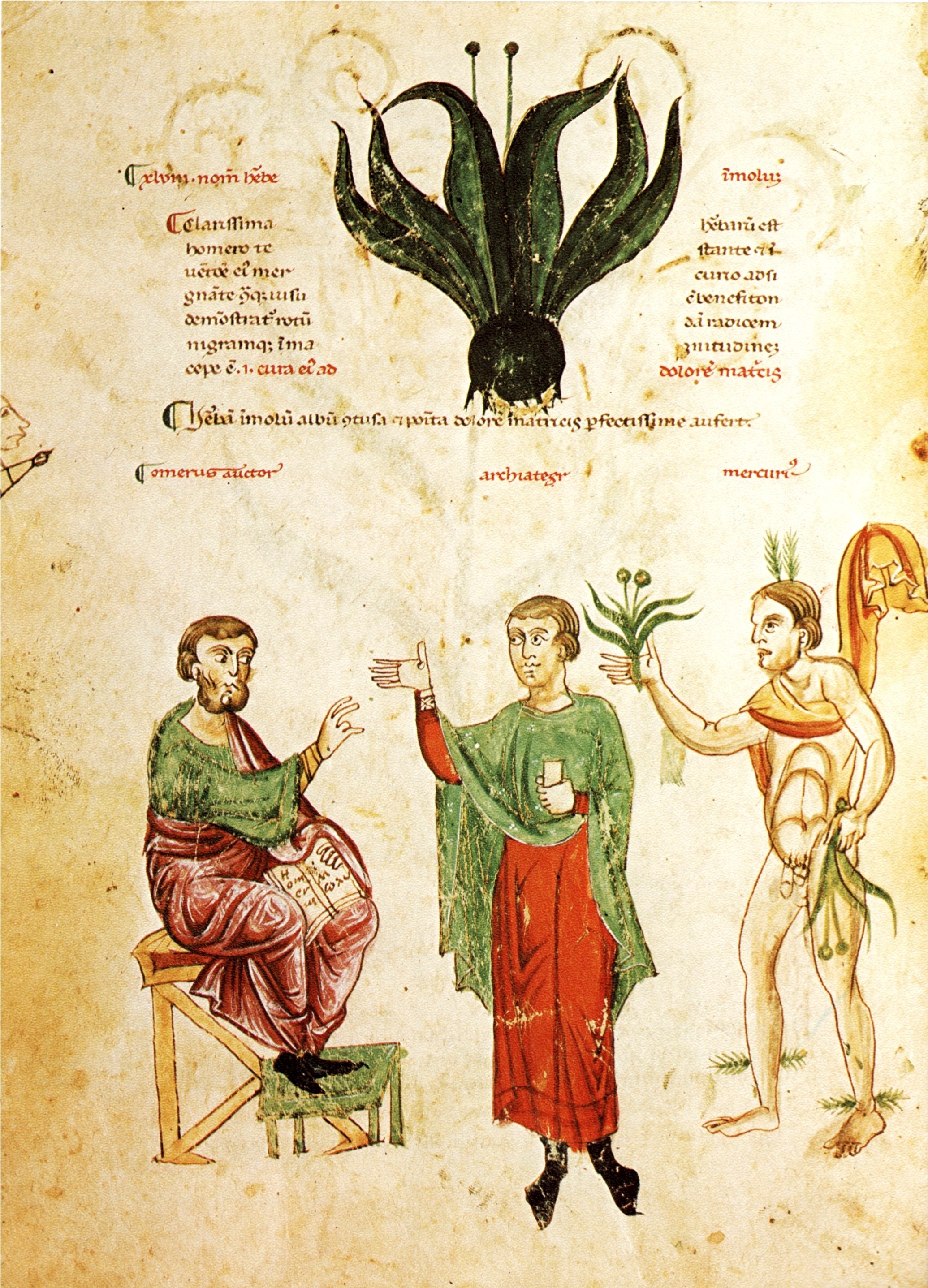
moly
※treachery:violation of allegiance or of faith and confidence
※fawn:to court favor by a cringing or flattering manner
-----------------------------------------------------------------------------------------------------------------------
3.Calypso

Calypso was a nymph in Greek mythology, who lived on the island of Ogygia, where she detained Odysseus for several years. She is generally said to be the daughter of the Titan Atlas.
Hesiod, and the Homeric Hymn to Demeter, mention either a different Calypso or possibly the same Calypso as one of the Oceanid daughters of Tethys and Oceanus. Apollodorus includes the name Calypso in his list of Nereids, the daughters of Nereus and Doris.

Calypso is remembered most for her role in Homer's Odyssey, in which she keeps the fabled Greek hero Odysseus on her island to make him her immortal husband. According to Homer, Calypso kept Odysseus prisoner at Ogygia for seven years.Calypso enchants Odysseus with her singing as she moves to and fro, weaving on her loom with a golden shuttle. During this time they sleep together, although Odysseus soon comes to wish for circumstances to change.
Odysseus can no longer bear being separated from his wife Penelope and wants to go to Calypso to tell her. His patron goddess Athena asks Zeus to order the release of Odysseus from the island, and Zeus orders the messenger Hermes to tell Calypso to set Odysseus free, for it was not his destiny to live with her forever. She angrily comments on how the gods hate goddesses having affairs with mortals, but eventually concedes, sending Odysseus on his way after providing him with wine, bread, and the materials for a raft.

Homer does not mention any children by Calypso. By some accounts, which come after the Odyssey, Calypso bore Odysseus a son, Latinus, though Circe is usually given as Latinus' mother.
In other accounts Calypso bore Odysseus two children, Nausithous and Nausinous.
-----------------------------------------------------------------------------------------------------------------------
God's will+Moirai(The fate ,destiny)+Catharsis
Moirai

In Greek mythology, the Moirai or Moerae , often known in English as the Fates , were the white-robed incarnations of destiny; their Roman equivalent was the Parcae (euphemistically the "sparing ones"). Their number became fixed at three: Clotho (spinner), Lachesis (allotter) and Atropos (unturnable).

They controlled the mother thread of life of every mortal from birth to death. They were independent, at the helm of necessity, directed fate, and watched that the fate assigned to every being by eternal laws might take its course without obstruction. The gods and men had to submit to them, although Zeus's relationship with them is a matter of debate: some sources say he is the only one who can command them , yet others suggest he was also bound to the Moirai's dictates.In the Homeric poems Moira or Aisa, is related with the limit and end of life, and Zeus appears as the guider of destiny. In the Theogony of Hesiod, the three Moirai are personified, daughters of Nyx and are acting over the gods.Later they are daughters of Zeus and Themis, who was the embodiment of divine order and law. In Plato's Republic the Three Fates are daughters of Ananke (necessity).

It seems that Moira is related with Tekmor (proof, ordinance) and with Ananke (destiny, necessity), who were primeval goddesses in mythical cosmogonies. The ancient Greek writers might call this power Moira or Ananke, and even the gods could not alter what was ordained.The concept of a universal principle of natural order has been compared to similar concepts in other cultures like the Vedic Rta, the Avestan Asha (Arta) and the Egyptian Maat.
In earliest Greek philosophy, the cosmogony of Anaximander is based on these mythical beliefs. The goddess Dike (justice, divine retribution), keeps the order and sets a limit to any actions.
Clotho ( "spinner") spun the thread of life from her Distaff onto her Spindle. Her Roman equivalent was Nona, who was originally a goddess called upon in the ninth month of pregnancy.
Lachesis ("allotter" or drawer of lots) measured the thread of life allotted to each person with her measuring rod. Her Roman equivalent was Decima (the 'Tenth').
Atropos ( "inexorable" or "inevitable", literally "unturning", sometimes called Aisa) was the cutter of the thread of life. She chose the manner of each person's death; and when their time was come, she cut their life-thread with "her abhorred shears".Her Roman equivalent was Morta ('Dead One').
-------------------------------------------------------------------------------------------------------------------------
※primeval: very old or ancient; basic and powerful
※cosmogony: a theory of the origin of the universe
※ordain:to establish or order by appointment, decree, or law
※allortter:to give someone (an amount of something) to use or have
※incarnation:a concrete or actual form of a quality or concept; especially a person showing a trait or typical character to a marked degree
※abhor:to dislike (someone or something) very much
※shear: to cut off
----------------------------------------------------------------------------------------------------------------------
SOCRATES, PLATO, AND ARISTOTLE: THE BIG THREE IN GREEK PHILOSOPHY

SOCRATES: ATHENS’ STREET-CORNER PHILOSOPHER
Socrates was the big-city philosopher in ancient Athens. Accused and convicted of corrupting the youth, his only real crime was embarrassing and irritating a number of important people. His punishment was death.
Famous quote: “The unexamined life is not worth living.”
Socrates didn’t write books; he just liked to ask probing and sometimes humiliating questions, which gave rise to the famous Socratic Method of Teaching. This street-corner philosopher made a career of deflating pompous windbags.
PLATO: THE PHILOSOPHER WHO WOULD BE KING
An aristocratic man with plenty of money and a superb physique, Plato at one time won two prizes as a championship wrestler. Actually, the man’s real (and little known) name was Aristocles; Plato was just a nickname given to him by his friends, whose original connotation made reference to his broad shoulders.
Plato became an enthusiastic and talented student of Socrates and wrote famous dialogues featuring his teacher verbally grappling with opponents. Our wrestler believed in the pre-existence and immortality of the soul, holding that life is nothing more than the imprisonment of the soul in a body. In addition to the physical world, there is a heavenly realm of greater reality consisting in Forms, Ideals, or Ideas (such as Equality, Justice, Humanity, and so on).
As his crowning achievement: He wrote a famous treatise (The Republic) on the ideal society, in which he expressed the thought that a philosopher, of all people, who should be king (big surprise!).
ARISTOTLE: A LONG WALK TO THE GOLDEN MEAN
Aristotle was Plato’s best student. He went on to become the very well-paid tutor of Alexander the Great — probably the highest paid philosopher in history. Aristotle started his own philosophical school when he was 50 years old. Although he lived only ten more years, he produced nearly a thousand books and pamphlets, only a few of which have survived.

This great thinker was called a peripatetic philosopher (peripateo = “to walk around”) because he liked to lecture to his students while taking a walk. Another group of philosophers were called stoics because they preferred sitting around on porches when they shot the breeze.
A key theme in Aristotle’s thought is that happiness is the goal of life. Aristotle was a good deal less other-worldly than Plato. He voluntarily went into exile from Athens when conditions became a bit politically dangerous for him, in his words, “lest Athens sin twice against philosophy.”
The founder of logical theory, Aristotle believed that the greatest human endeavor is the use of reason in theoretical activity. One of his best known ideas was his conception of “The Golden Mean” — “avoid extremes,” the counsel of moderation in all things.
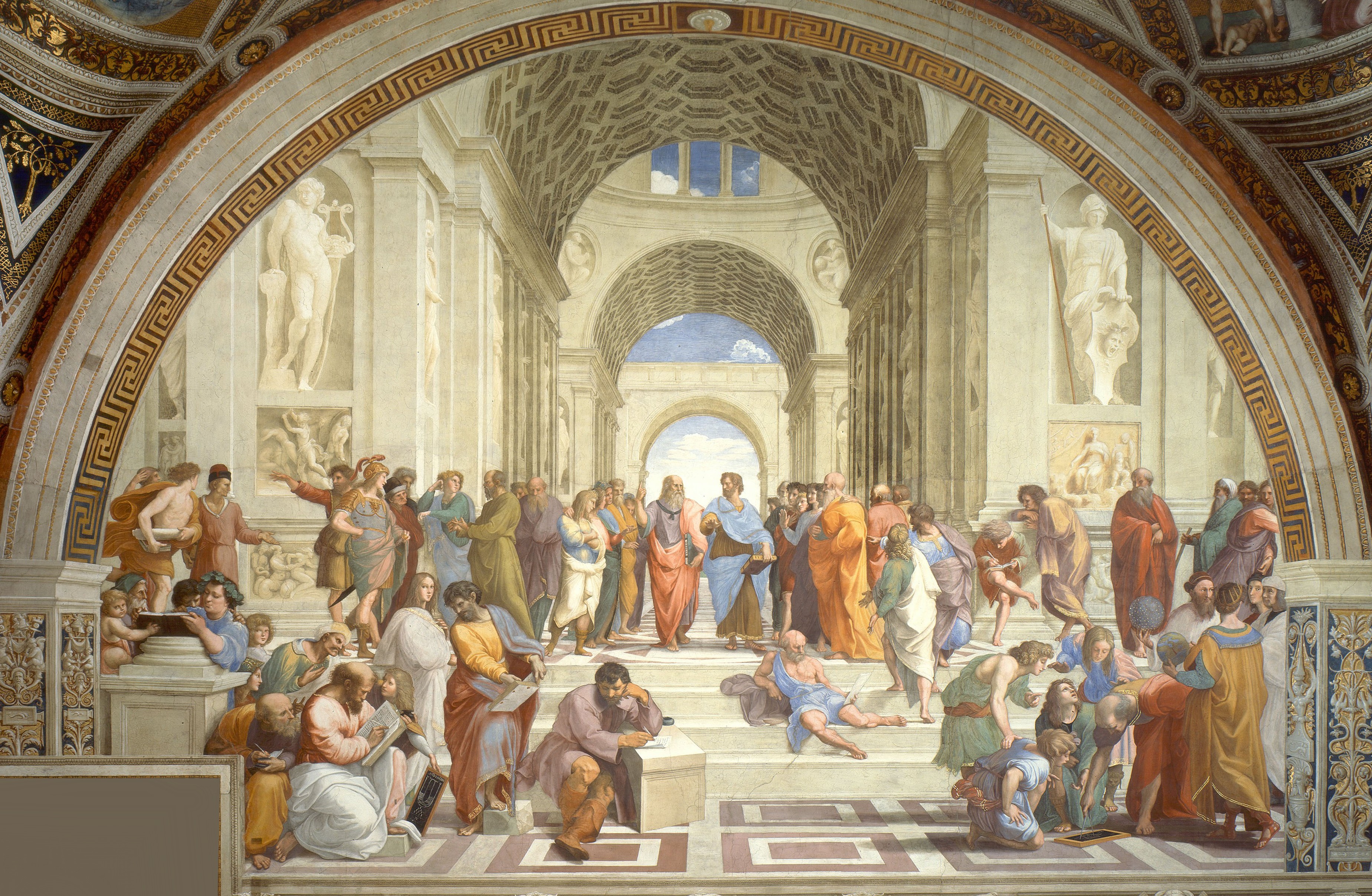
Raphael's School of Athens.
 |
| Theseus and the Minotaur |
The myth of Theseus and the Minotaur
The myth of Theseus and the Minotaur is one of the most tragic and fascinating myths of the Greek Mythology.
Theseus, a genuine Greek hero of the Mythology and Minotaur, one of the most devastating and terrifying monsters are the main protagonists of a myth that involves gods and monsters, heroes and kings and two of the main city–states in the Hellenic world: Athens and Crete.
The Minotaur and the Labyrinth of Crete
The Minotaur was the son of Pasiphae, wife of King Minos of Crete.
Queen Pasiphae slept with a bull sent by Zeus, and gave birth to Minotaur, a creature half man – half bull. King Minos was embarrassed, but did not want to kill the Minotaur, so he hid the monster in the Labyrinth constructed by Daedalus at the Minoan Palace of Knossos.
According to the myth, Minos was imprisoning his enemies in the Labyrinth so that the Minotaur could eat them. The labyrinth was such a complicated construction that no one could ever find the way out alive.
Son of Minos, Androgeus, went to Athens to participate to the Panathenaic Games, but he was killed during the Marathon by the bull that impregnated his mother Pasiphae. Minos was infuriated, and demanded Aegeus the king of Athens to send seven men and women every year to the Minotaur to advert the plague caused by the death of Androgeus.
The third year, Theseus, son of Aegeus decided to be one of the seven young men that would go to Crete, in order to kill the Minotaur and end the human sacrifices to the monster. King Aegeus tried to make him change his mind but Theseus was determined to slay the Minotaur.
Theseus promised his father that he would put up white sails coming back from Crete, allowing him to know in advance that he was coming back alive. The boat would return with the black sails if Theseus was killed.
※labyrinth:something that is extremely complicated or difficult to understand
Theseus and the Minotaur
Theseus kills the Minotaur
Theseus announced to King Minos that he was going to kill the Monster, but Minos knew that even if he did manage to kill the Minotaur, Theseus would never be able to exit the Labyrinth.
Ariadne
Ariadne Giving Theseus a Ball of String to Find His Way Out of the Maze
Theseus met Princess Ariadne, daughter of King Minos, who fell madly in love with him and decided to help Theseus. She gave him a thread and told him to unravel it as he would penetrate deeper and deeper into the Labyrinth, so that he knows the way out when he kills the monster.
Theseus followed her suggestion and entered the labyrinth with the thread. Theseus managed to kill the Minotaur and save the Athenians, and with Ariadne’s thread he managed to retrace his way out.
Theseus took Princess Ariadne with him and left Crete sailing happily back to Athens.
Theseus and Ariadne
Aegeus and the Sails
Theseus’ boat stopped at Naxos and the Athenians had a long celebration dedicated to Theseus and Ariadne. After long hours of feasting and drinking, Ariadne fell asleep on the shore and didn’t enter the boat that sailed to Athens. Theseus figured out that Ariadne was not with them when it was too late and he was so upset that he forgot the promise made to his father and did not change the sails.
Ariadne Sleeping on the island of Naxos
King Aegeus was waiting at Cape Sounion to see the sails of the boat. He saw the black sails from afar and presumed his son was dead. He dropped himself to the waters, committing suicide and since then, this sea is called the Aegean Sea.
The myth of Theseus and the Minotaur has inspired numerous artists throughout the centuries, who have created paintings and sculptures dedicated to the myth and the hero of Athens.
-------------------------------------------------------------------------------------------------------------------------
The Apology of Socrates by Plato
Plato's The Apology is an account of the speech Socrates makes at the trial in which he is charged with not recognizing the gods recognized by the state, inventing new deities, and corrupting the youth of Athens. Socrates' speech, however, is by no means an "apology" in our modern understanding of the word. The name of the dialogue derives from the Greek "apologia," which translates as a defense, or a speech made in defense. Thus, in The Apology, Socrates attempts to defend himself and his conduct--certainly not to apologize for it.
For the most part, Socrates speaks in a very plain, conversational manner. He explains that he has no experience with the law courts and that he will instead speak in the manner to which he is accustomed: with honesty and directness. He explains that his behavior stems from a prophecy by the oracle at Delphi which claimed that he was the wisest of all men. Recognizing his ignorance in most worldly affairs, Socrates concluded that he must be wiser than other men only in that he knows that he knows nothing. In order to spread this peculiar wisdom, Socrates explains that he considered it his duty to question supposed "wise" men and to expose their false wisdom as ignorance. These activities earned him much admiration amongst the youth of Athens, but much hatred and anger from the people he embarrassed. He cites their contempt as the reason for his being put on trial.
※ Death of Socrates
Socrates then proceeds to interrogate Meletus, the man primarily responsible for bringing Socrates before the jury. This is the only instance in The Apology of the elenchus, or cross-examination, which is so central to most Platonic dialogues. His conversation with Meletus, however, is a poor example of this method, as it seems more directed toward embarrassing Meletus than toward arriving at the truth.
In a famous passage, Socrates likens himself to a gadfly stinging the lazy horse which is the Athenian state. Without him, Socrates claims, the state is liable to drift into a deep sleep, but through his influence--irritating as it may be to some--it can be wakened into productive and virtuous action.
Socrates is found guilty by a narrow margin and is asked to propose a penalty. Socrates jokingly suggests that if he were to get what he deserves, he should be honored with a great meal for being of such service to the state. On a more serious note, he rejects prison and exile, offering perhaps instead to pay a fine. When the jury rejects his suggestion and sentences him to death, Socrates stoically accepts the verdict with the observation that no one but the gods know what happens after death and so it would be foolish to fear what one does not know. He also warns the jurymen who voted against him that in silencing their critic rather than listening to him, they have harmed themselves much more than they have harmed him.
-------------------------------------------------------------------------------------------------------------------------
Odysseus's women
1.Nausicaa
She is the daughter of King Alcinous and Queen Arete of Phaeacia. Her name, in Greek, means "burner of ships" .
In Book Six of the Odyssey, Odysseus is shipwrecked on the coast of the island of Scheria. Nausicaä and her handmaidens go to the sea-shore to wash clothes. Awoken by their games, Odysseus emerges from the forest completely naked, scaring the servants away, and begs Nausicaä for aid.
Nausicaä gives Odysseus some of the laundry to wear, and takes him to the edge of the town. Realizing that rumors might arise if Odysseus is seen with her, she and the servants go ahead into town. But first she advises Odysseus to go directly to Alcinous' house and make his case to Nausicaä's mother, Arete. Arete is known as wiser even than Alcinous, and Alcinous trusts her judgment. Odysseus follows this advice, approaching Arete and winning her approval, and is received as a guest by Alcinous.
During his stay, Odysseus recounts his adventures to Alcinous and his court. This recounting forms a substantial portion of the Odyssey. Alcinous then generously provides Odysseus with the ships that finally bring him home to Ithaca.
Nausicaä is young and very pretty; Odysseus says that she resembles a goddess, particularly Artemis. Nausicaä is known to have several brothers. According to Aristotle and Dictys of Crete, Nausicaä later married Telemachus, the son of Odysseus, and had a son named Ptoliporthus.
Homer gives a literary account of love never expressed. While she is presented as a potential love interest to Odysseus – she says to her friend that she would like her husband to be like him, and her father tells Odysseus he would let him marry her – no romantic relationship takes place between the pair. Nausicaä is also a mother figure for Odysseus; she ensures Odysseus' return home, and thus says "Never forget me, for I gave you life," indicating her status as a "new mother" in Odysseus' rebirth. Odysseus never tells Penelope about his encounter with Nausicaä, out of all the women he met on his long journey home. Some suggest this indicates a deeper level of feeling for the girl.
odysseus and nausicaa
--------------------------------------------------------------------------------------------------------------------
2.Circe
Circe was a powerful sorceress—variously described as a goddess, nymph, or witch—in Greek myth and legend. By most accounts, Circe was the daughter of Helios:[1] Titan of the Sun and Perse[1] the Oceanid. Her brothers were Aeetes, the keeper of the Golden Fleece, and Perses. Her sister was Pasiphaë, the wife of King Minos and mother of the Minotaur.[2] Other accounts make her the daughter of Hecate, the goddess of witchcraft herself.
In Homer's Odyssey, Circe is described as living in a mansion that stands in the middle of a clearing in a dense wood. Around the house prowled strangely docile lions and wolves, the drugged victims of her magic;they were not dangerous, and fawned on all newcomers. Circe worked at a huge loom.She invited Odysseus' crew to a feast of familiar food, a pottage of cheese and meal, sweetened with honey and laced with wine, but also laced with one of her magical potions and drunk from an enchanted cup. Thus so she turned them all into swine with her magic wand or staff after they gorged themselves on it. Only drunken Eurylochus, suspecting treachery from the outset, escaped to warn Odysseus and the others who had stayed behind at the ship. Odysseus set out to rescue his men, but was intercepted by the messenger god, Hermes, who had been sent by Athena. Hermes told Odysseus to use the holy herb moly to protect himself from Circe's potion and, having resisted it, to draw his sword and act as if he were to attack Circe. From there, Circe would ask him to bed, but Hermes advised caution, for even there the goddess would be treacherous. She would take his manhood unless he had her swear by the names of the gods that she would not.
Odysseus followed Hermes' advice, freeing his men and then remained on the island for one year, feasting and drinking wine. According to Homer, Circe suggested two alternative routes to Odysseus to return to Ithaca: toward Planctae, the "Wandering Rocks", or
passing between the dangerous Scylla and the whirlpool-like Charybdis,
conventionally identified with the Strait of Messina. She also advised Odysseus to go to the Underworld and gave him directions.
-------------------------------------------------------------------------------------------------------------------------
※nymph: a spirit in the shape of a young woman who lives in mountains, forests, meadows, and water
※docile: easily taught, led, or controlled
※drug: to give a drug to (a person or animal) in order to make that person or animal very sleepy or unconscious
※pottage: a thick soup of vegetables and often meat
※gorge:to eat greedily or to repletion
※moly: a mythical herb with a black root, white blossoms, and magical powers
moly
※treachery:violation of allegiance or of faith and confidence
※fawn:to court favor by a cringing or flattering manner
-----------------------------------------------------------------------------------------------------------------------
3.Calypso
Calypso was a nymph in Greek mythology, who lived on the island of Ogygia, where she detained Odysseus for several years. She is generally said to be the daughter of the Titan Atlas.
Hesiod, and the Homeric Hymn to Demeter, mention either a different Calypso or possibly the same Calypso as one of the Oceanid daughters of Tethys and Oceanus. Apollodorus includes the name Calypso in his list of Nereids, the daughters of Nereus and Doris.
Calypso is remembered most for her role in Homer's Odyssey, in which she keeps the fabled Greek hero Odysseus on her island to make him her immortal husband. According to Homer, Calypso kept Odysseus prisoner at Ogygia for seven years.Calypso enchants Odysseus with her singing as she moves to and fro, weaving on her loom with a golden shuttle. During this time they sleep together, although Odysseus soon comes to wish for circumstances to change.
Odysseus can no longer bear being separated from his wife Penelope and wants to go to Calypso to tell her. His patron goddess Athena asks Zeus to order the release of Odysseus from the island, and Zeus orders the messenger Hermes to tell Calypso to set Odysseus free, for it was not his destiny to live with her forever. She angrily comments on how the gods hate goddesses having affairs with mortals, but eventually concedes, sending Odysseus on his way after providing him with wine, bread, and the materials for a raft.
Homer does not mention any children by Calypso. By some accounts, which come after the Odyssey, Calypso bore Odysseus a son, Latinus, though Circe is usually given as Latinus' mother.
In other accounts Calypso bore Odysseus two children, Nausithous and Nausinous.
-----------------------------------------------------------------------------------------------------------------------
God's will+Moirai(The fate ,destiny)+Catharsis
Moirai
In Greek mythology, the Moirai or Moerae , often known in English as the Fates , were the white-robed incarnations of destiny; their Roman equivalent was the Parcae (euphemistically the "sparing ones"). Their number became fixed at three: Clotho (spinner), Lachesis (allotter) and Atropos (unturnable).
They controlled the mother thread of life of every mortal from birth to death. They were independent, at the helm of necessity, directed fate, and watched that the fate assigned to every being by eternal laws might take its course without obstruction. The gods and men had to submit to them, although Zeus's relationship with them is a matter of debate: some sources say he is the only one who can command them , yet others suggest he was also bound to the Moirai's dictates.In the Homeric poems Moira or Aisa, is related with the limit and end of life, and Zeus appears as the guider of destiny. In the Theogony of Hesiod, the three Moirai are personified, daughters of Nyx and are acting over the gods.Later they are daughters of Zeus and Themis, who was the embodiment of divine order and law. In Plato's Republic the Three Fates are daughters of Ananke (necessity).
It seems that Moira is related with Tekmor (proof, ordinance) and with Ananke (destiny, necessity), who were primeval goddesses in mythical cosmogonies. The ancient Greek writers might call this power Moira or Ananke, and even the gods could not alter what was ordained.The concept of a universal principle of natural order has been compared to similar concepts in other cultures like the Vedic Rta, the Avestan Asha (Arta) and the Egyptian Maat.
In earliest Greek philosophy, the cosmogony of Anaximander is based on these mythical beliefs. The goddess Dike (justice, divine retribution), keeps the order and sets a limit to any actions.
Clotho ( "spinner") spun the thread of life from her Distaff onto her Spindle. Her Roman equivalent was Nona, who was originally a goddess called upon in the ninth month of pregnancy.
Lachesis ("allotter" or drawer of lots) measured the thread of life allotted to each person with her measuring rod. Her Roman equivalent was Decima (the 'Tenth').
Atropos ( "inexorable" or "inevitable", literally "unturning", sometimes called Aisa) was the cutter of the thread of life. She chose the manner of each person's death; and when their time was come, she cut their life-thread with "her abhorred shears".Her Roman equivalent was Morta ('Dead One').
-------------------------------------------------------------------------------------------------------------------------
※primeval: very old or ancient; basic and powerful
※cosmogony: a theory of the origin of the universe
※ordain:to establish or order by appointment, decree, or law
※allortter:to give someone (an amount of something) to use or have
※incarnation:a concrete or actual form of a quality or concept; especially a person showing a trait or typical character to a marked degree
※abhor:to dislike (someone or something) very much
※shear: to cut off
----------------------------------------------------------------------------------------------------------------------
SOCRATES, PLATO, AND ARISTOTLE: THE BIG THREE IN GREEK PHILOSOPHY
SOCRATES: ATHENS’ STREET-CORNER PHILOSOPHER
Socrates was the big-city philosopher in ancient Athens. Accused and convicted of corrupting the youth, his only real crime was embarrassing and irritating a number of important people. His punishment was death.
Famous quote: “The unexamined life is not worth living.”
Socrates didn’t write books; he just liked to ask probing and sometimes humiliating questions, which gave rise to the famous Socratic Method of Teaching. This street-corner philosopher made a career of deflating pompous windbags.
PLATO: THE PHILOSOPHER WHO WOULD BE KING
An aristocratic man with plenty of money and a superb physique, Plato at one time won two prizes as a championship wrestler. Actually, the man’s real (and little known) name was Aristocles; Plato was just a nickname given to him by his friends, whose original connotation made reference to his broad shoulders.
Plato became an enthusiastic and talented student of Socrates and wrote famous dialogues featuring his teacher verbally grappling with opponents. Our wrestler believed in the pre-existence and immortality of the soul, holding that life is nothing more than the imprisonment of the soul in a body. In addition to the physical world, there is a heavenly realm of greater reality consisting in Forms, Ideals, or Ideas (such as Equality, Justice, Humanity, and so on).
As his crowning achievement: He wrote a famous treatise (The Republic) on the ideal society, in which he expressed the thought that a philosopher, of all people, who should be king (big surprise!).
ARISTOTLE: A LONG WALK TO THE GOLDEN MEAN
Aristotle was Plato’s best student. He went on to become the very well-paid tutor of Alexander the Great — probably the highest paid philosopher in history. Aristotle started his own philosophical school when he was 50 years old. Although he lived only ten more years, he produced nearly a thousand books and pamphlets, only a few of which have survived.
This great thinker was called a peripatetic philosopher (peripateo = “to walk around”) because he liked to lecture to his students while taking a walk. Another group of philosophers were called stoics because they preferred sitting around on porches when they shot the breeze.
A key theme in Aristotle’s thought is that happiness is the goal of life. Aristotle was a good deal less other-worldly than Plato. He voluntarily went into exile from Athens when conditions became a bit politically dangerous for him, in his words, “lest Athens sin twice against philosophy.”
The founder of logical theory, Aristotle believed that the greatest human endeavor is the use of reason in theoretical activity. One of his best known ideas was his conception of “The Golden Mean” — “avoid extremes,” the counsel of moderation in all things.
Raphael's School of Athens.

沒有留言:
張貼留言