2016年10月9日 星期日

Virgil's Aeneid and Homer's Iliad and Odyssey

「virgil and homer」的圖片搜尋結果

「virgil」的圖片搜尋結果「homer」的圖片搜尋結果


When writing the Aeneid,Virgil (or Vergil) drew from his studies on the Homeric epics of the Iliad and the Odyssey to help him create a national epic poem for the Roman people. Virgil used several characteristics associated with epic poetry, more specifically Homer's epics, including the use of hexameter verse, book division, lists of genealogies and underlying themes to draw parallels between the Romans and their cultural predecessors, the Greeks.

Similarities to the Odyssey
The first half of the Aeneid mimics the journey of Odysseus in several ways. Though the Odyssey takes course over the span of 24 books while the Aeneid replicates the happenings in the Odyssey in 6 books, there are several comparisons to make.

The Characters
Odysseus and Aeneas are both royalty, Odysseus being the king of Ithaca and Aeneas a Trojan prince. Without the help of divine intervention though, neither hero would have met his destiny, though there were opposing gods who wanted to delay and provide hardship for the heroes along the journey.Odysseus’ antagonist was Poseidon, the god of the sea, whom he angered by blinding Poseidon's son Polyphemus. In doing this, Poseidon's wrath was given every chance possible, especially with storms blowing the Greek ships off course, even destroying them. Hera was the goddess who used everything in her power to delay Aeneas from ever fulfilling his prophecy since Aeneas was a Trojan, and Hera  that she was the most beautiful out of her, Athena and Hera. Storms caused by Hera also blow the Trojan fleet about and off course, which ultimately lands them at Carthage (leading to another reason for Hera to despise Aeneas and the Trojans).

Stories within a Story
The concept of a character narrating a story within the current story, providing subsequent layers, is seen in both the Aeneid and the Odyssey, more specifically the story of the heroes' journey up until that point in time, since both epics start in medias res, in the middle of things. With the story of Odysseus, the Greek washes up on the shores of Scheria, the land of the Phaeacians, whom hospitably take Odysseus in and ask him how he has come to their land. Odysseus spends Books IX through XII recounting his journey from Troy to where he was presently. In Aeneas' case, upon arrival in Carthage, Dido asked Aeneas to share his story, so Books II and III were narrating the fall of Troy and how Aeneas and his people arrived at Carthage.

The Journey
The ultimate purpose of both Aeneas and Odysseus is returning home, or in Aeneas' case, founding a new home.[6] Both heroes sail over the same sea, sometimes visiting the same locations and experiencing the same difficulties. In Book III of the Aeneid, Aeneas and his men come close to Scylla and Charybdis, as Odysseus and his men do in Book XII of the Odyssey, followed by the Trojans landing on the island of the Cyclopes, as Aeneas does in Book IV. Aeneas' crew had the fortune of not having the same fate as some in Odysseus' crew. Virgil also included an emaciated Greek named Achaemenides, who had sailed with Odysseus but had been left behind. The two heroes also make a katabasis into the Underworld to retrieve information from the deceased.

The Homecoming
Upon arrival in Ithaca, Odysseus is met with suitors in his home, destroying it and trying to win his wife, Penelope's hand. Odysseus proceeds to fight off these suitors, killing them so he can have his home back. Similarly, Aeneas is supposed to found his home in Latium and marry the princess Lavinia, where he is met with the army of Turnus, who was the king of Rutuli and Lavinia's leading suitor before Aeneas came along. Aeneas has to engage in a battle before he can finally rest in his newfound home.

Similarities to the Iliad
The second half of the Aeneid, Books VI through XII, follow similarly to what happens throughout the Iliad.

Absences of the Heroes
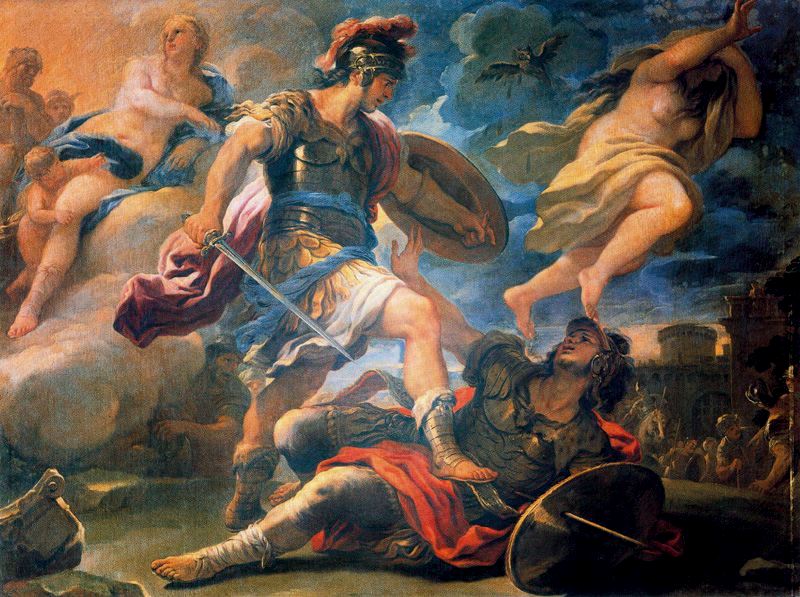
Book VI of the Aeneid reveals a prophecy for Aeneas by the Sibyl of Cumae stating that a Latin-born Achilles exists, who is also the son of a goddess (Aeneid, Book VI, lines 89–90)[1] exists. There are many scholarly debates on who this Latin-born Achilles is, whether he is Aeneas, Turnus, or some other character, and if so, is the opponent symbolic of another character from the Iliad?[citation needed] If comparing Aeneas to Achilles and Turnus to Hector, several parallels can be drawn. One example is when Aeneas is absent from the battlefield, Turnus lays waste to the Trojan army, just as Hector did to the Greek army in the absence of Achilles. Just as Hector kills Patroclus, Turnus slaughters Pallas, and to avenge the deaths of their friends, both Achilles and Aeneas slay their opponents.
Prophecies
Prophecies contribute a large theme among epics, especially that of the Iliad, the Odyssey and the Aeneid. From the beginning of the Iliad, readers knew that the Greeks were fated to triumph over the Trojans, as was declared by the king of the gods, Zeus. Achilles fate was also foretold; if he went to war he would die a hero. Similarly, Aeneas was told by the ghost of Hector in Book II that he was to leave burning Troy to found a new city.Throughout the rest of the epic, the gods include reminders that Aeneas is destined to find Italy and found Rome for future generations.

----------------------------------------------------------------------------------------------------------------------
Did Virgil Copy Homer?
fromPosted on 26/08/2011 by Maddy V-T
「Aeneid」的圖片搜尋結果
The Aeneid

Now, I know this is more of a literary question than a historical one, but why shouldn’t it be included? As everyone else on the blog can tell you, Classical Civilisation is my true passion (History is a very close second), and I thought I’d share some of that with our lovely readers.

When looking at The Aeneid, there is debate as to whether Virgil has simply plagiarised Homer’s works, written centuries before. It is argued that Virgil intended the Aeneid to be a tribute to Homer, while others say he’s manipulated Homer’s works to create his own. In particular, you can see many parallels between the storms in book one of The Aeneid and in books five and twelve of The Odyssey.

One of the most glaring similarities is the parts the gods play in the storms. All are started by a god who has something against the hero. However, there is a notable difference in that whilst Poseidon starts the storm, his Roman counterpart, Neptune, calms it.
----------------------------------------------------------------------------------------------------------------
“With that he marshalled the clouds and, seizing his trident in his hands, stirred up the sea.”
The Odyssey, Book 5

“These were his words and, before he had finished speaking, he was calming the swell…”
The Aeneid, Book 1
----------------------------------------------------------------------------------------------------------------
This is the main difference between the gods’ actions in the storms. Despite this, in both a god who supports the hero calms the storm Neptune in the Aeneid and Athene in the Odyssey.
 Also, there is a goddess featured in both although, again, there is a role-reversal- Virgil’s goddess is the villain whilst Homer’s is a heroine.
On the same topic, Virgil’s portrayal of Juno makes her seem less omnipotent that Poseidon in the Odyssey. Whilst he doesn’t say that she can’t raise the storm by herself, she persuades another god to do so for her- Aeolus, King of the Winds. This makes her seems less powerful and more conniving, whereas Poseidon, as seen in the quote above, has no trouble raising a storm by himself.

Another similarity is the way the gods seem to be completely human, only with far more power than any human could ever have. All the gods shown in the storms- Poseidon, Athene, Juno, Aeolus and Neptune- all have their own motives and grudges.
---------------------------------------------------------------------------------------------------------------------
“The sight of Odysseus sailing over the seas enraged him.”
The Odyssey, Book 5

“He recognised the anger and cunning of his sister Juno…”
The Aeneid, Book 1
---------------------------------------------------------------------------------------------------------------------
This is a huge similarity between all Greek and Roman tales- the gods are far more human than we see our modern deities as. They fight with each other as any mortal would, they all have favourites and their family ties are as important as ours are. Since this is a feature of all literature and mythology from that period, it can’t be used to say that Virgil copied Homer.

The way the hero speaks and acts is also quite similar. For example, as the storms gain intensity, they act almost identically- “Odysseus’ knees shook and his spirit failed.” (The Odyssey, Book 5) “A sudden chill went through Aeneas and his legs grew weak.” (The Aeneid, Book 1)
What both heroes also do is make long, heartfelt speeches about their terrible plight and how they wish they’d died heroically at Troy, instead of the ignominious end that would come at sea. They wax lyrical about those who perished at Troy, Achilles mentioned by both. Here is an example of Virgil heavily borrowing from Homer.

Both of the gods who start the storms- Aeolus and Poseidon- use a long weapon to spark it off.
--------------------------------------------------------------------------------------------------------------------
“At these words he struck the side of the hollow mountain with the butt of his spear and the winds seemed to form a column and pour out through the open gate to blow a hurricane over the whole earth.”
The Aeneid, Book 1

“With that he marshalled the clouds and, seizing his trident in his hands, stirred up the sea.”
The Odyssey, Book 5
---------------------------------------------------------------------------------------------------------------------
The difference here is the way they start the storms- Poseidon uses his trident to stir up the sea, whilst Aeolus uses his spear to release the winds who do the stirring for him. However, despite using them in a different fashion, both use weapons to start the storm.

As he describes the winds, seas and skies, many of Virgil’s descriptions bear vast similarity to Homer’s. Amongst these, the most striking similarity is the whirlpool in the Odyssey and the waves in the Aeneid.


------------------------------------------------------------------------------------------------------------------------
“…the waters opened and in the troughs could bee seen the sea-bed and the seething sand.”
The Aeneid, Book 1

“…the awesome Charybdis sucked down the salt water in her dreadful way… and the dark blue sands of the sea-bed were exposed.”
The Odyssey, Book 12
------------------------------------------------------------------------------------------------------------------------
Other examples include the darkening of the sea.
In The Odyssey, Homer tells us ‘the sea was darkened by shadow’ and in The Aeneid, Virgil writes ‘black night brooded over the sea’.

★In my opinion, Virgil was intending for the reader to detect the similarities between his poem and the works of Homer- which all literate Romans would have learnt. He was using intertextuality to increase the reader’s enjoyment of the poem. However, I think that he could have achieved the same effect without taking as much from Homer as he did.
------------------------------------------------------------------------------------------------------------------------
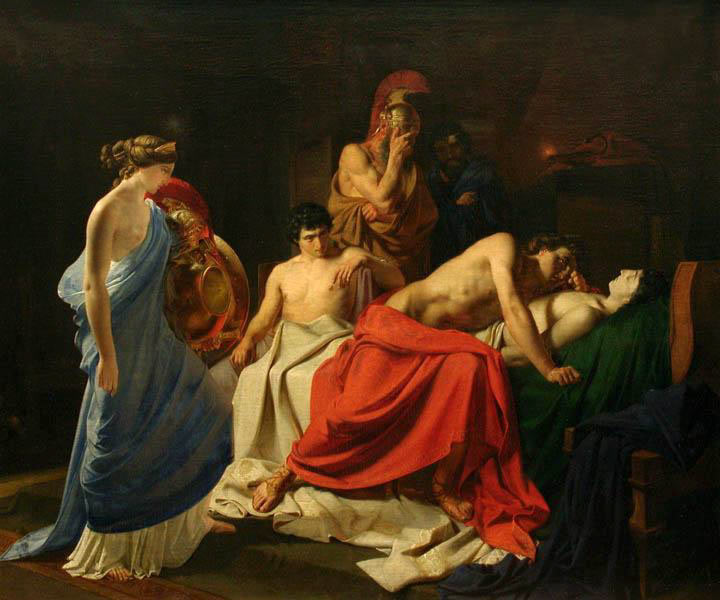
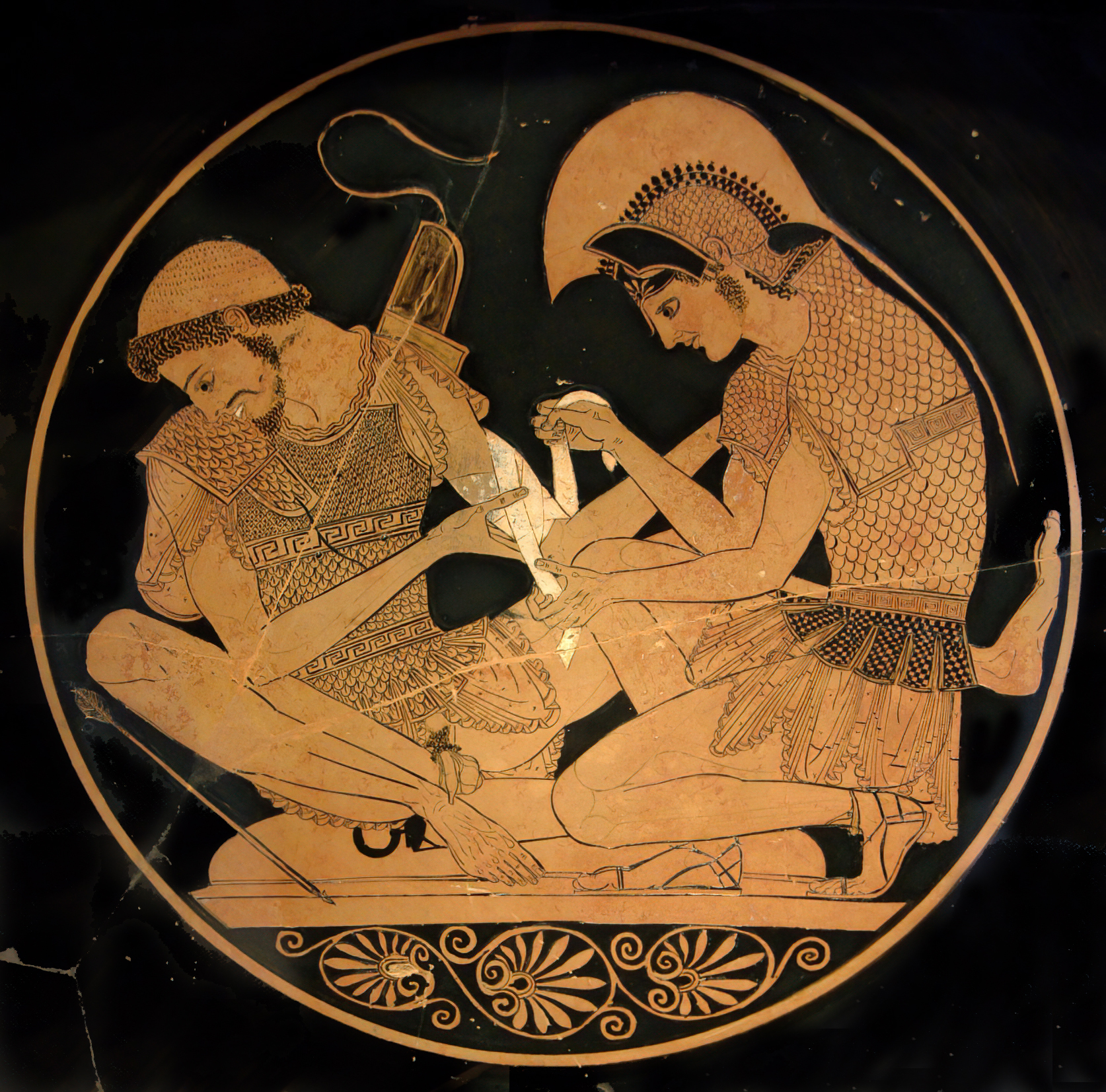
Achilles and Patroclus
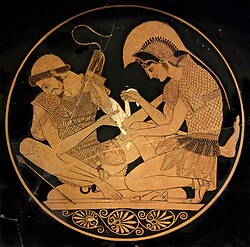
「achilles and patroclus」的圖片搜尋結果

The relationship between Achilles and Patroclus is a key element of the myths associated with the Trojan War. Its exact nature has been a subject of dispute in both the classical period and modern times. In the Iliad, the two heroes have a deep and meaningful relationship. Achilles is tender towards Patroclus, while he is callous and arrogant towards others. In the Iliad Homer describes the friendship of Achilles and Patroclus.
In the Iliad
Due to this strong relationship, the death of Patroclus becomes the prime motivation for Achilles to return to battle. The friendship of Achilles and Patroclus is mentioned explicitly in the Iliad. Whether in the context of a tender friendship or military excellence, Homer makes their strong connection clear.

The death of Patroclus underpins a great deal of Achilles' actions and emotions toward the Trojan war for the rest of the poem. Achilles' strongest interpersonal bond is with Patroclus, whom he loves dearly. As Gregory Nagy points out,

For Achilles ... in his own ascending scale of affection as dramatized by the entire composition of the Iliad, the highest place must belong to Patroklos.... In fact Patroklos is for Achilles the πολὺ φίλτατος ... ἑταῖρος — the ‘hetaîros who is the most phílos by far’ (XVII 411, 655).
Hetaîros meant companion or comrade; in Homer it is usually used of soldiers under the same commander. While its feminine form would be used for courtesans, an hetaîros was still a form of soldier in Hellenistic and Byzantine times. In ancient texts, philos denoted a general type of love, used for love between family, between friends, a desire or enjoyment of an activity, as well as between lovers.

Although most warriors fought for personal fame or their city-state (including, at times, Achilles), at certain junctures in the Iliad, Achilles fights for Patroclus. He dreams that all Greeks would die so that he and Patroclus might gain the fame of conquering Troy alone .After Patroclus dies, Achilles agonizes, touching his dead body, smearing himself with ash, and fasting. He laments Patroclus' death using language very similar to that later used by Andromache of Hector. For a brief moment Achilles' character shifts from a strong and unbreakable warrior to an emotional and vulnerable character. However, Thetis motivates Achilles to return to the battlefield. Achilles returns to the battlefield with the sole aim of avenging Patroclus' death by killing Hector, Patroclus' killer, even though the gods had warned him that it would cost him his life.

Achilles' attachment to Patroclus is an archetypal male bond that occurs elsewhere in Greek culture: Alexander the Great and Hephaestion who made symbolic public references to Achilles and Patroclus, Damon and Pythias, Orestes and Pylades, Harmodius and Aristogeiton are pairs of comrades who gladly face danger and death for and beside each other.


2016年10月7日 星期五

Information for quiz

The major of Olympians

Greek Roman

ZeusJupiter*King of the gods and ruler of Mount Olympus;
god of the sky, lightning, thunder, law, order, justice.  
HeraJunoQueen of the gods and the goddess of marriage and family. 
PoseidonNeptuneGod of the seas, earthquakes, and tidal wave. 
DemeterCeresGoddess of fertility, agriculture, nature, and the seasons. 
AthenaMinervaGoddess of wisdom, reason, intelligent,activity,literature,handicrafts and science.
ApolloApolloGod of light, prophecy, inspiration, poetry, music and arts,medicine and healing. 
ArtemisDianaGoddess of the hunt, virginity, archery, the moon, and all animals.
AresMars*God of war, violence, and bloodshed. 
AphroditeVenus*Goddess of love, beauty, and desire. 
HephaestusVulcanMaster blacksmith and craftsman of the gods; god of fire and the forge. His Latin name, Vulcan, gave us the word "volcano."
HermesMercury*Messenger of the gods; god of commerce, communication, borders, eloquence, diplomacy, thieves and games. 
HestiaVestaGoddess of the hearth and of the right ordering of domesticity and the family.
DionysusBacchusGod of wine, celebrations, and ecstasy. Patron god of the art of theatre. 
「greek deity」的圖片搜尋結果
Greek Roman 

Hades Orcus God of the Underworld, dead and the riches under the Earth.
HeraclesHerculesA divine hero, the son of Zeus and Alcmene.He was the greatest of the Greek heroes, a paragon of masculinity and a champion of the Olympian order against chthonic monsters.
PersephoneProserpinaQueen of the Underworld ,also goddess of spring time. 
AsclepiusVejovisThe god of medicine and healing. He represents the healing aspect of the medical arts.
 His daughters are
 Hygieia ("Health"),
 Iaso ("Medicine"),
Aceso ("Healing"),
Aglæa/Ægle ("Healthy Glow"),
and Panacea ("Universal Remedy"). 
ErosCupid The god of sexual love and beauty. He was also worshipped as a fertility deity.
HebeJuventas
 The goddess of youth.
※chthonic:Of or relating to the underworld.
※deity:a god or goddess
--------------------------------------------------------------------------------------------------------------------------
Planet Names and Greek Mythology
「nine planets」的圖片搜尋結果
1.Mercury (Hermes) is the god of commerce, travel and thievery in Roman mythology.
                               Named for the winged Roman god of travel because it appears to move so swiftly.
------------------------------------------------------------------------------------------------------------------------
2.Venus (Aphrodite) is the Roman goddess of love and beauty. The planet is aptly named since it makes a beautiful sight in the sky, with only the Sun and the Moon being brighter.
--------------------------------------------------------------------------------------------------------------------------
3.Earth (Gaia) is the only planet whose English name does not derive from Greek/Roman mythology. The name derives from Old English and Germanic. There are, of course, many other names for our planet in other languages.
--------------------------------------------------------------------------------------------------------------------------
4.Jupiter (Zeus) was the King of the Gods in Roman mythology, making the name a good choice for what is by far the largest planet in our solar system.
--------------------------------------------------------------------------------------------------------------------------
5.Mars (Ares) is the Roman god of War. The planet probably got this name due to its red color.
-------------------------------------------------------------------------------------------------------------------------
6.Saturn (Cronus) is the Roman god of agriculture.
7.Uranus is the ancient Roman deity of the Heavens, the earliest supreme god.
-------------------------------------------------------------------------------------------------------------------------
8.Neptune (Poseidon)was the Roman god of the Sea. Given the beautiful blue color of this planet, the name is an excellent choice!
-------------------------------------------------------------------------------------------------------------------------
9.Pluto (Hades) is the Roman god of the underworld in Roman mythology. Perhaps the planet received this name because it's so far from the Sun that it is in perpetual darkness.
=======================================================================
※red herring
A red herring is something that misleads or distracts from a relevant or important issue.It may be either a logical fallacy or a literary device that leads readers or audiences towards a false conclusion. A red herring might be intentionally used, such as in mystery fiction or as part of rhetorical strategies , or it could be inadvertently used during argumentation.
「red herring」的圖片搜尋結果
The origin of the expression is unknown. Conventional wisdom has long supposed it to be the use of a kipper (a strong-smelling smoked fish) to train hounds to follow a scent, or to divert them from the correct route when hunting; however, modern linguistic research suggests that the term was probably invented in 1807 by English polemicist William Cobbett, referring to one occasion on which he had supposedly used a kipper to divert hounds from chasing a hare, and was never an actual practice of hunters. The phrase was later borrowed to provide a formal name for the logical fallacy and literary device.
--------------------------------------------------------------------------------------------------------------------------
※foreshadowing
Meaning:
Foreshadowing or guessing ahead is a literary device by which an author hints what is to come. Foreshadowing is a dramatic device in which an important plot-point is mentioned early in the story and will return in a more significant way. It is used to avoid disappointment. It is also sometimes used to arouse the reader.

It often appears at the beginning of a story or a chapter and helps the reader develop expectations about the coming events in a story. There are various ways of creating a foreshadowing. A writer may use dialogues of characters to hint at what may occur in future. In addition, any event or action in the story may throw a hint to the readers about future events or action. Even a title of a work or a chapter title can act as a clue that suggests what is going to happen. Foreshadowing in fiction creates an atmosphere of suspense in a story so that the readers are interested to know more.
------------------------------------------------------------------------------------------------
Function of Foreshadowing
Generally, the function of foreshadowing is to build anticipation in the minds of readers about what might happen next and thus adding dramatic tension to a story. It is deliberately employed to create suspense in mystery novels, usually by giving false clues or “red herrings” to distract readers.

Moreover, foreshadowing can make extraordinary and bizarre events appear credible as the events are predicted beforehand, so that readers are mentally prepared for them.
------------------------------------------------------------------------------------------------------------------------
※flash forward
Meaning:A flash-forward (or sometimes known as a flash-ahead) in a narrative occurs when the primary sequence of events in a story is interrupted by the interjection of a scene representing an event expected, projected, or imagined to occur at a later time. The flash-forward technique is used less frequently than its reverse, the flashback, or the flash-sideways.
-----------------------------------------------------------------------------------------------------------
Function of Flash-Forward
Flash-forward enables a writer to give logical explanations to the actions of the characters in a narrative. The character’s actions make more sense to the readers – after having developed a greater understanding of the character and the character’s personality.

Moreover, flash-forward grabs the readers’ interest in the current events of the narrative to see how the story develops towards the future that has already been shown to them.
-----------------------------------------------------------------------------------------------------------------------
★Difference between Flash-Forward and Foreshadowing
Flash-forward is similar to foreshadowing. However, foreshadowing hints at the possible outcome in future without any interruption and using events or dialogues of characters in the current time. It may also be present in the titles of narratives or chapter titles.
 Flash-forward, on the other hand, is an interjected scene in a narrative that takes the narrative forward in time. The events presented in a flash-forward are bound to happen in the story. Foreshadowing predicts the future events, but the events do not necessarily take place in the future – as in “red-herring”.

「what's the difference」的圖片搜尋結果
--------------------------------------------------------------------------------------------------------------------------
★Lame vs Cripple - What's the difference?
「crippled and lame」的圖片搜尋結果Crippled is a synonym of lame.
As adjectives the difference between crippled and lame is that
crippled is having a less than fully functional limb, or injuries which prevent full mobility
while 
lame is unable to walk properly because of a problem  with one's feet or legs. 

☆As verbs the difference between crippled and lame is that crippled is (cripple) while lame is to cause a person or animal to become lame or lame can be (obsolete) to shine. 

2016年10月1日 星期六

Week3---- About the word

Prefix

1.para-
before vowels,
par-, word-forming element meaning "alongside, beyond; altered; contrary; irregular, abnormal," from Greek para-  "beside, near, issuing from, against, contrary to".
EX: parallel1 from Middle French parallèle  and directly from Latin parallelus, from Greek parallelos "parallel," from para allelois "beside one another," from para- "beside" + allelois "each other," from allos "other". 
---------------------------------------------------------------------------------------------------------------------
2.-vo-    ----->meaning''voice"
EX:
vocal
voice
evocation
:from Latin evocationem (nominative evocatio) "a calling forth, a calling from concealment.
🙄Meaning:the act of bringing something into the mind or memory : the act of evoking something
invoke:
🙄Meaning:to mention (someone or something) in an attempt to make people feel a certain way or have a certain idea in their mind
invocation
🙄Meaning:(1)the act or process of petitioning for help or support; specifically often capitalized :  a                      prayer of entreaty (as at the beginning of a service of worship)
                    (2)a calling upon for authority or justification
-----------------------------------------------------------------------------------------------------------------------
3.-mor------->meaning"to die"
 from Latin mors (genitive mortis) "death"+ root of facere "to make" .
EX:
immortal
mortification
mortify


2016年9月23日 星期五

Week2:Portrait of Cassandra--the tragic prophetess

「cassandra in greek mythology」的圖片搜尋結果Paris's sister,Cassandra

In ancient Greek stories, Cassandra was the daughter of Priam, the King of Troy. The god Apollo gave her the power to see what would happen in the future, but he also made sure that no one would believe her, so when she warned her father that the Greeks could use the Trojan Horse to take control of Troy, no one believed her. Struck by her beauty, Apollo had provided her with the gift of prophecy, but when Cassandra refused Apollo's romantic advances, he placed a curse ensuring that nobody would believe her warnings. Cassandra was then left with the knowledge of future events, but could neither alter these events nor convince others of the validity of her predictions.

「cassandra in greek mythology」的圖片搜尋結果「cassandra in greek mythology」的圖片搜尋結果

Mythology is ripe with tragically sad stories. In fact, very few myths actually finish with a happy ending. However, I consider the story of Cassandra to be one of the very saddest tales of all time. Cassandra was princess of the legendary city of Troy. As was very common in Greek mythology, the god Apollo lusted after the beautiful young mortal woman and intended to make her his own. To convince her to give into his advances, he promised to bestow upon her the gift of prophecy.

While Cassandra was obviously flattered that an Olympian god sought her favors, she wasn't at all convinced that she wanted to take him as lover. Still, unable to resist the gift he offered, she eventually relented.
Apollo took Cassandra under his wing and taught her how to use her prophecies. Once her mentorship was finished, however, Cassandra refused to give her body to Apollo as promised.
Furious at being rejected by a mere mortal Apollo decided to punish her. While he couldn't take back the gift he'd already given, he could alter it. After having his way with Cassandra, the god's anger was still not satiated. So he leveled a terrible curse upon her head. While Cassandra would still be able to foresee the future, the curse ensured that no one would believe her. Worse than that, they would believe that she was purposely telling lies.
True to his word, Cassandra was able to foresee the future for herself and those around her. But every attempt she made to warn people in advance of impending doom was ignored or, worse yet, labeled as an out right lie.
Ashamed of his daughter's supposed madness, the king pronounced her insane and jailed her by locking her inside her own chambers. Denying his daughter altogether, he told many people that she had died. Others, who already knew of her predicament simply didn't care since they, too, thought she was either crazy or a pathological liar.
One of Cassandra's most important prophecies involved the fall of Troy at the hands of the Greeks and the infamous Trojan Horse. Escaping from her prison, she begged her people to believe her predictions but, once again, no one would listen.
Cassandra managed to escape from Troy and elude the raping and pillaging of the Greek's as they tore apart her home. She hid within the temple of the goddess Athena, who promised to provide shelter to her former priestess. But Ajax found the girl there, clinging helplessly to the statue of Athena and he could not resist forcing himself upon the young beauty.

The goddess, infuriated that such an act would happen in her sacred temple, involving someone under her protection took revenge upon Ajax. She vowed that he would never again return home. Her wrath was fulfilled when Ajax died after his ship crashed against the rocks of Gyraen.
Twice raped, labeled a liar and insane, Cassandra finally relented and gave in to her fate. She allowed Agamemnon to claim her as his concubine, considering herself a rightful spoil of the Trojan War. Although he didn't marry her, she bore him two children, twin boys named Teledamus and Pelops.
Upon return to his home shores, Agamemnon's wife Clytamnestra greeted the couple with full heroic honors. She even embraced Cassandra, promising the young girl that she would make certain her servitude would not be too difficult. However, Cassandra had foreseen her fate as well as that of Agamemnon and she chose to fight it no longer.
-----------------------------------------------------------------------------------------------------------------

Vocabulary in THIS article:

😉concubine: one having a recognized social status in a household below that of a wife
😉servitude:the condition of being a slave or of having to obey another person
😉pillage:the act of looting or plundering especially in war
------------------------------------------------------------------------------------------------------------------


Greek NameRoman NameDescription
AphroditeVenusThe famous, beautiful love goddess, the one awarded the apple of Discord that was instrumental in the start of the Trojan War and for the Romans, the mother of the Trojan hero Aeneas
Apollo Brother of Artemis/Diana, shared by Romans and Greeks alike
AresMarsThe god of war for both Romans and Greeks, but so destructive he was not much loved by the Greeks, even though Aphrodite loved him. On the other hand, he was admired by the Romans, where he was associated with fertility as well as the military, and a very important deity.
ArtemisDianaThe sister of Apollo, she was a hunting goddess. Like her brother, she is often combined with the deity in charge of a celestial body. In her case, the moon; in her brother's, the sun. Although a virgin goddess, she assisted in childbirth. Although she hunted, she could also be the animals' protector. In general, she is full of contradictions
AthenaMinervaShe was a virgin goddess of wisdom and crafts, associated with warfare as her wisdom led to strategic planning. Athena was the patron goddess of Athens. She helped many of the great heroes.
DemeterCeresA fertility and mother goddess associated with cultivation of grain. Demeter is associated with an important religious cult, the Eleusinian mysteries. She is also the law-bringer
HadesPlutoWhile he was the king of the Underworld, he was not the god of death. That was left to Thanatos. He is married to Demeter's daughter, whom he abducted. Pluto is the conventional Roman name and you might use it for a trivia question, but really Pluto, a god of wealth, is the equivalent of a Greek god of wealth called Dis
HephaistosVulcanThe Roman version of this god's name was lent to a geological phenomenon and he required frequent pacification. He is a fire and blacksmith god for both. Stories about Hephaestus show him as the lame, cuckolded husband of Aphrodite.
HeraJunoA marriage goddess and the wife of the king of the gods, Zeus
HermesMercuryA many-talented messenger of the gods and sometimes a trickster god and god of commerce.
HestiaVestaIt was important to keep the hearth fires burning and the hearth was the domain of this stay-at-home goddess. Her Roman virgin priestesses, the Vestals, were vital to the fortunes of Rome. 
KronosSaturn
A very ancient god, the father of many of the others. Cronus or Kronus is known for having swallowed his children, until his youngest child, Zeus, forced him to regurgitate. The Roman version is far more benign. The Saturnalia festival celebrates his pleasant rule.
PersephoneProserpinaThe daughter of Demeter, the wife of Hades, and another goddess important in religious mystery cults.
PoseidonNeptuneThe sea and fresh water springs god, brother of Zeus and Hades. He is also associated with horses.
ZeusJupiterSky and thunder god, the head honcho and one of the most promiscuous of the gods.

Week2:About the word

ori :起  始  源

origin (n)起源
=ori開始  +  gin產生
original (a)最初的,原始的,原創的
=ori開始  +  gin產生  +al形容詞字尾

aboriginal  (a)原來的 (n)原住民
orient(v)定方向,使朝東(orientation (Noun))
disorient(v)失去方向感(disorientation(n)失去方向Or迷惑)
-------------------------------------------------------------------------------
a-
prefix meaning "not," from Latin a-, short for ab "away from" (as in avert)

apathy
Definition from Webster's Dictionary: the feeling of not having much emotion or interest ;
                                                     an apathetic state.
E.g:Many commentators are surprised by the apathy [=indifference] of the country's voters.
atheist
Definition from Webster's Dictionary:1570s, from French athéiste (16c.), from Greek atheos "without god, denying the gods; abandoned of the gods; godless, ungodly," from a- "without" + theos "a god"

E.g:Although he was raised a Catholic, he was an agnostic for most of his adult life.
----------------------------------------------------------------------------------------

How agnostic Differs from atheist

Many people are interested in distinguishing between the words agnostic and atheist. The difference is quite simple: atheist refers to someone who believes that there is no god (or gods), and agnostic refers to someone who doesn’t know whether there is a god, or even if such a thing is knowable. This distinction can be troublesome to remember, but examining the origins of the two words can help.

Agnostic first appeared in 1869, (possibly coined by the English biologist Thomas Henry Huxley), and was formed from the Greek agnōstos (meaning "unknown, unknowable"). Atheist came to English from the French athéisme. Although both words share a prefix (which is probably the source of much of the confusion) the main body of each word is quite different. Agnostic shares part of its history with words such as prognosticate and prognosis, words which have something to do with knowledge or knowing something. Atheist shares roots with words such as theology and theism, which generally have something to do with God.

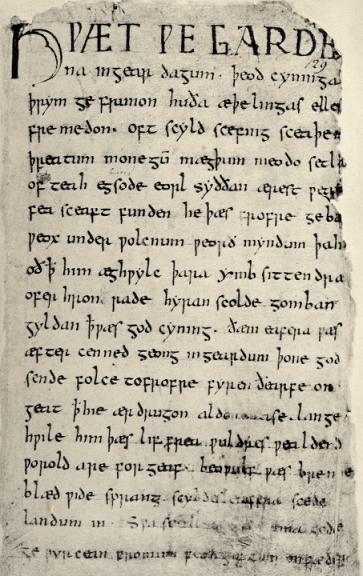
「epic poetry」的圖片搜尋結果Notable epic poems

2016年9月22日 星期四

Week2:Dante Alighieri--the writer of Divine Comedy

「Divine Comedy'」的圖片搜尋結果

 The Divine Comedy is an epic poem by Dante Alighieri, begun c. 1308 and completed 1320, a year before his death in 1321. It is widely considered the preeminent work of Italian literature and is seen as one of the greatest works of world literature.


Out of my curiosity,i took some rough research of this great Italian poet.


Dante was born in Florence,Italy.The exactly date he born was remained unknown.

When Dante was 12, he was promised in marriage to Gemma di Manetto Donati, daughter of  member of a powerful Donati family. Contracting marriages at this early age was quite common and involved a formal ceremony, including contracts signed before a notary. But by this time Dante had fallen in love with another, Beatrice Portinari, whom he first met when he was only nine. Years after his marriage to Gemma he claims to have met Beatrice again; he wrote several sonnets to Beatrice but never mentioned Gemma in any of his poems.
-----------------------------------------------------------------------------------------------------------------

Beatrice and Dante--The love story

「dante alighieri and beatrice」的圖片搜尋結果
In this epic poem(Divine Comedy), Beatrice talks to Dante, the author and a character himself, for the first time in Canto 2 of Inferno: she descends into Limbo and prays that the poet Virgil can rescue Dante. She then reappears in Canto 30 of Purgatory, when Virgil disappears.
Finally, Beatrice accompanies Dante in Paradise to the point closest to God that he is allowed to reach.

Their last meeting is set among the blessed in Heaven at the end of their afterworld journey.

Tradition says that Dante and Beatrice were also neighbors outside the walls of Florence—near the hill of Fiesole, where the Portinari and Alighieri families had two neighboring summer villas. It is plausible that Dante and Beatrice met each other as children there.

In his Vita Nova, Dante says he saw Beatrice for the first time when they were children: he was nine years old and she was eight.

He never forgot her after this meeting.


He meets her again after nine years in an unexpected way: Beatrice was walking with two women on Lungarno (one of the Florence streets along the Arno River).Dante remembered the episode well, but he ran away without saying a word.
Today, we know that Dante’s love for Beatrice was real. She represented the ideal of beauty and grace but was also a real woman.

Beatrice died at the age twenty-four. Dante was devastated and took refuge in poetry. He was not able to find peace, however, until he decided to start writing The Divine Comedy.

What did i learn from this article?


Maybe Dante wrote one of the world's greatest masterpiece just in order to obtaining his spiritual console for his beloved,however,this epic poem now possesses much more meaning in the field of Western Literature than an ordinary love poem.